Monday, 17 October 2022

All Things Are Relative & SRH Statements

Bit of history, my first maxim.

Derived from understanding a line of physics "there is no nail we can hammer into the space-time to give us an absolute reference point for velocity" All velocity is relative to something else (a frame of reference. However the speed of light is constant to all frames of reference). But understanding the relative nature of speed gave the analogy to see all things as relative.

When we take any measurement it is with reference to a "yard stick." The issue then was whether deciding what something was required a yard stick.

Original investigation was colours as these are the most apparent qualia. Usually we think the colour of something is absolute.


That is green and if we pick a bit of it the "greenness" we think is "just there" and is "green in itself." 


There we go a patch of green cut from the above picture. In there are "pixels" that are green in themselves. However we have placed it on a white background in order to see it. Suppose we cut a bit of white from a picture:


There we go a bit of "whiteness" we think is "just there" and is "white in itself."

Now actually what is uncovered here is different from what I investigated as a child. The presence/absence of white above is down to "context" and is Quine's use/mention distinction. The page is white, the gap above has an ambiguity because I am referring to s specific patch of white in the same way as the green above, and yet because it is white on a white background we're unsure which is the patch being mentioned. While the contextual white of the page is being used.

A a child I was investigating the actual qualia. A much deeper problem than just a meaning problem. Does the "whiteness" or "greenness" have a quality that is "in itself."
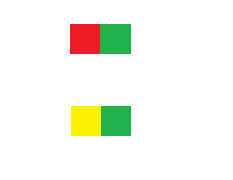
So the question to resolve is whether the green in a red context is different from the green in a yellow context. To his credit and I mentioned this before in the blog a friend when asked this question decide that at the boundary between red/green and yellow/green the green was different.

As a way in to this suppose the whole world was green. If all we ever knew was green then we would never have a word for green. Why would we say something was "green" since everything was green. It would be meaningless. I think I first met that idea in The Machine Stops. When Kuno gets outside the machine he notices a quietness and realises for the first time that the machine makes a continual sound that no one notices because it is constant.

Our experience is indeed relative. We are like dinosaurs and reptiles that we can only detect change. In fact difference is the basis of our perception. Things need to change or be different for us to be able to apply meaning to them. This was the great realisation embedded in that maxim. Which itself came from a jhana. In jhana it seems "the machine stops" and you see the fundamental noise of experience.

So back to the colours it is never-the-less very difficult to rethink the qualia of colour as a relative experience. Its easier to see the meaning of the words of colour as use/mention and depending on the contextual than to relativise the actual experience itself. Green does seem very absolute when we see are actually seeing it.

This goes back to a conundrum I was taught. While the words are the same, how can we tell whether the actual experience we have is the same as someone else. Perhaps someone else sees what you would call red when they look at the green box above, and vice versa. How would you know?

Now this conundrum enters a very shady world because it separates our experience absolutely. It is what Dennett calls the "Cartesian Theatre." Somehow what happens in my experience is completely divorced from yours. And I mean completely. But we agree that the words are the same. So that means that the words have no connection with the experience either. Even the mighty Wittgenstein in his later writing "On Certainty" puzzles over the mystery of how the colour red related to the word. Looking at a red thing and thinking the word "Red" there seems to be no connection. Now we can see here that there is the use and mention distinction. Normally we say "pass me the red box" and the red is in use and we don't think about it. In Wittgenstein's musing on the word "Red" he is actually mentioning it. So there is this added use/mention problem to that thought. And perhaps Wittgenstein got here himself and I forget, because this type of Language Game thinking is all his. When you puzzle over how the word Red gets applied to a red thing you are using "Red" in a different way, you are mentioning it, rather than using it as you normally would. That puzzle may stem entirely from language. We simply don't normally puzzle over the connection between words and what they refer to when we normally think and speak. I mean if we stopped to look at how the words of this sentence actually worked the sentence would break down and be of no "use."

So this is very Ryle in fact. Can we attribute the mystery of the link between "qualia" and their "words" to a change in the way we think and use words during such thoughts. To separate qualia and words we actually reuse the word as a mention and then no wonder we find qualia and words no longer belong together.

But this is perhaps not all of it. Aren't we left with the nagging feeling that qualia somehow exist separate from the words.

Well to cut this short there are several reasons why this all dries up. Firstly if you cannot tell then there is nothing to find out. What is the name of the oldest unicorn in existence? Unicorns don't exist so we have no difficulty in ignoring this question. What is the name of the oldest person in nearest parallel universe that we can never have contact with? Well its the same answer, we can just ignore it. Is the sensation I see when I see green the same as yours? Well we can never know so we just ignore it.

And that is interesting isn't it. There is something wrong with a question that has written into it a clause that says it can never be answered. "My Experience" appears to suggest that it is not yours and you can never know. Well in a weird way if you can never know then how can I know? This is again Wittgenstein and his argument against a Private Language.

It appears when we start telling people things that only apply to us we are entering into a contradiction. "But I am seeing Green but its not something you can see, only I can see it. You might be seeing Red" kind of statements are a bit weird. We can never know the answer cos the statement entails the impossibility of you seeing what I see.

Long post short. Shall we just leave it for now as a bit weird to say things like this.

So what of these "private qualia" the actual stuff of experience. Are they atomic absolute or are they relative. They are certainly a bit weird, and talking about them is weird also.

Its interesting that in the years since those experiments as a kid a lot has happened in perception research. Take Purves and Lotto's now famous illusion. I've cut a piece of the blue tile and piece of the yellow tile and moved to the white background. 

They are the same colour grey! And yet the context actually changes the qualia so that the same grey looks blue in the left Rubix cube and yellow in the right Rubix cube. 

OMG there we go the qualia are not absolute they are indeed the result of processing and depend upon context. Now we might dismiss as an "illusion" with no universal value. Under normal circumstances we think when we are not being "tricked" colour works normally and we see what is there, and our absolute qualia. But the point is this shows that a "grey" qualia can be seen as blue or yellow depending upon the context.

In other words we don't see the qualia! We see what we think.

Don't we then need to invents Qualia2 which are the perceived qualia from the actual qualia. So while the actual pixels are grey and the qualia are Grey we perceive Blue or Yellow Qualia2.

Its starting to look weird. That is all I need for now.

The point of the blog was to investigate again my first maxim that "all things are relative" and this indeed turns out to be an interesting maxim as its hard to find anything absolute. Even the certainties of vision "seeing is believing" become less absolute on examination.

So are we floating in a bubble of relativity? In Buddhism the gods tremble when Buddha starts going here. It takes a long time to deal with "emptiness" or sunyata when we are used to grasping at the certainty of sense experience.

However finally the Platonic argument and I received this very quickly at school. I was evidently very lucky to have smart colleagues. Plato argues that if all things are relative then how can you have an absolute statement like that? He demolishes Heraclitus with this argument against flux and never looks back (I think to the detriment of the Western World which spun off into nonsense there after).

It seems at the time like a pointless argument. It doesn't capture the value of the idea of relativity and seems to just try and shut the door as if not wanting to look at what lies behind. I believe Nietzsche argues like this too. Who cares for contradictions, they should not stop us venturing forth.

But it remains a thorn in the side of emptiness and freedom. How can we have doctrines that teach of No-Absolute, and how can we have Rules to guarantee Freedom? This is the Truth but it seems the truth somehow breaks logic.

Well we can turn to Godel instantly and show that systems with self-reference are either incomplete are have contradiction so we shouldn't be too troubled by contradiction.

But it is never-the-less interesting to just sit with that contradiction "all things are relative" is not itself relative. And its a funny thing about Truth that it always turns against its own definition.

And we are now on to, what has become probably the core of this blog, SRH. To make a universal statement implies self reference: "All things." And when there is self-reference the SRH says "beware!" Whatever you are trying to say of "all things" implies you are trying to deny something else. And that means you are limiting the freedom of "all things" and that limitation becomes a limitation of the statement. The negative side of the statement becomes compounded and self-defeating as Koesler observes briefly in "Godel, Esher, Bach"

"All things are  relative" is the same as "No things are absolute" and it is this negative side which then damages the statement itself.

Statements like to start with complete freedom. When we first say something we don't like to start with conditions. But when there is self-reference the statement becomes its own condition.

"No things are absolute" given that no things are absolute. Is what the maxim actually becomes.

And so actually because of self-reference it is relative to itself!

So the Platonic critics are stumbling into contradiction themselves. They are using the relative nature of the statement to show that it contradicts.

The Platonic Criticism depends itself upon the relative nature of the maxim "all things are relative"!

So to find fault is actually to prove the maxim! How odd is that.

Its not that the maxim does not contradict, but to self-contradict it must be relative to itself which proves the maxim. To contradict we must adopt the maxim!

This is very "I am false" or more modern its analogous to the infinite loop and never halting algorithm that cannot find an exit point.

Its not wrong, and its not right, you just can't find an exit point.

What is the logic status of algorithms that do not halt like "I am false"? Not sure what the technical status is: I'm going to call them "SRH statements" on the broad (unproven) conjecture that all halting problems arrive from recursion, or in logic from the isomorphic self-reference which is the SRH.

Conjecture 1: recursion is iso-morphic with self-reference
Conjecture 2: Halting problems are isomorphic with SRH problems.

Conclusion: statements that are neither True nor False are SRH problems and halting problems.

so "All things are relative" is actually a very interesting maxim indeed and its taken me almost 40 years to get to this point (how embarrassing).

This is partly due to the poor state of modern western society. At school I had a bright and smart environment in which to think and that paid dividends. But in the modern Capitalist world there is nothing but dullness and ignorance. Capitalism really is the last hurrah of the human race and the final decent into the pit of planetary destruction and mental stagnation.

Is there a broad statement that can be made about the axioms of Capitalism and how it entails destruction of all things (hopefully then itself!) ?

Sunday, 16 October 2022

Relative Self

Here's an important distinction.

Who are you?

When we answer its like the information we would give on a dating site. Things like what we want, and what we do. And for the most advanced dating site entries how we say it too reflects much about our intelligence, humour, creativity and education.

But all this is relative. We are trying to stand out from the crowd, differentiate ourselves from the crowd. Indeed when we have an "identity" it is relative like this.

We may select memberships of groups like the football team we support or religion we follow, but we do not wish to be seen as just another football supporter or religious devotee. We add that so that just a part of ourselves is illuminated, without obliterating the precious self that is "me".

But this is all just relative self. Self that exists in a society. Self that has been given a name by our parents that reflects our place in a family, and differentiates us from other people in our society.

This self also leads us down the most dangerous path of identity with a "permanent entity" we feel is "our" self.

I recently had reason to look at "To The Lighthouse" by Virginia Woolf [pdf]. In the novel, Lily a local painter, is struggling with the idea of impermanence and whether humans can create something lasting in this world. Mr Ramsey wants to create a lasting philosophy, Mrs Ramsey some lasting memories and finally Lily wins by completing a painting of the lighthouse that outlives the book and presumably herself. Not quite sure how Woolf decides that art is any better than Emperor Chin looking for immortality at the inception of China, but the book has indeed outlived Ms Woolf.

But Buddha's great realisation is that all these endeavours at immortality stem from an already existing belief and identity with a permanent self. Because we already believe in a permanent self or identity passing through time, we are already set up to suffer and fail. We think inside the childhood me is the same person who is inside the adult me and the me right now. The person looking through these eyes and reading right now is the same person who stared through those child's eyes we see in photos of our past. A little homunculus taking a ride with us and other people through life. This is a fundamental error, there is no such person hidden inside us. We are just what we are right now. The past is gone and the future is yet to happen, and they exist only as imagination in this person we are right now.  

When we meet old friends and put a name on them we think that somehow this is the same person we knew as a child. It is the same person in the same way that the sea is all the rivers that flow into it. There is a link but you won't find a river in the sea. You won't find the child you were anywhere in yourself now. There is a continual flow of time that links all the people we have been but that time has very low fidelity. Every step of the way it changes something so that the person you meet after so many years is not the same person. Obviously this is not to say we are a completely different person at each stage, we stand on the shoulders of past selves in a huge tower and where we are and the height we now stand is because of them, but we are not them. If those past selves have been good and constructive our tower will be very high and we will see very far.

They say that every 7 years we change every atom in our bodies. It is the classic Ship of Theseus paradox. The things that look the same are the same in the way that twins are the same. But we don't say twins are the same person. Just because our future self bears resemblance does not mean they are the same self in any way.

All this is possible because of Relative Self.

We know that there is one universe. Its that little paradox we learn not to think about. There is one world, and yet we like to think it revolves around each person, and we like to give each person (well us anyway) the powers to be centre of that world and to decide how it is, and also to remain unchanged by it as a being somehow outside the world and looking in from a divine unaffected vantage point.

There is one world, and that world is a world of change, and a world of millions of people and other creatures. How can there be one homunculus here that is not affected and is somehow centre to that world. No! that "homunculus" is just a relative self and the rotating around it and orbiting it just comes from identifying with it.

When we let go of this (and that is not a simple process) we begin to see our relative self in its place alongside the bustling and swirling society in which it lives, rubbing shoulders continually with other relative selves, depending on them, being needed by them, being made from the food it eats, being born and ultimately dying. It is all relative existence. This body not that body, that body not this body. This person not that person, that person not this person. This self not that self, that self not this self. There is just one world of many people, but the this/that comes from identifying and grasping to just one of them.   

Being free from this we actually achieve that unaffected state we knew deep down was our true nature but we mistakenly tried to get using the vehicle of the relative self. The same struggle we see in Lily and Virginia Woolf and I wonder whether such concerns ultimately weighed her down to her death.

The unconditional, non-relative self is very unlike the relative self. It does not have any features that set it apart from other people. You can't grasp it, there is nothing to hold on to or grasp. And at the same time there is nothing to hold on to yank it away from us with. We can't affect it, it just is. We arrive at it through letting go of the grasp on the relative existence. That grasping as we enter into this issue can also become a throwing away and denial of relative existence. Buddha himself followed the path of self mortification to try and throw away the relative mortal self. What can be grasped so as to clutch close or throw away is not us. The true self is already being, and it is only a smooth rock face that you can't grasp hold of to either pull near or push away.

Questions like is the true self immortal, or is it a soul and do I live forever are questions only for the clinging to a relative existence. We let go of these concerns too.

But its not like we live forever. Instead we cease to identity and grasp to anything that doesn't. Its all in the grasping! All our struggles and concerns lie with whatever we grasp on to and identity with.

Is letting go the same as dropping out and giving up. Absolutely not! This is the same as trying to pushing away relative existence as already mentioned. That is just one relative existence being swapped for another. This way and that way are two sides of the same coin. Letting go is not a this way or that way. Its not grasping onto a new things. You can't measure it like that. Its not a lifestyle choice. Its just the seeing the relative side-by-side nature of what we previously grasped as the centre. Seeing the relative as it stands in a relative world along with all the other relative things. Once we see all relative things shoulder to shoulder then we are already letting go. 

Tuesday, 11 October 2022

Will Meditation Help Me?

 Its the classic reason to start religious practice: some trouble in life. We think if we pay our debts to God or other people, say sorry, do some good deeds we will be forgiven and the bad things will go away.

Well in one sense of course this is true. We start behaving well, treating people with respect and clear our own hindrances and we will find life starts flowing more smoothly. (Fruits of Good Karma in eastern lingo) 

But I'm realising there is something much more important. Suppose we have a bad feeling, or some anxiety or some other mental affliction and we start meditating to cope with it. We find we concentrate on our breath and eventually after days, months, years of practice we find that we can leave this behind and enter states of bliss where we are free from the suffering. It doesn't need be mental it can be anything, but mental is particular interesting for this realisation.

Commonly we are then disappointed as we leave meditation that the bad states are still there waiting in the shadows to grab us. But at least we have faith now that we know how to get away from them which is an amazing thing to realise. Whatever life throws at us, actually we are powerful to always escape it through meditation at the very least.

But there is something much more profound in this. Why does concentrating on the breath give us this power to leave unwholesome states behind and replace them with bliss?

Well if we analyse exactly what happens when we concentrate on the breath we have a clue.

So our teacher or book or perhaps our own intuition (I kind of did this sometimes as a kid) says watch the breath as it comes in and then goes out. Count this breaths to 10, not letting the mind wander. If it wanders go back to 1. When you get to 10 go back to 1. Keep doing until the mind becomes solidly focused on the breath... years later still doing this. 

At first when I started meditating I couldn't tell whether I was experiencing the thought of "in breath" "out breath" versus the actual sensation. Then I got caught up in the whole  "I am breathing in", "I am breathing out." In fact this is the sticking point for much of meditation. And this is the clue as to why meditation works.

If we have a bad feeling the key thing is that it is "my bad feeling." If you have a bad feeling I don't (unless I am a Bodhisattva) think to meditate to clear your bad feeling. The reason I meditate is not the bad feeling but that it is "mine."

And this is why meditation works because eventually we get beyond "my meditation", "my breath", "my bad feeling" even "my good feeling" and start to see just the meditation, the breath, the feeling. And this quite extraordinary transformation puts us "outside our self." We no longer look at everything through the lens of "mine" and just see it. It sounds like a flash of inspiration or really noticeable thing but of course such thinking is still "me" based. Suppose we do find the bliss of just seeing things and forgetting about our self being linked to them, the last thing we want to do is think "oh look I have attained the state of non-self" although this very likely will happen and we fall back into ego.

So its interesting that the very reason we want to meditate in many cases starts with the ignorance we actually wish to transcend. I want to get away from "my bad feeling" does happen in meditation, but this bliss comes not from losing the bad feeling, but rather getting away from the self that has grasped the feeling as its own. That same self will try and grasp the in-breath and the out-breath, and will grasp as my thoughts that it thinks so important that it will leave the breath to pursue some thought train. All the while grasping at things, and dividing the world into that which belongs to and is part of it and that which is not. So everything, every feeling, every thought, every sensation begins as strong "mine" and in the process of meditation we start to see through the mineness and towards just the thing as it is.

And when we get closer to the thing, and far from the mineness then we start the blisses. Plural as there are many.

But its common for the self to "mine " the blisses as well. Wow I have attained a bliss. Or wow my meditation is good. Or perhaps we fail and have no bliss and we "mine" that too so that our self owns the failure. Interesting to note that the meditator who escapes the self into bliss but then owns it for themselves "I am a great meditator" is actually in exactly the same place as the meditator who failed to get the blisses and then owns that "I am not a great meditator"! The meditator who fails, but does not own that is actually in a very good place!

And this is why meditation is "good for nothing." I'm still rubbish at this, and I still own my meditation. But really it is something we just do. There is no reason, it is not ours, we don't do it, we think nothing and just do it. It is beyond our explanation and that is its power to go beyond ourselves.

So all that is quite unusual in a world that demands we take ownership of ourselves, our reputations, our careers, skills, health. But its subtle cos you can do all these things without ownership just as you can have the in-breath that belongs to no one.

Commonly trying to get away from self we actually dump the things that are owned rather than the ownership itself. Once we step beyond the self and the ownership to see things as they are then we can abide calmly and peacefully in the world in bliss.

48. The Destroyer brings under his sway the person of distracted mind who, insatiate in sense desires, only plucks the flowers (of pleasure).

49. As a bee gathers honey from the flower without injuring its colour or fragrance, even so the sage goes on his alms-round in the village.

[Dhammapada  Chapter 4, Flowers]


Monday, 10 October 2022

How Ego messes up Present Moment

Classic ways that the Ego interferes with Present Moment are thoughts like "I am in the Present Moment", "This is my Present Moment", "I've got to the Present Moment", "I should appreciate this as I'm finally in the Present Moment" etc

How many trips to the spa or sauna, or moments with the candles or incense lit are hijacked by thoughts like this.

I'm realising that the actual Present Moment looks at the Ego like a stranger. It is not a case of the Ego moving into the Present Moment to have a look, but the Present Moment illuminating the Ego. But the Present Moment illuminates all things, the Ego is not special. But the Ego misunderstands that and think it is special in being illuminated. That is the essence of the Ego in fact.

Its an automatic thing almost for the events that occur to either be owned by the ego or not. When things happen they happen to "us", or "other people and things". We grasp them for our self, or we push them away onto other things, or we don't really even notice them. But this is all Ego misunderstanding the situation. These things happen all by themselves neither to us or anyone. They just happen. The here and there for it, comes purely from us trying to be the centre of the universe. In fact almost like Relativity theory and its constant speed of life distorting time and space relative to the frame of reference, the Egos need to be the centre means everything else must be distorted.

Present Moment is not about distorting anything. It is how things just are. Meditation and firmly letting the Present Moment be as it is, is the actually the act of undoing the Ego's insistence of being at the centre.

Wednesday, 5 October 2022

Avoid GoDaddy

I bought a throw away cheap account for a 1 month job and then forgot to cancel. GoDaddy then renewed the account for £100 for which I actually get nothing. The unusable account has been sitting there for almost a year after which it will be finally killed. If I even click on anything it sets up even more billing to GoDaddy.

GoDaddy are a predatory company who hate their customers and bend over backwards to defraud their users. These are the people who give Capitalism a bad name. But instead of making such dishonest behaviour a crime, the establishment actually encourages it. This is the model of economics that's being touted in the West.

So this is more than GoDaddy this is proof that we should stop voting for the governments that endorse companies like this and allow them to operate.

Monday, 3 October 2022

Perfect 10

Slight departure from the blog's purpose but a neat solution to a problem posed by Kevin Bloody Wilson in his song The Perfect Ten. The problem is to bed a girl who scores a 10 in looks etc such as Bo Derek in the film Ten.

Failing at 10 Wilson works his way down the scale seeking to sleep with at least someone. Half way he realises that if he sleeps with two "5s" that is the same as a 10. With this blogs preoccupation with "self" and self-referent systems its interesting that his final position is to reject the "other" and to masturbate using his 10 fingers.

Now is it true that two "5s" make a 10? Some might say that a two-some introduces a new dimension that may be even better than a 10. Others may say that no matter how many 5s they are still not a 10.

Well after many years of musing various approaches a friend came up with the solution. It is Pythagoras. He argued then when faced with trying to get a scalar from multiple dimensions this is the usual approach.

So in fact two "5s" only score Sqrt(5^2 + 5^2) = 7.07

To get a 10 you actually need to sleep with two "7s". Or you would need to sleep with four "5s." and so on like this.


I had a different approach using Optimal Foraging Theory  The problem with bedding a "10" is the amount of work/drink etc involved. You can get a better return by lowering your threshold. In fact this is a strategy observed by the author in student unions.

It was a work break game to think about this. One achievement was an actual definition of "10." It was the Desert Island Test. How long would it take you--were you ship wrecked with this girl--to want to sleep with her. Immediate is the definition of 10. Altho writing this I realise that Von Neumann approach to pricing is better. Faced with two "immediate" girls you may still prefer one over the other so she scores better. I think the original argument had nuances to "immediate" like whether you ran to her or walked and how fast you did this. Another version of the test is how many pints of beer to achieve the same. Armed with this actual definition for Kevin Wilson's numbers it gave a way in to Desert Island modelling where you try to maximise the returns.

Anyway the Pythagorean solution won for its simplicity and surprising effectiveness.

Blogged here not for the ironically sexist joke of it all, but actually seriously for the thinking involved which may be useful to someone one day.

Sunday, 2 October 2022

My Meditation

So you have a cold and you meditate. The #1 thought is: I have a cold this is going to make my meditation not very good. My mind if foggy I will struggle and so on.

But this is the best opportunity for a particular realisation. Who does this cold and foggy mind belong to? Surely there is just a cold and a foggy mind and in fact rather than go through the mental gymnastics and thought processes to determine ahead of time the nature of our meditation if we just meditate on what there is we would see that our thoughts do not represent reality.

Now this is not to say that meditation when the body is ill is not of a different quality. We have less energy, we are more easily distracted, and the feelings we have are not so pleasant, perhaps nausea and even difficulty breathing. There is a lot of noise that is not usually present.

And yet the reason this affects meditation is just attachment to the body. When someone else's body has an illness does it affect "our" meditation? Why should our body affect meditation? The only reason must be that we see a difference between this body and that body. Intellectually we know there is just one universe and this body and that body sit side by side. And indeed the phenomena that are present are linked to this body not that body. For instance you close the eyes of this body and everything goes black, while the eyes of that body close the "world" remains unaffected. And I take this association between this body and the phenomena of the eyes as proof of attachment. But there lies the mistake. There is no attachment beyond that idea. True these eyes are linked to these phenomena via cause and conditions but that is all there is to say.

So actually nothing in the field of meditation is "mine" and nothing in the field can affect meditation. All things that arise, arise from cause and condition. And all things that have arisen will decay through changing condition. There is no distinction separating things into mine and not mine.

If meditation is affected by having an illness, then this highlights the present of ignorance and points towards the work to do.

US displaying its Imperialist credentials... yet again

Wanted to know the pattern of UN votes over Venezuela and then got into seeing if ChatGPT could see the obvious pattern of Imperialism here....