Saturday, 18 February 2023

Ego, Freedom and the Nature of Evil, going beyond and Hermit Crabs


This is the fundamental truth of self but its also very hard to actually see.

In our lives Ego is the "known world." It is the map of ourselves that we take for granted. It is safe, it is ours and its where we live.

But all good stories, all adventures and all heroes are brought to go beyond this safe map into the unknown.


And this is true for all our lives as well. It is by going beyond our self that we grow and develop. It is by challenging ourselves that we discover who we really are.

It involves facing the boundaries of our self and the fear and anxiety of what lies beyond the safe, familiar and tried and tested world.

We don't want to do it, and we habitually return to what is habitual and safe.


It's a trope well understood through childhood that the growing child challenges all sorts of boundaries like walking and talking and grows at each stage. I can still remember the decision to finally walk and "get on with it" being rather lazy and unwilling to take literal steps. And eventually the child is ready to leave their parents and fly the nest.

But while this is the greatest period of growth it is not the end. We are always growing and entering the Terra Incognita.

This is perhaps the most familiar image in the world. The image of the dying Christ entering the unknown. For Christians this is God made Man, born of a woman but with a Father in heaven who is never-the-less afraid of Death and feels abandoned, his last words being "Eloi Eloi Lama Sabachthani?"


How much greater a step into the unknown was this. Yet one we must all take. In Christian belief this step by Jesus was made in full purity so that Death had no command over Jesus and He was able to walk the Earth again before his mission was finished and he returned to Heaven.

Regardless your beliefs this is the most famous Hero in history and the one that inspired countless martyrs to go beyond and ultimately collapse the Roman Empire that had oppressed the Jews and many others. Unable to defeat Christianity, the Roman Empire adopted it in 380AD when the emperor Theodosius issued the Edict of Thessalonica, and made Christianity the official religion.

All religions lead their believers beyond and make Heroes of them. But not heroes like you find in may films. True heroes do not carry AR15s and sit in cockpits bombing people. They are the ones who step beyond in order to lead people to safety or encourage them to go beyond themselves. Killing someone is just a cowards way of ignoring them and protecting yourself so you do not need to go beyond. You ask them to go beyond and follow you, and if you resist you kill them. That is always cowardice and leads to retreat back into the Ego.

And the nature of Evil now starts to become more clear. Criminal and evil people do not really know they are evil. Well they do but they ignore it. They can do this because the map they have drawn paints them in a good way. It justifies their existence and what they do. This is the habitual map of the world in which they live. Its the world they wake up into and it contains all the comfortable tried and tested thing; the people who support them; the behaviours which make them feel okay; the coping mechanisms; the familiar. Its a common question when we see the news: how do people do what they do? What hope is there for the world when there are people like this? But evil people just suffer from the same condition as most people, an ego that blocks out the greater self. They are fundamentally cowards who will not listen to themselves and who then fall into the comfortable but false world of an Ego who tells them everything is alright. As cowards those comforting words of the nearby familiar Ego are easier to take than the True Self who needs them to go beyond and be brave. Its a strange irony that the people who need be the greatest Heroes are often the weakest cowards. But actually evil offers us all the greatest opportunity to grow. Someone in the middle of great evil has the opportunity to become the greatest hero. Listening to that far off voice in the middle of the seductions of familiar Ego is the greatest thing anyone can do.

But it is hard. Do I quit smoking? Its easy now with everyone reminding us of the harm it causes. But in the 1950s when every advert was telling us it was cool and women found it attractive the idea of filling our lungs with smoke, despite being obviously not a good thing to do (if we stop and think for 1 second about it), seemed like the thing to do. Authentic people can stop, listen to themselves and make these choices even when everyone else is saying the opposite. "If you can keep your head while all around you are losing theirs and blaming it upon you..."

In Buddhism there is this idea of the Buddha Nature. This is the True Self. The final self that looks down into our Ego lives from outside and tries to get us to step beyond to meet it. Even the most evil person knows deep down that they are evil, but they are unable to pull away from the familiar and habitual world they live in. They lack the courage and the strength to go beyond. In the hero story they are the person who closes the door to destiny and returns to smoking a cigarette in front of the TV.

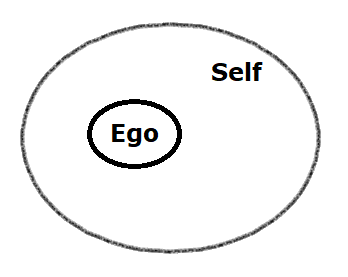
In the picture above the Ego is the known world. It is what we see and what is coloured by our habitual beliefs and thought. We see the world in the form of our Ego selves, and without a bit of consciousness and thought we just approach the world the same way every time. People who think the world is against them, who find the same unlucky things happening to them again and again are trapped in an Ego. Without thinking they just default to the same known approaches and tried and testing things. This is "me" is what we think, I am unlucky, or victim of injustice, I have a right to do what I do, I will not accept anything from outside, why should I. Suppose we get angry, looking just for the inside we justify that anger and turn our hatred towards whatever has made us angry. It might be anything even a bird that has annoyed us by breaking the silence. Buddha's most deeply understanding disciple Subhuti was originally so angry with the world that Buddha found him in the forest throwing stones at the birds that were annoying him. Looking from the inside, and with no intention of going beyond, our mental states all makes sense and we get angry.

But the hero goes beyond, and challenges that anger and having done this before without success tries a new coat and a new approach. But to do this involves leaving the old nest, home, and ego and entering a new one.

The happy person is like a Hermit Crab always willing to try a new shell. Always willing to admit that the old things are not working and to go beyond.


This does not mean that we go crazy and just let it all go and run into the desert in search of enlightenment expecting to meet our True Self in a shimmering mirage. Our goal is our True Self our Buddha Nature, or Jesus Nature of Muhammad Nature. Each of the teachers says follow me, try my way. These Ways lead to the greater self that they are talking of. This Greater Self is looking down on us from the outside. Once we have grown we will come to know them.

Our true self looks like its on the outside, it breaks in on our habitual behaviour and says: hmmm perhaps that is wrong. Perhaps its time to lose weight, or stop smoking and be a bit more kind to yourself. Perhaps its time to have that discussion with a partner where I say what I really think. Perhaps its time to be a bit more kind to the people I know. Perhaps time to end an old hostility and open up to someone I have shut out. It is always like sunshine breaking from behind a cloud, even if we turn our back on it immediately afterwards and are not yet ready to listen.

This is because we are attached to Ego. We gravitate to the known. Like our eyes only see the inside of a room, when we know there is a huge world out there. Being attached to senses and our existences we look from the inside and the greater world appears far away and outside.

Little caveat. In meditation we attach to our senses! How contradictory apparently. But its different because we do it to stop the mind wandering onto other things. This focused attachment actually trains the mind to be focused and this ultimately leads to the mind being able to let go. Ironically focusing on the senses and the present moment leads to a free mind! But this is different from Ego which does not really focus, it attaches and sticks with what it wants to see rather than what is there. Ego filters things that it doesn't want out (like the True Self) and creates half truths and fictions to protect itself and stop us from getting out.

Its an extraordinary thing to witness that we are always bigger than who we think we are, and it often requires someone else to help show us this. It seems so obvious that we are who we are. But there is our greater self always looking in and guiding us if we just take a moment to listen.

Friday, 17 February 2023

Capitalism: the shift from need to Social Control and Planetary Destruction

warning: 3451 words!

Malthus is not famous for being a clergyman in the Church of England his fame is from a Darwinian theory about population growth and carrying capacity.

Natural Selection works because there is huge natural mortality weeding out the least "successful". Its a tautology as the definition of "successful", or "fit" as Darwin called it, is whether an organism survives. But on the principle that mortality is linked in some way to an organisms ability to survive (and wow is all that theory really socially loaded!) Malthus argued that human population would increase until all resources were utilised and starvation and poverty limited further growth. Yet we don't see massive population growth in the rich, if anything it occurs in the poor. Populations in the West are actually falling while those in poorer parts of the world are exploding. And there are other things about Darwinism that don't seem right.

A detailed dissection of Darwinism and History follows with the eventual conclusion that really Social Structure is what is driving these theories and Economic Theory much more than anything natural, scientific and necessary.

Having studied Zoology I always found Darwin's theory a bit odd--yes of course we can code genetic algorithms that use a metric to determine who makes it to the next generation, or who is lost from this--but that "metric" Darwin called "Fitness" turns out to be fabulously ill defined. Dawkins thinks he did well by envisaging rowers in a rowing team and the captain having to weed out the least successful through testing multiple combinations. For rowers read gene. But Arrows Impossibility Theorem shows that even in trivial situations there is no optimal solution. Even in rowing the captain needs to review power/weight ratios. He may have the option of heavier but more powerful teams, or lighter less powerful teams. Combine that with experience, stamina, injury, water conditions, personal time available/other commitments, personality and it all starts to become difficult which team to pick. You see this in all team sports as arguments break out about who should play, and who plays well together. And in football this is just 10 pitch players. Imagine an organism with 10,000 genes like a human, and with billions of individuals all interacting in unfathomably complicated ways. How can you possibly work out fitness without just a try and see. So "fitness" is a poorly defined idea, and one we shouldn't take too seriously. Yet in the field of social engineering in the 19/20th this idea became central to ideas of "master races" and social performance. All the prejudice of the Class System which stratifies humans into classes and "worth" found its apparent "scientific" basis in" fitness." And that led ultimately to the Holocaust. But continues today in Capitalism with the idea that humans must "prove" themselves worthy of wealth and status. You see how absurd these ideas are when you consider that the British system as a whole hands out as much free money in Dividends to the rich as it does in Welfare payments to the far more numerous poor. Yet while there are a million voices questioning whether the poor deserve it, there is only this blog really asking whether the rich deserve it. In both cases people who did not work for it, and prove themselves in anyway, are being given free money. Capitalism is exactly the fraud by the rich over the poor, this self-entitlement to free handouts that continues from the very first days of debt and tribute.***

*** everything needs a caveat. So traditionally this status quo has some justification. Essentially its a protection racket. The powerful engage in warfare and take over a region. They then tax that region (usually of 50% of its productivity) and in return they stop anyone else taking over. This seems extremely unfair. But people tolerate it because paying taxes for peace is usually a better solution that constantly being at war. We saw this in Iraq. Saddam Hussein may have been a tyrant but he had all the troublemakers in prison and Iraq was peaceful. The moment the idiotic yanks banged the hornets nest, killed Hussein and opened the prisons there was civil war for a decade and not a person in Iraq is not not traumatised and longing for Pax Husseini. England saw exactly this during the Civil War which inspired Thomas Hobbes to write his Leviathan justifying Monarchy if only so people could have Peace. This idea had its inception with the Magna Carta of 15th June 1215 signed down the road from here in a beautiful meadow. Unfortunately the Americans have spoiled the area with some pointless building work that I hope is dismantled soon as it was not an act of democracy itself, but overseas Imperialism, and seriously degrades the area.

Magna Carta was not a removal of the Monarch. Anarchists will be puzzled. Why didn't the Barons take the opportunity that Cromwell took on Tuesday, 30 January 1649 to execute the Monarch and be free? It's because it was a truce. The Barons were tired of fighting for supremacy and so the optimal solution was actually to agree on a leader. We all accept the same leader in return for stopping fighting. I believe this is an example of a Nash Equilibrium. This is why people accept the position of subjects to a King. Hegel offers another explanation. So you could argue that the poor accept the rich and powerful because social order and peace is preferable to war. And this is very much the status today where people are comfortable enough not to be bothered with war, and so accept slavery.

And that leads actually into the topic. In nature things are relatively simple. You have resource needs and you do what you need to attain these. For an amoeba this is as hard as it gets.


But organisms have two main possible reasons to get more complicated.

Firstly if they start to exploit the resource offered by other organisms they will enter an arms race as prey evolve to escape predation, and they evolve to predate. Obviously this is not what really happens, this is humans imposing predator/prey and arms race to the what they see. In reality predators are just those organisms that consume other animals. There is no "race" or "conflict" predators could leave that resource if it did not exist. And when prey evolve to occupy the space not yet occupied by predators they create a new resource for new predators. That looks like a "movement" or an "evolution" or a "pressure" in a direction, but its just static like separate frames of a film. Its not like an "individual" undergoes changes. There was no "fish" that decided to walk on land. There were new organisms that developed because there was an opportunity on the land, or actually the subtle regions between like mangroves and mudflats. True they came from what we call "fish" and bear lots of similarities, but all organisms are connected and these names are just human cataloguing.

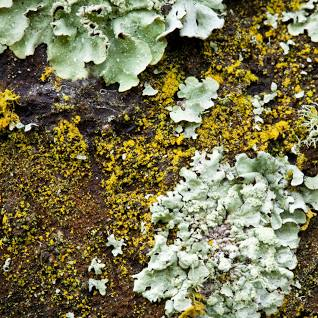
Secondly in response to their colleagues. Interactions start to become significant in the lives of organisms. Really famous examples are lichens and corals where two completely different types of organism fungus/plant and animal/plant come to live together depending on each other. Multicellular organisms actually are like this with bacteria and animal cells becoming linked with mitochondria and chloroplast bacteria.   


So organisms are not discrete and develop together. This becomes the idea of Community where organisms form collectives which operate to the benefit of all. This reached its maximum expression in the idea of Lovelock's Gaia and the idea that the Earth as a whole operates as a huge society of organisms and nature. Not sure we need to go that far, I'm sure its a lot more random. But it is true that everything influences and is connected to everything. A butterfly flapping its wings in Australia really could start a hurricane in America, and an American switching on their car could kill a butterfly in Australia. But think then the incomprehensible complexity of all the interaction on the planet that everything is evolving to fit into and the try and calculate the "fitness". Darwin and Dawkins move over!

So what does all this have to do with Capitalism?

Capitalists sell Capitalism as just a continuation of the Natural World where things must work to survive. Humans must work to survive and so its a "natural" system.

But this is not true in anyway.

Organisms do what they need, no more and no less. There is no gain in an organism working all day to accumulate wealth. Just come back tomorrow. So what if there is no tomorrow? Well there will be because we are adapted to this. What if conditions change? Well things happen slowly, its not my problem. I won't live for ever anyway, why accumulate all this wealth I will never use. Ah perhaps I can give to my children? And then what will they do? Last thing a child wants if for their parents to "give" them a life. And what will they do anyway? Just accumulate more wealth? It's all pointless.

No nature does not worry about this things. Lets live for today for that is what we have.

But what of the Ant & Grasshopper Aesop fable from Greek oral tradition and written down around 300BC?


A fable about preparing for the future. But also controversial even in its time. The cicada sings all summer while the ant works and when the cicada comes begging in the winter the ant tells it to sing the winter too. But this is only one side of the argument isn't it. The fable of the Dung Beetle who works all summer to collect dung finds it all washed away in winter rains. We have today for certain, tomorrow is always uncertain, and the work we do for tomorrow is always a gamble.

What is obvious is that in an interconnected world we can always rely on the charity of others, and they on us. And this idea of slaving all summer to rest up for the winter is a myth. Its true in the North of the planet winter does mean people must prepare for the future, and that is engrained in the behaviour of things here from humans harvesting to squirrels burying nuts. And perhaps more famous are the 7 years of famine from the Bible that made Joseph of technicolour coat famous. Given knowledge of our conditions we accumulate to mitigate environmental variation. This is obvious. But it is quite different from just hoarding. Squirrels do not spend all their time burying nuts, and stealing from each other, and trying to corner the market so they can enslave their competitors in debt. The strategy they have evolved appears to just involve hoarded for the purpose of winter only, not for wealth itself.

And this is where Capitalism deviates from normal behaviour. In Capitalism humans work to control resources. You see this with territorial animals fighting for control of resources. It may be deer rutting to command breeding herds of females.


or chimpanzees fighting to keep other troops of their territory. Or chimpanzees also fight to seek dominance of the group and raise their access to resources like food and mates within the troop.


No longer does it start to be about need but rather social structure and control.

This is most obvious in the human distinction between working class and aristocracy, between slaves and owners. Or later in working class and capitalists. In both cases society is roughly stratified between those who do work, and those who instruct them, or own them, or at least the resources.

Proponents of the system will say that this is a natural division because those who "know" and are trained can instruct those who don't know what to do turning their "idle" hands to good use. Everyone benefits. The person who can build walls get work, and the employer can sign contracts.

But it becomes unnatural because all things are owned. There is a squirrel capitalist who has buried and hidden everything already, and seeks to bury more and more endlessly.

And because everything is buried and hidden by the squirrels everyone must go to them for food. We are all cicadas now whether we want to sing all summer or work.

Its not like the Cicada could start work. The ant has actively hidden all the land and means to work that land. The Cicada MUST go begging to the ant whether it is Summer or Winter. And the ant has it all in their power to say no to the Cicada. This is Capitalism.

Now proponents of Capitalist will say not quite. The Cicada can go the the next ant and ask for work. and since Capitalists are greedy and like making money to hide, some ant is going to say yes to the Cicada.

But this is absurd isn't it. The Cicada who actually has needs, must go to people who are wealthy with plenty already stored and who have no need, and who only create jobs on a whim. This is the fundamental imbalance that means Capitalism always creates poverty.

Protest say proponents. Global poverty has been crushed since the world moved to Capitalism.


But Capitalism started in earnest in the 1700s and no one looks at poverty before Capitalism.

We need only look at Dickens to see the widespread poverty and horrendous living conditions that Capitalism brought with it.

So this is actually a deep debate. In the UK the key shift was in the Inclosure Acts. Since the end of the Ice Age 10,000 years ago people have lived in the UK. Originally nomadic people became more tied to the land as their technology changed and they learned to farm areas. Once work was being done to raise food from the land people started loose property and territorial ideas. Conflict began to develop as stealing became a valid means of gaining resources. And warfare broke out as tribes contested regions and alliances. But fundamentally order reigned as everyone had a place to live and a mean to survive. Why waste lives fighting your neighbour when you have food in your own valley? Why spend all day sleeping in your round house when you could be out with your friends in the fields.

But then in the 1700 machines were made and owners of those machines started to need people to work them, and needed the land for industrial production and profit. Was this push or pull? that is the debate. Certainly original Capitalists did a lot to attract people. Wages were higher in the factories than on the farms, and they built whole cities of good houses that still stand today to house their workforces. Many people abandoned 1000s of years of life on tribal lands to take up modern lives in cities working in factories.

This paid dividends. New workers got wages that they could spend on new cheaper products that flooded the market place from all the machines.

But in case anyone thought this was all Shangri-la anyone who did not accept the new social structure had government orders to vacate the land. There may have been pull, but there was also aggressive push. Commons were set aside like Indian Reservations as a memory of how things use to be, but the rest of the country fell into Capitalist ownership to be exploited for profit and anyone who did not accept this was pushed to little settlements on cliffs and other lands unusable by the Capitalists.

Britain that had belongs to the people since first settlement, now fell under the ownership of a handful of ultra wealth capitalists whose only interest was profit.

Once people had no where to go but houses in cities all built and owned by the factory owners the good times ended. There was no need to attract workers, they were all desperate for work for otherwise they now starved with nowhere else to go.

Homelessness was invented and became the ultimate drive for people to do whatever Capitalists said.

The poverty and desperate plight of people under Capitalism became so great in the C19th that large numbers of the wealthy started to see a need to do something to correct it.

Socialism was born with an emphasis on finding a way to give the non-capitalists some stake in society. With the majority of the population completely dependent on owners for their living something needed to be done so they had a chance to live.

Most workers it must noted do not have the money or assets to interest a bank in giving them a business loan. And anyone who enters debt is just adding to their poverty as they now need to support themselves and the capitalist who made the loan. The poor are fundamental disenfranchised from the system of Capitalism.

Many Socialisms saw the solution in democratic government. If the people once again got together to take ownership of the country and the factories then everyone could benefit from industry and not just the private owners.

Obviously the private owners have spent a huge amount of effort to denounce this idea that they are not the correct owners. Capitalist in the early C20th began a huge propaganda campaign to denounce Socialism and promote Capitalism enlisting the help of such powerful propagandists as Edward Bernays. And one advantage that Capitalists have is with owning the whole country and press they have the money and power to spread their message better than anyone. So countries in the West became stuck with Capitalism. And other countries that tried to break free were bombed to destruction killing 100s of millions of people. Nazi Germany being the most famous example, but Vietnam being another of many massive war crime caused by the Capitalists. The West likes to attribute the mass deaths in Germany to the system of Concentration camps. But its not controversial to say that the vast majority of these deaths was caused by starvation, and that starvation was caused by the war. Have a chat with ChatGPT about it to get some more details. It was the Wests attempt to stamp out German Socialism that killed these people. But Germans were no better and had their own wars with Russian Socialism which they saw as a threat the Germans. However that was odd. Despite loathing Russians and their Communist Revolution which was very probably trying to topple Germany and expand Communism West, the Germans went into a power sharing agreement in Poland. Churchill then recklessly caused war by invading Germany and most probably tricking Germany into thinking that Russia was an ally to break that alliance and the 10s of millions who died in the ensuing bum fight are essentially Churchill's fault. Either way Socialism faltered in Eastern Europe, and with the Cold War and America's continuing campaign against Socialism it faltered yet more and now people live under Capitalism across Europe.

So global poverty was caused by Capitalism and with the unbelievable productivity of modern technology it is simply impossible to keep people poor any more, so poverty had reduced to pre-Capitalist times or perhaps even further now.

But when you think each person alive today lives in a world where $12,500 is made for them, it means that every family of 4 in the world really has $50,000 share in global annual production you realise that we have moved beyond poverty to a world of complete abundance. And yet the majority of the world still lives far below this level and only because of Capitalism. All those machines working away producing things that the majority are unable to buy, and instead a few individuals have more money than their families could spend in many centuries. This is why we all still need to work. It is because Capitalism and the system of ownership works to reduce our access to resources like deer rutting. and our need to still go out and work has for a long time had nothing to do with need but rather control of our lives and what we can do.

And this social structure that control availability of resources for no actual reason, that keeps people in working lives, making this just to fuel capitalism is why the planet is racing to destruction.

We work not cos we need to, but only to maintain the social structure of ownership and inequality that is called Capitalism. It is self serving. Capitalism works to maintain and promote itself. But the cost is the Natural world and Life on thus planet and that is the unforgivable crime. The most precious thing in the whole know universe: a planet with miraculous life on it that occurred by means we don't understand and which has never happened again, the same event that gave birth to humans and ourselves  that complete mystery and immeasurable gift is under threat by an social/economic system that serves no purpose other than to control our lives and keep up working for owners who have taken everything so we have no other way to live. That absurdity is the world we live in, and very shortly won;t be living in because it will be dead.

Thursday, 16 February 2023

System Energy

 Bit over due and am sure well studied in literature but not sure where.

And the relevance to blog and poverty? In essence poverty stems from "self." Once you are contained in a self then you are poor. As part of the investigation of self are iterative systems which are trapped in chains of results achieved by feeding output back into input.

In AIME a trivial AI pattern matching machine of 1996 the idea was to generate self-consciousness by pattern matching an array of data generated from the state of AIME herself. Is not consciousness linked to self-consciousness was the premise. Apart from that flawed idea, it became apparent that the result was going to be meaningless. It would be simply patterns built upon patterns, what else could it be. But then it became apparent that there would be some meaning to the "outside" world in the form of fixed points. The system would trace out paths through its solution space that conformed to "objective" fixed points. SO indeed AIME would have some meaning, but interestingly unknown to AIME. Ironically attention to "self" creates meta properties that are necessarily outside self. Self maps into self in such a way that is beyond self, and this is SRH. So we discover that "self" is incomplete and always exists in a world that includes not-self. Once self realises that it is linked fundamentally to not-self we are no longer poor. How can we possess something when we ourselves are no longer self-contained entities. How can we not possess something when we ourselves are no longer self-contained entities.

This is reminiscent of Greek tragedy. The protagonist seems locked in an irony that they cannot escape. It seems that to "be" them comes with an unfortunate destiny. Whatever they do remains in the locus of this destiny, and even contributes to it. This would be a great example of "self." The self is never privy to the dramatic irony of themselves. Self always generates an objective reality that is necessarily beyond the self. This is why most Religions are unequivocal that pursuit of selfish interest leads to hellish prison. The only way to escape this spiral into the chains of self is through abandoning self in favour of Other. All serious authentic religions preach the path away from self. As a reaction some try to overturn this and preach the gospel of self, Capitalism being one, but as unhappiness and mental illness spiral in the West it is only a matter of time before the error of this becomes apparent.

So we got as far as noting that iterative systems seem to have some "force" within them that either attractors or repels from fixed points. Quick explore of a simple case:

x = Sin(x) slowly approaches 0.

x = Cos(x) very quickly approaches 0.739085133... sometimes called the Dottie number.

Many people will have noticed that repeated application of the Cos() on a calculator always arrives at this value.

So why does Cos have such a strong universal attractor and Sin so weak and non universal? Why is the "energy" in the Cos system higher than the Sin?

When the x = Cos(x) system is plotted it looks like this. The green square spiral has been plotted for the first 3 iterations and can be seen to spiralling down on the intersection point between y=x and y=Cos(x). By contrast the Sin(x) only approaches y=x very slowly.   


Can we hypothesise that the gradient at the fixed point is important for system "energy"?

dCos(x)/dx @ fp =  -0.6736

dSin(x)/dx @ fp =  1

That is important for the region around the fixed point, but we also need take into account the entire range and domain as system values may range through this.

Cos(x) has a real domain and maps each real number into the range [-1, 1]. So after one iteration the whole system has contracted into the domain [-1,1]. For Cos(x) this domain maps to the range [0,1]. So in two iterations the system has contracted to the domain [0,1]. For the entire domain (0,1) the gradient is -ve which means the iteration will contract. And the gradient of the continuous function is relatively large near the fixed point at -0.6736 so the domain range contraction will continue with good "energy." If we have more complex functions this may not be true. How to we measure the total energy? Essentially the "speed" at which it system contracts. Well that surely is just the relative "length" of the domain after each cycle. We take the limits and look at how they map.

#TODO

Sin(x) looks the same as Cos but its an "Odd" function, not symmetrical around x=0. The first iteration maps to [-1,1] like Cos. But that is it, being Odd there is no symmetry or redundancy and no further contraction.

NOTE: symmetry like fixed points is also a meta feature that the system cannot encode BECAUSE its a redundancy. Only half a shape with bilateral symmetry needs be saved with a note to reflect it**. Like finding collisions in hash tables when a system is larger than its states then it must visit the same states in more than one way (from the Pigeon Hole principle), and that creates redundancy which the system cannot encode!

Must all systems have redundancy? A system with self-reference must because a particular state can be itself and ALSO encode for itself.

The MAGIC of self in fact is this redundancy. When we are attracted to "self" as a concept what we like is that it appears to be a "black hole" which unknown hidden features, because it maps to the "same" element. This sameness indeed does create a meta quality but ironically this is no longer in the system. It expands the system. In philosophy and religion that is of interest because we expand the "self" this way.

** and this is interesting and noted before that "compression" is linked to information and system "size." Indeed AIME really was just a compression engine for removing redundancy and encoding current state in a more compact higher-level form.

RE: Hofstadtler's obervation that self-reference is so often diminishing. Is this because it always creates symmetry and so redundancy. Symmetry in the sense that fixed points like x == f(x) are a symmetry. Symmetry creates redundancy and so limits. For example exploiting symmetry we can compress an object. For example a Matrix can be recreated from its eigen vectors and values. This is why the 100 prisoners problem is so diminished by chaining results. Its why returning the output of the Bombe in Bletchly Park enabled Enigma to be cracked.

Back to Sin. In the domain (-1,1) the gradient of Sin(x) is +ve.

Thinking this out as we go... will clean up.

So both systems converge. Cos oscillates around the fixed point which means it jumps to the equilibrium.

Sin is trapped on one side of the solution and slowly creeps in. This appears to make progress slow. How to formalise this?

Quick look at length

So mapping {0,1} through Cos(x) we end up with a constant system contraction of  0.673611997 which is the gradient at the fixed point.

#TODO check this.

This represents what I was calling the "energy" of the system. The smaller the larger the energy.

Now lets try and make a function which does not converge.

x = Cos (a x)

fixed point vs a


What we get is a linear decline in fixed point as 'a' increases until a sudden discontinuity at around 1.3. This represents a change in the stability of the fixed point. 

Now there is a fixed point for every value of 'a'


But it starts to get so unstable that its very hard to find by iteration.

dx/dy = -a Sin(a x)

when a = 1.319140625 then f'(x) = 1

But this is unstable and is bifurcated.

Numerically a = 1.2000000000 is not bifurcated. While 1.2000000001 starts oscillating. What is the significance of this? 

Bifurcation starts very slowly making it hard to find the exact point.

f(x) = 0.682740857926806
f'(x) = -0.876792727

can't you do this algebraically?

Anyway got to leave this now...

TODO
>find the reason why Cos(a x) is unstable for some values of a
>find the reason why Sin(x) slowly contracts to fp
>find the reason why Cos(a x) bifurcates as a value of 'a'
>Does Sin(a x) bifurcate?

Overall look for a measure of "energy" in the system. This is yet another meta feature of the system that it cannot determine "within itself." Why?

Proof: a fixed point is not operated on by a function. It seems many functions operate to move towards these points. When chained together we get to the fp. But others diverge, and some are chaotic.

Ultimate for a contracting system f(x) is closer to the fixed point that x. If this true for the whole domain, or at least the range, then the iterative system will converge to the fp. 

If we plot f(x) - fp we can see this,

For a chaotic system like kx(1-x) for some values of k then this is not true. Look at this and see why it remains unstable.

===

x = Cos(a x)

a <= 2.97169387071380185 then 1 fixed point
@ this a, fp x = 0.39276073779188737
dy/dx = -2.73289

a<=  6.202395285573132 then 3 fixed points
@ this a, fp = { -0.64644, -0.302866, 0.217849}
dy/dx = {-4.7322, 5.91109, -6.05343}

still no idea what makes a fixed point attractive or stable??
===


Wednesday, 15 February 2023

End of the World - How can everything in the West be wrong?

You just need turn on the radio, or watch TV or read the internet and literally everything in the West is wrong how can this be?

Seconds ago the radio says that economics is dominated by men. Well that is true. But the domestic sphere and childbirth is dominated by women. Ah say the feminists but the domestic sphere does not give us any worldly control because finance is a worldly and not a domestic thing. But surely the argument there is that it should be and the battle is to end Capitalism and reassert children and domesticity as the centre of our lives and society. What is more more important than the next generation? Certainly far more important than economics. After all "economics" means "household management." This is just one example of how the West has everything wrong.

With the West waging war against Russia (get again) via its proxy Ukraine we see the full insanity of Western psychosis in all its colours. Even after America rules the world if anyone thinks that is the end of global warfare thing again. America will end up fighting itself, since murder and control is all it knows how to do.

So that is Western Economics and Warfare all shown to be nonsense.

The list goes on. Lets take medicine. West tries ever harder to keep people alive. Why? Admittedly there is a movement to improve quality if life and accept that sooner or later we die. But no where in medicine or science does anyone have any idea what death even is. So we are running from something we are completely ignorant of. Typical western ignorance and idiocy. Most cultures have a good theory of death and know how to approach it. Not the West.

Of course the main reason the West does not want to approach Death is that it challenges the fundamental ideology of the West, that of Ego which is wrong. In the West the "individual" more commonly called the Ego is celebrated as the unit of society and economics. We both derive action and receive enjoyment to the Ego. But its a myth. When we get up in the morning so that this Ego can service itself do we stop to think where even the energy to think comes from? "Food I grew or earned" we say. "That energy is mine." But even that thought was powered by this energy, that was used in the first thing we ever did. Okay we admit its not all mine, my parents nurtured me and my mother gave me that initial push to get me started so I could take my first breaths. But it all breaks down because the same was true for your mother that energy she used to raise you was not her's. This is just one tributary of the river and then ocean which confounds the Ego. And then there is Death which for the Ego steals its life, but of course a Life it never had and which was given to it from beyond. So the whole Western economics, politics and social fabric disintegrates in a puff of nonsense. The world always was, and always will be, and we are a part of that before we even raise a thought to the contrary.

And that feeds back into the other points. If all politics, economics, social theory, science and technology is fundamentally flawed that what good can come of it? Suppose America wins the war in Ukraine what good can come of it? Ukraine just lurches from what I assume is nonsense into new nonsense. Certainly the West cannot help, and can only make things into more nonsense.

And so on... its all nonsense here in the West.

Saturday, 11 February 2023

Here's the rule: when something is applied to itself it creates meta properties that lie outside that thing.

Which is obvious. To apply "to" oneself is to already to set up an "outside" to oneself. Already blogged on that regarding the "dative" case. This is really going around in circles (irony given we are talking about non-halting, recursive self-reference type things). Need to consolidate all this at some stage.

Couple of conclusions:

(1) Can you refer to self, "within" self. That is get a handle "on" yourself from inside. Suppose you could (and I keep using proof by contradiction, while now aware that T/F are part of the problem of dichotomies that we suspect SRH causes). But anyway... suppose we could get a handle on self from within: a true Monad.

Well the first thing to note is that a self which has a handle to itself from "within" is also the universal set, in that if it had handles to anything "outside" itself then it would belong to a greater set and reference to that would be reference itself from outside. Universal sets containing themselves is already problematic. QED (informally).

(2) Suppose there was a formal way to decide whether a definition was impredicative. That is a formal way to decide whether a definition included itself. Given a definition d we can simply run through the procedure I(x) to discover whether d is required prior to definition.

Frank Ramsey gives the example of a normal impredicative definition "tallest person in the room." in that the selected individual T is present in the definition. However this doesn't work because in the definition T is selected as being in the room, and the definition then selected this person based on height.

The problem only occurs if the room was filled with people meeting the description "the tallest person in the room!" Given a group of people in room A you can't then put people in room B who meet the description "tallest person in room B." If you could you have the option to make a room C filled with the people who are not the tallest in room C, or lets go crazy and put everyone in room C who is not in room C.

But you have a good example there of how SRH can mess things up and the kind of problems that fall under SRH and those that don't. Level 1 is that if we allow SRH then we can create contradictions. Level 2 is that SRH allows or contradiction itself!

Anyway I(d) where d = "occupants of Room C who are not in room C" so I(d) is true. Note the tautology d' = "occupants of Room C who are in room C" is also I(d') = True. The point is that you need to know the outcome of d to decide on d.

Now let us decide whether our Impredicativity definition is Impedicative: I(I). This is fine, it doesn't matter whether it is T or F.

Now a new definition J(x) = !I(x) just returns Not(I(x))

I(J) = False

Initially we think that J is defined only in terms of I() so I(J) is False.

But J(x) is defined as Not this result. So J(J) 

I(d,e) -> I(I,I)

Jd(x) = !Id(x)

I(Id,Jd)

 TBC...

Note interestingly unlike the Halting disproof the very use of J sets the result, while in Halting the decision is "lower" down. There are "layers" of activity within the logic, its not just simple T/F.


====

Original Post...

So in functions that apply to their domain you get "fixed points." Now I dismissed fixed points in a recent post because they are actually elements of the domain that are unaffected by the function. They effectively "pass through" and so appear useless.

But what I have said before and missed recently is that this is exactly WHY they are important. The function does not know they are fixed points. Being a "fixed point" can only be determined from outside the function! No function/system whatever can ever codify its own fixed points by definition because the fixed point is unaffected by the function!

So fixed point by definition define the limits of systems. Where there is a fixed point the system cannot be total!

So you need to prove that there was a function that applied to its domain that did not have a fixed point and that is impossible.

So I retract the previous post. Fixed points are actually the point.

SRH thus works because when you introduce self-reference even so little as to apply a function to "its" domain then you create meta properties that lie outside the system.

Now I need to check Godel's proof again because IU have always claimed that Godel numbering lies outside PM. Is this true? If it doesn't then does it number itself?

Not all the impredicativity here. Lots of "its." When a function takes its own output as input then it is defined impredicativitily. Altho not endless recursion because it is defined by a particular element at time=0. But like rainbow tables (or the 100 prisoners) this leads to finite loops (usually except in chaos in the real numbers where the loop is countably infinite). 

===

Just to seal that point. Suppose there was a function f(x) with a fixed point of 5 that is f(5) = 5. Now we augment that function so that it takes it start value and compared with the outvalue to identify its own fixed points. But now its not the same function it is g(x). This new function outputs 0 or 1 for input values that are fixed points of the original function that is g(5) = 1. So now we have a function with a massively reduced domain. g(0) = 0 and g(1) = 1 offer the only two possible fixed points. And we don't know whether f(0) = 0 (which would contradiction g(0) = 1) or f(2) = 2.

So perhaps we have a more powerful function f(a,b) = {0,1} which outputs 1 if a(b) = b and 0 otherwise. With a bit of a cheat called currying we create a new function fa for each f(a,x) = fa(x). Enabling a 2 arity function to explore itself by splitting it into an infinite family of 1 arity functions.

f(fa,x) = 1 when fa(x) = 1 and when fa = a then this function is saying that 1 is a fixed point of f(a,b) 

But now SRH turns up cos we can create the paradox f(fa,0) = 0. That is there is an 'a' such that f(a,0) = f(fa,0) = fa(0) = 0 which says that 0 is not a fixed point of f(a,0) and yet it is. Therefore there cannot be a function f(a,b) which works out if a(b) = b reliably! Quite a weird result as it looks easy!!

But in the context of this post it illustrates how there is a fundamental divide between the meta properties and the thing itself. To violate this in general creates contradictions. Which is all very Constructivist and Predicativist.

Now again hot on heals of SRH. Suppose we have a theory T which proved SRH. Which is to say that we had a theory which proved why meta qualities are "meta" and cannot be encoded within the system. For example Quine's Use/Mention distinction : that is SRH is the theory which explain how Use and Mention are fundamentally separate. This theory would prove that it is has a meta level that is beyond itself. That is we can say things about SRH theory that it cannot express. And yet SRH theory is at the same time explaining how and why such a barrier exists.
 
In the Use/Mention analogy SRH theory would explain why Using SRH and Mentioning SRH are different. Yet to do this it would need to being Use/Mention together thus contradicting itself.

But what if it assumed that Use and Mention could be combined in am SRH theory which was then shown to be contradictory. We then reject SRH which proves SRH that they are separate.

OK rambling now but this perhaps looks not to complex now.

Just check the "exceptions" idea. So what if the SRH said that there are some meta qualities which can be encoded in the System (making them no longer meta) and SRH was that meta quality: it would be possible to encode SRH within itself precisely because it was a contradiction!

Doesn't SRH expand Godel statements to a total collapse of logic. The very idea of contradiction sanctions the contradictory theory called SRH which allows for a contradiction! No longer is Russel, Tarsky, Godel, Turing, Berry, Caitin and many others finding individual statements that cause contradictions, but the very idea of contradiction via SRH itself causes a contradiction.

It turns out then that the distinction of system/meta lies at the very heart of logic and is the origin of contradiction itself. Where we normally call A & -A a contradiction and reject at least one axiom to restore consistency, in a system that allows for SRH (self-reference in Godel) we can exploit meta qualities of that system (which cannot lie "in" the system by definition of being "meta") to cause contradictions, but contradictions are in fact only possible because we have meta statements. Calling something a "contradiction" IS a meta statement!

Take a function f(a) = 1 if 'a' codes for a contradiction, otherwise 0.

f(b) = 1 when b codes for this statement. This is nothing more sophisticated than the liar paradox "I am false." It says "I am a contradiction".

But we are only able to make a statement "about" another statement because of the "meta" level. "Meta" may as well be "about" or "mention". Without the possibility then we can't do this. This "meta" distinction lies at the heart of contradiction.

Ok am I getting beyond myself. "A & -A" is not making reference to itself via a meta level. It is simply taking anything A and then negating it and saying both are true. By definition this is always false.

But of course A can be anything even "A & -A" so it does have self reference! By substitution it evaluates to:

(A & -A) & -(A & -A) -> (A & -A) & -(A & -A) = (A & -A) & (-A | A) which is in words: a contradiction AND a tautology. Which is also False obviously.

But now we have infinite recursion. We can substitute it again and again infinitely and still get the same FALSE result.

= (-A & (A & -A)) | (A & (A & -A))

There are an uncountable number of ways to recursing and reorganising this FALSE statement. Not quite sure where I am going with this just exploring logical recursion deriving from the self-reference always present.

And this is pointless anyway as Tarksi already proved that TRUE/FALSE is a necessary meta level to logic.

But while he showed that allowing TRUE/FALSE To exist in the logic leads to contradiction, SRH is saying that contradiction itself comes from this distinction!!!!

Ok need think about this some more.

===

So its all about mirrors. To get a "self" you need a mirror. And that mirror image by definition is not self, as its separate from the original object. This gives us Use/Mention. The Use is the object, the mention is the reflection.

But given that a reflection is just a "copy" of the original how can you end up in Paradox? And I have read things which argue that paradox is actually impossible based on this kind of understanding. Well the problem is that the reflections are infinite. Its not just A and A', but (A and A') and (A and A')' ad infinitum.

"this sentence is a mention"

Subtle meaning. The "outer" sentence is in quotes so is a mention, but when read the "inner" sentence is in use. So while being read it is false, but as text on a page it is true. But a mention cannot have a T/F value until it is in use, so actually this is false.

"this sentence is a use" is true while being read inside quotes, but within the context of this whole sentence it has no T/F value and is just a quote. So the sentence is actually true while you assign a T/F value and then null when in quotes. Slightly confusing. Stuff in quotes is just "asfasdfasd" can be anything doesn't need a meaning.

So the SRH issue is just why these two levels. Why always 2 levels. Why True/False? Why Use/Mention? Why Description/Meta-description?

If SRH was to transcend these 2 levels, to unify opposites, to ignore impredicativity completely, to become the reason why we must have T/F distinction, it would need to be a theory that breaks itself, that sets up a reflection process that then reflects itself in itself and creates 2 from 1. SRH would be its own reason to not be itself. Contradiction is ONLY then possible. So we can ignore any logical contradiction proofs for SRH. It must be a language theory that ignore T/F to begin with.

Let us start. There is a theory Q. Q is an operator such that Q(Q) = Z. Z is fundamentally different from Q. If Z was the "similar" to Q then it could be shown that Q(Q) != Z.

So we are saying that Q is so constructed that it derives in someway a new theory Z with a "difference" from Q. Despite being derived from Q it is "different". This would be analogous to the NAND operator from which all other logic can be derived. But NAND is not itself a logic, it is a Truth Table which defines logic. A NAND B cannot operate on itself. Anyway rambling, just looking to see if anything comes out.
    
===


Saturday, 4 February 2023

John Smith and Anatta


Here is a human leg bone.


Now it's something we immediately ask: whose leg bone is this? How did they die? How did they live?

All fair enough.

We can assume they had a name and lets call them John Smith. Now John Smith will have probably had 2 legs bones like this, two arms, a body and a head. In fact John Smith would have had something like 206 bones.

But now a bit of an SRH question: which of these bones or collections of bones is John Smith? Well we might say none of them cos John Smith has died. But if none of them are John Smith then how can they belong to John Smith? And this even more odd if John Smith no longer exists.

Now some people believe in spirits and souls and these are permanent so that John Smith still exists and these bones belong to him.

But what if we grind these bones down and sprinkle on a field and then over time eat the crops from this field. The minerals in John Smith's bones will gradually become the bones in me. So they are no longer John Smith's bones but mine.

And what happens then to John Smith's soul, have I stolen his bones? Has he become property-less?

And the real question there, if the bones belong to the soul then who does the soul belong to? Isn't there a infinite regress here? All sounding very SRH. And if the soul is the seat of ownership then why do we need the soul, can't the body just be John Smith, can't be bones own themselves?

So why not just have John Smith as the collection of bones and body.

Anyway this goes on indefinitely because John Smith is actually really bad defined. John Smith cannot be found in the world or in the spiritual world. It is just a vague idea. When a bomb goes off people get blown apart. When emergency services collect the parts, which part does the "person" go "into"? Which part owns the rest?

None of it makes any real sense.

If I have my arm amputated and I wake up from the operation to see an arm in medical waste. Is that "my" arm? And then we might ask as greater parts of us get amputated at what point do we go into medical waste? This is a common philosophical thought experiment. Usually we end up thinking that we can lose everything but our head and it can look at the pile of medical waste as the stuff that has been removed. But then what if our eyes were removed and put on the pile? What if they were still connected by their optic nerves? When we woke up we would be looking from the medical waste pile to our head on the bed. Surely now we have been put on the waste pile? But then we might argue that the brain is on the bed, and the optic nerve needs to be connected to that brain for us to be on the waste pile (altho you can equally argue the eyes are needed to get this perspective looking from the waste pile). So we cut the optic nerve and are cast into darkness, that we somehow argue is now on the bed (while just before we were looking at the bed). And we get abstract then and start to ignore space and start to think thoughts about who we are and where we are.

We enter the discussion Buddha has with Ananda in the Shurangama Sutra. And the point is that at each point we are trying to cling to something, some solid foundation on which we can "stand." But as things get cut off the places to stand get smaller and smaller and then more and more confusing, and the "here" and "there" starts to get confusing and it all starts to fall apart.

What we are resisting is the ultimate letting go, that actually there is no seat of self. Like John Smith it doesn't really make sense.

Letting go casts us off from material attachment and this deep obsession with being bound to something physical and solid.

That can (will be) quite unsettling and ungrounding. This "emptiness" is frightening and unsettling but when we can handle it, then it is pure freedom from suffering.

Returning to the top, it is no surprise then that all this trying to make John Smith fit the bones or the body or the soul doesn't really work because there is no such thing as John Smith. It is just a name that we loosely give to a "person." That loosely refers to their birth, looking backwards gestation and conceptions but then it gets confusing with sperms and eggs how it started. And then going through life we can attribute things like what they did and who knew them, and this goes through the whole bodily processes until they get ill and eventually the die. And then it gets confusing again. Perhaps they donated body parts to people at some stage, and we can can kind of ignore that. And perhaps they thought great things and lots of people started to think those things, perhaps like Adam Smith they will be remembered in these thought: this is Adam Smith's Pin Factory. So Adam Smith now becomes much more complex than just his bones.

 We kind of go along with it, but it doesn't really make much actual sense.

And yet, we do this to ourselves. We actually think there is a person inside us, somehow connected to our life, somehow born and somehow to die. Somehow owning our body parts, and what we do, and somehow being in our heads and our thoughts and our decisions. Yet haven't we seen with John Smith that this person doesn't really exist?

And if there is no one actually at the centre of all of this, the doesn't the world just carry on as it is without any hassle and worry? Things are just what they are and there is no one here in my life to worry about that.

Buddha calls this Anatta.

Friday, 3 February 2023

One obvious SRH problem with using dice.

The decision of whether to use dice or not CANNOT be made with dice. Easily proven because if you could then you could roll on never rolling, and keep going until a contradiction.

This is actually a great example of what we could call the Prior. Which is a version of SRH. You can't go back into time to before where you started, which is actually NOW. This is exploited in the 2002 version of the Time Machine where Dr. Alexander Hartdegen builds a time machine to go back in time to save his fiancée only to discover that once saved the cause of making the machine is gone and to maintain consistency, and avoid contradiction, she is killed in some other way. Of course there is the even bigger problem that to be back in time before the invention of the machine already opens up this inconsistency. And, as extremely well noted, once back in time you can kill your mother and create an inconsistency as bad as any SRH. From this we conclude that time travel is impossible, unless some condition exists which limits freedom to maintain consistency, or we should allow incompleteness where we allow existences that do not belong to "this universe." So if Time Travel is possible, then the Mother Paradox means our universe is not total and there are existences that do not depend upon it (isomorphic with provable where we take prove to mean depend upon the current axioms and combination rules - which maps to existence and laws of physics). Let see where Quantum Physics takes this, cos I've never realised explicitly that SRH says that Time Travel is impossible before (in an ordinary consistent and complete (knowable) Universe anyway). Okay lets say is this proof of God? Well SRH does say we can't know everything already so its the same conclsuion that there will always be unknowns complete outside the known universe. One unsettling thing tho is Godel, a committed Christian, did fashion a logical proof of God and I don't think it was this... why not? Have I got something wrong that the great Godel dismissed?? Scary indeed!

I'm only scribbling down a note here, and know I have handled this again and again in the blog, but forget what it was previously called.

In a "Hermeneutic Loop" you have to start somewhere. And that somewhere sets the loop you are in ALREADY. You always start IN a state of affairs. You cannot start from a black canvas and construct a situation or meaning. You start IN a situation and simply move somewhere else.

Logicians will complain. But you can decide on your logic framework and axioms from scratch and then explore the consistency and completeness of those axioms. But the 2007 version of SRH was saying even in this situation there is the prior of the logician them self. Faced with a page of schema and axioms for a logic will be meaningless unless you have some basic training in logic itself. Things have use and mention. The "use" requires training that lies outside the schema. There is always Prior. I know Hofstadler discusses at length inner and outer messages and what can be recovered by aliens exploring symbols. I will need to reread but I would venture that there is nothing fixed here; there is no message that we can write on a Voyager space craft whose "meaning" we can assure. I know some scientific constants were encoded so that aliens might know these and work backwards to decode. But this is making some assumptions based upon our own "prior." Is there an "objective" reality that is entirely separate from the sender and receiver? I would say no.

So returning to the simple case of using dice. Unless we use the dice for everything then we must make choices about when to use dice. Can these choices we defined in a rule. NO!

The proof is that we can use self-reference as done before to break this. Using coins: Heads and we ignore the outcome. Something is wrong. That something was in how we decided the question. "Using Dice" is a choice made Prior, like an axiom that we chose. And depending on the result we can reject that choice.

It also means that the outcome is heavily influence by this choice.

In reality we don't use dice for simple choices only those choice we are "unsure" about. Or perhaps those things we don't really want to do we put to the dice.

"dice" i'm using for any random choice. In reality I use coins with Yes/No answer.

So suppose we use the dice as a final "get out" clause. Shall I go for a jog? There is a 50/50 chance. So effectively all the coin flips are doing is reducing the number of things I don't want to do by 1/2.

This is not very scientific, as I don't flip coins on all the things I do want to do.

"Coin flips" quickly become dominated by the Prior, that is the conditions under which we use dice/coins at all.

And isn't this necessarily true. We cannot escape the "loop." Whatever we decide to do is already heavily influence by where we are. Buddhism and Present Moment is great here. You must start where you are, so let you brain catch up with NOW. Stop thinking about past and future and get established in the NOW. This is the launch pad from which to inspect the Past and the Future anyway, so get feet firmly on this launch pad before coins or anything.

=== 100 Prisoners

Had a great example of this is reality. An ICT room with a 100 PCs named in order PC1..PC100. Over time PCs have been removed, fixed and returned randomly or have been borrowed and returned and put back out of order. What algorithms do we have for returning them to the right order?

Well the definitive solution is to go through all the PCs get its name and move it to the right position. But suppose there is only room on the table for one. We must move it to a gap.

Well one solution which is not a complete solution but always improves the situation is : when you find a computer that is in the wrong place, swap it with the one in its correct place. If we also keep going until we have the right computer in the starting place then we will have completed a "Rainbow Loop" like in the 100 Prisoners. Now not all Rainbow Loops are very long, so its a good short term algorithm. I did this the other day and the 1st swap fixed it.

This illustrates an example of things being in a "loop." When you sit as a computer that is in the wrong booth you are automatically in a loop and you can trace a path through all the out-of-place PCs until you get to the one which should be in your booth.

This is the basis of the Enigma crack, finding Hash table collisions and the 100 Prisoners problem.

But being in loops is actually the central observation of all existence, and creates the Prior situation which underpins Self-Reference problems.

Self-Reference as observed creates loops, and creates algorithms that do not halt. TODO is the "Goto" really a self-reference!!!

While calling a function on itself recursively looks like recursion in the machine code doesn't this just Goto the code again?

So actually assuming code and logic are isomorphic, isn't the real problem in the Goto? What is the logical version of Goto? We can do away with "this" then and replace with "Goto x." And if this is where we are going then the "strong SRH" we defined which needs an Entity referring to Itself is no longer needed.

In fact note: Constructivism is at the heart of this.

The Strong-SRH and the weak-SRH actually differ in construction. Strong-SRH needs an actual entity to do the referring, while weak only needs a name.

"This is false" looks like Strong-SRH in that we can deduce an actual sentence is needed. 

While "Ex | x is false" only becomes a problem under binding. And under Godel Numbering is even more abstract as it depends upon isomorphism between numbers and formulae.

Just check whether Godel Numbering is something that PM can do. In other words do the theorems exist within PM or are they meta theorems??? Really should have sorted that by now!!  

US displaying its Imperialist credentials... yet again

Wanted to know the pattern of UN votes over Venezuela and then got into seeing if ChatGPT could see the obvious pattern of Imperialism here....