My first insight into SRH was the "new term" problem in AI. I have no idea whether that is the "official name" I came across it in the mid 90s on the internet. It captures my insight.
Intelligence is not just selecting and reordering the contents of the solution space, it is developing the solution space.
Definition: at least my understanding of Solution Space is the same as Parameter Space. You define the boundaries of a problem with parameters and then the Solution must be some value of these parameters. The multi-dimensional space with all possible values of these parameters is the Solution Space.
So the new term problem and how I think of intelligence is the ability to add or remove parameters to the solution space as one approaches a problem. Just searching pre-defined solution spaces is not intelligence.
Suppose you teach a computer to play chess. The solution space is easy to define, but it is a huge tree of possibilities. The problem for players of chess is not understanding the solution space but just selecting which branches to walk. In theory a brute force approach is sufficient altho it is not practical given the side of the tree.
Neural Networks seem to generate extraordinary intelligent behaviour. I am certainly open to the possibility of radical achievement by AI. But, I'm always a bit suspicious. In this example by Two Minute Papers the AI discovers solutions outside the solution space imagined by the programmers who built the experiment. It finds things that the human observers of the systems didn't see. This is always the WOW moment of AI to be out smarted by a machine. The first time I heard of this was in the LISP programming language in the 1980s and a command line adventure game. The developer was playing the game, climbed on a statue and then cast a spell which killed him. He had to think about why he died and realised that the spell destroyed the statue so he fell and died. The machine was out smarting its player. But can't all this be explained simply by the fact that machines are able to search through the solution space and literally find things that humans had missed. It doesn't suggest that the machines have mastered the solution space. An AI set to work in a 2-dimensional game will NEVER find enter a 3-dimension solution space. Any more than these Hide'n'Seek bots will utilise the 4th dimension to hide.
This is the illusive "new term" or parameter that I don't fully grasp even 25 years later.
When people say that a problem is "NP" they saying that like chess the solution space is vast and also structured like a tree. You can't just solve a differential equation to pick a solution. In a trivial way the solution space to lowest value of (x^2 + 3x - 3) is vast in that x can be any one of an infinite values, but we can chose the answer -5.25 very simply and exactly with rules of algebra and calculus. Chess despite only having 32 pieces with very limited moves leaving not many options each turn, requires you and the opponent to wade through the solutions, trying to close down dead ends early and using a database of known solutions and patterns. An obvious difference is that continuous solution spaces are easier to navigate than discrete spaces like "moves."A chess players strategy includes tricking the opponent causing them to close down and ignore valuable moves. Once you understand the opponents game you can beat them knowing what move they are likely to make, producing a game that perhaps no AI would ever play.
But if an NP problem could be transformed into a different solution space it might be simpler to solve. Finding the route from point A to point B walking is difficult if we search the roads of the city. If we have a drone we can spy on the situation from the 3D dimension and put A and B on a 2D map and automatically prioritise paths that lead in the right direction and the wrong. Practically too tracing a route with ones eye means we can try out routes a lot faster than walking them, and we have added information like being able to see busy junction points which suggest if we can get to them we have lots of options. This last bit I believe is the basis of Dijkstra shortest path algorithm.
So crudely NP is hard to prove it seems to me because we have to eliminate the possibility of a new-term which transforms the solution into something easier to solve than brute force searching. Almost certainly this proof that "brute force"is either not resolvable N != NP or can be reduced to P only needs to be done once, like Turing Complete, as all such problems are hopefully isomorphic and what is proved for one can be shown for all.
So all this blog was inspired by a good example of new-term. The Cross-Product. Two vectors define a plane. Using the Cross-Product we have a procedure to apparently "create" the 3rd dimension, the Normal to that plane. Likewise living in a 3D world we can prove there is a 4D world by creating the Normal to our 3D world. Any dimension apparently has the tools to bust out of its limitations into new space. The infamous ants walking around their Mobius Strip world just need to calculate the Cross-Product to have a vector pointing outside their world. (Obviously these ants are 3D so they are already aware of the 3D but flat 2D ants in a Mobius world.)
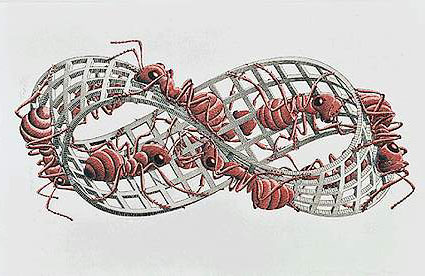
However actually there is no creating of a "new term" because to calculate the Normal we need to equip our vectors with a 3rd vector before we start! We might be able to show that we get some weird results if we try to do it with just 2 dimensions (e.g. just do part of the calculation using just 2 rows of the matrices) but the break through is not something we can calculate.
As a kid I spent considerably time trying to think of a new "mode of transport." we had flying, swimming, running, walking etc but try and think of a "new one." Novelty it seems is extremely difficult, the boundaries of our world are extremely rigid, the freedom we have exists only within rigid rules. It is like Mozart pushing the limits of Classical. He explored the space but traditional musical history says he never went outside.
Outside is what I call intelligence, and SRH proves, in the same way that Godel showed that self-referential systems are incomplete, that there must be an outside. But how we get there remains illusive and magical. Even in 21st century we must wait for divine inspiration and the grace of God it seems for such revolutions.


No comments:
Post a Comment