Wednesday, 29 July 2020

Heads SRH is true, Tails it is false

"This is a lie" is the classic contradiction. Sometimes Godel's theorems are styled as logical examples of that.

If we use random coins flips to make decisions as I have been for a while we can generate similar problems.

One such problematic decision is whether we should use coins to make decisions at all. We can ask the coin:

Heads: coins are fine for decisions.
Tails: never use coins to make decisions.

Fine if the result is Heads but what to do with the Tails decision. It says never use coins, so presumably we dismiss the result as it was made with a coin. But to dismiss the result is to make a decision based on a coin. So we keep the result which tells us to dismiss it and we are trapped. Its isomorphic with "This is a lie" and "This statement is not provable i.e. is not a member of the set of our logical statements"

SRH is an intuition I have that there was a problem with self-reference which I called the "Self-Reference Hypothesis" although I don't yet know what this is.

It seems that you don't need very strong self-reference to get into difficulties. It is sufficient for the player of "coins" to just ask questions about Coins.

Indeed any decision mechanism which can make decisions about itself has problems. And "itself" just needs to be its name, not "itself" in the complex "self-conscious" ways I was initially envisaging.

To recap. There are many types of self-reference. The loosest is using names. "Statement 5 is false" when put at position 5 in a list becomes a problem. The context of that "world" understands the "5" to mean position in the list. It requires no work "within" the statement. It's all up to the reader and inferred context. But "This statement is false" seems to contain its own context and world. It is always problematic regardless of context. Well not entirely true, the context must be English reading population. Such a statement in a world where English did not exist is just marks on a page and no problem exists. We might certainly decide there was information present if we found it on a beach as marks like that are rarely natural. But with no other context it remains a mystery.

Returning to coins. That decision seems to have us trapped. Every time I think about this I get to the same position something unsatisfying like Russel's Types or Cantor's hierarchy of Infinities. Systems that enable decisions about themselves seem to form a hierarchy. That self-reference like the cross-product generating a statement that points outside.

The point is that to ask the paradoxical question: "Can Coins be used to make valid decisions?" presupposes a context *outside* of Coins. The player is clearly more sophisticated than a machine that just makes decisions by flicking a coin. Such a machine couldn't ask the question. To ask such a question already requires a world in which coins are just a part.

As one sceptical paper on Godel argued: contradictions do not exist in reality. The "real" version of this paradoxical coins question is a machine that blows itself up if it gets a tails result. But obviously "time" is a constant here that is *outside* the question. If we allow the machine to go back in time and stop itself being created on a tails result then the paradox returns. 

It appears that to ask a "self-referential" question of a decision device requires the question to exist in a wider context than the device. If we allow the device to make decisions about the context of the question we run into problems.

There does seem to be some necessary hierarchy with the context being a larger order than (and *outside*) the device.

Returning to the Coin Paradox. The coins cannot make meaningful decisions about the whole of the Coin game. To play the game puts the player in a different place to the coins. The coins know nothing of the world, even of decisions far less they can make decisions. It is up to the user to interpret the result and make the decision based upon the result. And the user is fundamentally and necessarily not a coin. This the paradox is being misunderstood. The coins are not the point. Really the user is asking "should I play coins?" this is something they must decide. Now they could decide to play coins to answer the answer, but the point is they already made the decision to play coins. The contradiction is no more paradoxical than someone flicking a coin and then flicking it again and getting a different answer. The first flick was the decision to play coins actually made by the user, and the second flick said don't play coins. It is not a paradox, but requires understanding the contexts outside the game.

Th paradox occurs if we forget the context and try and understand the game as "self contained". And this was the original insight into SRH (or God Principle as it was also called) that any system exists embedded in a context and so cannot become self-contained and so self-knowing or entirely self-referential within itself.

Sunday, 26 July 2020

SRH stub

If not already said "Outside" is the key to SRH.

In the same way as Godel there is the broad suggestion that any system that has self-reference must have an outside already. In other words self-reference cannot be contained in the system itself. To be self-referential means to have a view of a system, with a boundary and to gain that perspective we must be outside the system. A system cannot be self referential.

Consider taking a plane trip to see the land. We have a dilemma. Stay on the ground and not see the whole view, or leave it. You can't both have a view of the land and vbe part of it.

We need some distance from objects, See Pymalion. 

What does most of this have to do with poverty?

So the blog got retitled Joy of Poverty. Yet how does economic reformation, insights into Life, and logic have anything to do with Poverty?

It could just as easily be called Joy of Freedom.

Poverty IS freedom!

Why?

Consider the drug addict. Within their world getting the drug hit IS freedom. That blissful moment when they are satisfied and the worries and struggles of the world seem far away seems like freedom.

But for someone looking on the outside all they see is someone desperately rushing around trying to get their drug and then a period of inactivity while they consume it and then its back on the tread mill of searching for the next hit. This is not freedom but a cage crafted by the drug and the brain.

Well seriously what is the difference between that and most organisms!

We have some image of what we "want" we search for it until we find it, or we think of something else we want. If we find it all is good for a while but soon the search starts again. If we don't find it obviously the search continues. And if we stop that search we will just divert to a new one.

Being on the treadmill of desire is not freedom. Looked out from "outside" it is clearly not freedom.

So being "outside" is critical to seeing slavery in action and so understanding freedom. Indeed all the slave or prisoner wants is to be "outside" the prison. Being "inside" is actually a euphemism in English for being in prison. Outside is deeply linked to freedom in English at least. But it appears that until the prisoner knows there is somewhere outside the prison they don't see the bars.

The mind is a cage, exactly as portrayed in the Matrix. The issue of poverty is covered there.

Logic is a formal way to approach the question of outside, and so freedom.

Economics is currently built around desire, consumption and production. It is an economics of slavery. That needs to change.

Discovering the Joy of Poverty, or finding that happiness that is not dependent on drugs and searching is the key to this blog and Life.

Saturday, 25 July 2020

SRH, new term, intelligence, NP vs P, cross product

Once again back on SRH.

My first insight into SRH was the "new term" problem in AI. I have no idea whether that is the "official name" I came across it in the mid 90s on the internet. It captures my insight.

Intelligence is not just selecting and reordering  the contents of the solution space, it is developing the solution space.

Definition: at least my understanding of Solution Space is the same as Parameter Space. You define the boundaries of a problem with parameters and then the Solution must be some value of these parameters. The multi-dimensional space with all possible values of these parameters is the Solution Space.

So the new term problem and how I think of intelligence is the ability to add or remove parameters to the solution space as one approaches a problem. Just searching pre-defined solution spaces is not intelligence.

Suppose you teach a computer to play chess. The solution space is easy to define, but it is a huge tree of possibilities. The problem for players of chess is not understanding the solution space but just selecting which branches to walk. In theory a brute force approach is sufficient altho it is not practical given the side of the tree.

Neural Networks seem to generate extraordinary intelligent behaviour. I am certainly open to the possibility of radical achievement by AI. But, I'm always a bit suspicious. In this example by Two Minute Papers the AI discovers solutions outside the solution space imagined by the programmers who built the experiment. It finds things that the human observers of the systems didn't see. This is always the WOW moment of AI to be out smarted by a machine. The first time I heard of this was in the LISP programming language in the 1980s and a command line adventure game. The developer was playing the game, climbed on a statue and then cast a spell which killed him. He had to think about why he died and realised that the spell destroyed the statue so he fell and died. The machine was out smarting its player. But can't all this be explained simply by the fact that machines are able to search through the solution space and literally find things that humans had missed. It doesn't suggest that the machines have mastered the solution space. An AI set to work in a 2-dimensional game will NEVER find enter a 3-dimension solution space. Any more than these Hide'n'Seek bots will utilise the 4th dimension to hide.
This is the illusive "new term" or parameter that I don't fully grasp even 25 years later.

When people say that a problem is "NP" they saying that like chess the solution space is vast and also structured like a tree. You can't just solve a differential equation to pick a solution. In a trivial way the solution space to lowest value of (x^2 + 3x - 3) is vast in that x can be any one of an infinite values, but we can chose the answer -5.25 very simply and exactly with rules of algebra and calculus. Chess despite only having 32 pieces with very limited moves leaving not many options each turn, requires you and the opponent to wade through the solutions, trying to close down dead ends early and using a database of known solutions and patterns. An obvious difference is that continuous solution spaces are easier to navigate than discrete spaces like "moves."A chess players strategy includes tricking the opponent causing them to close down and ignore valuable moves. Once you understand the opponents game you can beat them knowing what move they are likely to make, producing a game that perhaps no AI would ever play.

But if an NP problem could be transformed into a different solution space it might be simpler to solve. Finding the route from point A to point B walking is difficult if we search the roads of the city. If we have a drone we can spy on the situation from the 3D dimension and put A and B on a 2D map and automatically prioritise paths that lead in the right direction and the wrong. Practically too tracing a route with ones eye means we can try out routes a lot faster than walking them, and we have added information like being able to see busy junction points which suggest if we can get to them we have lots of options. This last bit I believe is the basis of Dijkstra shortest path algorithm.

So crudely NP is hard to prove it seems to me because we have to eliminate the possibility of a new-term which transforms the solution into something easier to solve than brute force searching. Almost certainly this proof that "brute force"is either not resolvable N != NP or can be reduced to P only needs to be done once, like Turing Complete, as all such problems are hopefully isomorphic and what is proved for one can be shown for all.

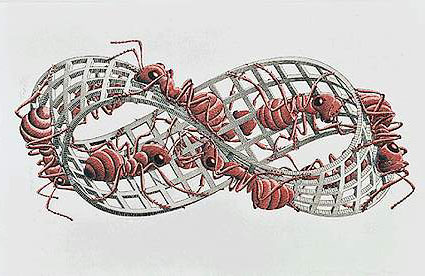
So all this blog was inspired by a good example of new-term. The Cross-Product. Two vectors define a plane. Using the Cross-Product we have a procedure to apparently "create" the 3rd dimension, the Normal to that plane. Likewise living in a 3D world we can prove there is a 4D world by creating the Normal to our 3D world. Any dimension apparently has the tools to bust out of its limitations into new space. The infamous ants walking around their Mobius Strip world just need to calculate the Cross-Product to have a vector pointing outside their world. (Obviously these ants are 3D so they are already aware of the 3D but flat 2D ants in a Mobius world.)  


However actually there is no creating of a "new term" because to calculate the Normal we need to equip our vectors with a 3rd vector before we start! We might be able to show that we get some weird results if we try to do it with just 2 dimensions (e.g. just do part of the calculation using just 2 rows of the matrices) but the break through is not something we can calculate.

As a kid I spent considerably time trying to think of a new "mode of transport." we had flying, swimming, running, walking etc but try and think of a "new one." Novelty it seems is extremely difficult, the boundaries of our world are extremely rigid, the freedom we have exists only within rigid rules. It is like Mozart pushing the limits of Classical. He explored the space but traditional musical history says he never went outside.

Outside is what I call intelligence, and SRH proves, in the same way that Godel showed that self-referential systems are incomplete, that there must be an outside. But how we get there remains illusive and  magical. Even in 21st century we must wait for divine inspiration and the grace of God it seems for such revolutions. 


Thursday, 23 July 2020

The Cabal

If there is a Dominant Narrative (one is the rise of Civilisation and the Battle of the West to overcome oppression and Enlighten the World and the other is the Existence of God and the battle of Good and Evil) then there is a Counter Narrative.

Over the last 30 years the Internet has seen the development of this negation narrative.

It has reached its zenith now in videos like this:
https://www.youtube.com/watch?v=EAOHLw_8m2w

A tight consistent narrative that equals the narrative that came before it.

I have on problem with it, but firstly it is to be applauded in bringing new life to the old challenges of challenging corrupt power and protecting the weak and vulnerable. Although Nietzschians would argue that Power was just Power and the powerful will get away until a greater power brings them down. 

My problem with this new narrative is that it is entirely negative. It tells us what is wrong but not what we can do about it. It is like a Jesus or Messiah exposing the working of the Devil but offering no guide to Goodness of Heaven. Narratives of the Past like Jesus protecting the weak and championing the Good, the Peasants Revolt in 14th Century Britain to overcome Norman oppression, Marxism being the theory of theories about the end of corrupt rule by Feudal Aristocracies, and then Capitalists and many battles by people against corrupt power structures of the millennia have all offered an alternative view of reality. Today there is none.

The best we have is Aliens will save us or Trump and JFK Jnr will save us.

Even Christianity which seems to say that Jesus will save us requires faith and obedience on our part. That it is true is a complex piece of theology: I saw it argued in the Zoom pulpit only a few weeks ago that salvation cannot come from our own hands and we cannot do good deeds expecting God to save us as a result. God is absolute freedom and mysterious as a result: He makes the Laws he doesn't need to obey them. We can hardly argue with St Peter based upon our faultless life, this is not what Goodness is about. It is not a bank account of deeds. As Jesus Himself says pray to God in silence, because if you go to the temple just to be seen by others as pious then that is all you will gain. While those who pray sincerely in silence are the ones that God hears. But if you get angry because God didn't hear you you don't understand prayer or God. It is not an equation, God is not there for deals. He is gracious if we are lucky! However all that said, Jesus gave us a very good idea of how we should live and what allowing the Spirit of God into our hearts is like. There is nothing to expect, and no currency, just an attitude and striving to be more like Jesus.

Yet what of the new narrative? Apart from uncovering the unspeakable evils of the corrupt elites like detectives and putting the State legal system to work to rid them what else is there? What does the new world look like? How are we to behave to make things better, what is the meaning of our life, what should we strive to do? It's actually just the same. And one wonders if its just the same whether the future is just going to be the same. It looks a lot like blaming a small cabal of bad people for the world's wrongs. There are high profile people in the US system being brought to light now for abuse of people. Yet no mention of the vast networks of criminality that span the globe trafficking people from all countries. The immigrant problem is not a problem with people running from oppression in "bad" countries but rather a mature market in human beings being fooled into giving up their life saving to criminal gangs for a better life abroad before ending up being dumped at the gates of foreign powers with no protection or assurance. Many end up in slavery both economic and sexual. This is nothing to do with The Cabal but a deep problem with human beings exploiting each other for personal gain.

The Devil is extremely subtle. He infiltrates the World at all levels. Removing a corrupt global elite will not change this. And Trump is not able to take on the Devil. However he may do a lot to clean up the current corruption in the US and good luck to him. But I suspect we shouldn't hope for too much, and we shouldn't get complacent that things will change by themselves. We need ensure that we are part of that better world, and we need to strive for clear ideas about what a better future looks like.

The current narrative is not enough. A lot more work is needed especially in the area of economic reform.

Saturday, 11 July 2020

Finally Blue Print for the New Economy. Remove Capitalism and allow Monetarism to Flourish.

Abstract: allowing The Democratic State to compete as a lender with the wealthy reestablishes power in the hands of the democratic mass and removes the distortions of an economy run for the rich allowing it to function correctly.

Without going into too much detail on the problems of Capitalism which I've covered over the last few years here, the key problem is the further rewarding of the already rich.

In Capitalism the wealthy have the opportunity to lend at interest. This might be renting a property or a lawn mower, or it may be direct financial assistance with lending for a mortgage.

The obvious problem with this system is that it makes the wealthy more wealthy and pushed the poor further into poverty. If I cannot afford a house in cash I must either take out a mortgage or rent. In either case the wealthy who have spare money can get an income from their extra money, while the poor who do not have enough must on top of this pay the rich. It is an absurd system and one that has been tolerated by some kind of miracle.

So what is the solution?

You get great insights into systems when they break. In 2008 when wild gambling by the wealthy created such huge unpayable gambling debts that the Western financial system was brought to the point of collapse it was the tax payer (as usual) who was called upon to bail out the wealthy. The tax payer is pivotal to the whole economic system. It is the tax payer paying back debt that creates the AAA rated government gilts and bonds that under-pin the whole financial system. And, with the tax payer always there to bail out the financial system, there is unreasonable trust in its products vastly reducing risk and increasing profits for the wealthy. In short the tax payer is continually exploited by the wealthy to keep their system of returns on capital running. Indeed without the tax payer it would collapse and historically, even with the usual level of support by the tax payer, it required extra-ordinary tax-payer measures at least twice.

And again this year 2020 the capitalist system has folded and the tax-payer once again is bailing the system out. But this time unlike in 2008 where the tax-payer bailed out the rich, the tax payer is bailing themselves out! And this is the key, why do we need Capitalism when the tax-payer can finance themselves? Why do we borrow from the rich and make them richer when we can just borrow from our self?

So why does the tax payer host the world's wealthy? What do they gain from it?

Well some would say it is because of banks that I can afford to buy a house. They kindly offered me a mortgage to buy my dream home. But wait. By offering mortgages and flooding the economy with extra money all the banks do is increase the price of houses because everyone can apply for mortgages and so afford to spend more and so the prices go up. This is a classic example of the "tragedy of the commons". Originally conceived to criticise the Commons (which contrary to the argument operated quite successfully) it is more often used by the wealthy to trap the poor. For instance here by offering lending, the wealthy create a system where you are able to spread pay back over time - a kind of reverse saving. Instead of save while not having and buy in the future, it is buy and have now but pay twice as much in the future. But this has the effect of increasing the prices so you force other people to do the same. Eventually prices rise so far that everyone has to borrow even to get what they could afford before, and all this borrowing from Capitalists means they have the extra burden of paying interest to the rich. How the poor must curse that first person who look a loan from a Capitalist and lead everyone who followed into poverty.

Every way you look at Capitalism it is designed to extract wealth from the poor non-capitalists who are also the majority tax payers (by coincidence?).

So the answer is for the nation of tax-payers to take back control of their finances. We can borrow from ourselves! And in so doing also avoid interest payments to the rich on national debt. Any interest paid on this debt goes to the treasury which is owned by the tax-payer! Indeed taxation could be replaced with just interest payments on treasury debts. But rather than the money going to buy a new palace for some rich aristocrat the money exists in the public fund to be used by government for their elected purpose.

Capitalists would argue that if the tax-payer borrows from them-self then what is to stop them just borrowing and never paying back? Nazi Germany running into hyper inflation being an example. The answer is "real economics" rather than some artificial fear of losing a fake Moody rating like AAA. Consider:

If we just borrowed and never paid it back then we would flood the economy with money and this would create inflation. This is called "money printing" and the result is increased prices so people end up paying the debt back anyway but through a quite natural tax of inflation. No need for messing around with VAT or interest rates. Milton Friedman and Monetarism is actually an economics that works perfectly Without Capitalism!

It means we can just ignore the Central Bank. Everything they say becomes irrelevant. Indeed the whole financial system becomes irrelevant. Companies don't need to float shares to raise money, and no-one needs to visit a bank. They simply need to apply to the treasury for a loan.

The treasury being controlled by the Democratic Politicians as a Public entity has its finances completely under scrutiny and transparently available quite unlike the completely closed, very loosely regulated (and therefore criminal) world of private finances.

The Capitalist argument here is that you need to let the wealthy make the decisions because the politicians will use financial decisions for political purposes. But as argued already Monetarism shows us that true economics will always have the last laugh and if the public only ever vote for governments who spend they will face rising prices.

The corollary of this is anathema to Capitalists: a government who saves will lead to falling prices! Deflation is impossible under capitalism because once prices start to fall people start to wait to shop knowing it will be cheaper in the future. This starts to puts the breaks on the economy and prices spiral down, and this hurts the Rich cos their dividends and interest payments start to fall too. The rich will argue that the problem is loss of jobs, but a we've seen in 2020 there is nothing to stop the treasury just paying salaries to keep the economy going. Prices can't drop forever: there are things people must buy. You can't delay food purchases for ever. So deflation actually trims the economy perfectly to keep it efficient and stop unnecessary production. This in a single step solves the whole problem of ecological destruction through unlimited economic growth.

Now a nation with a good economy who can pay off its debt to itself has the opportunity to lend. This is not something in the spirit of this article but the 3rd world has been in bonded labour to the 1st through interest payments to the global rich elite. And the placement of corrupt officials by the British in countries around the world enabled countries everywhere to become drowned in debt. This is usually blamed on the corrupt leaders but never a mention of the installation and support for that leader by the Common-Wealth and the City of London as the money launderer and broker for the corruption. 90% of the world corrupt money goes through the City of London. The wealthy global elite Capitalists don't just rot the UK they rot the world. But if the tax-payer was to continue this exploitation and lend from the treasury rather than the rich then the UK tax-payer would be the beneficiary of those interest payments. The UK properly managed by Democracy rather than by a Plutocratic tyranny of the wealthy could actually become a Capitalist itself and the people of the UK benefit from their finances rather than being exploited to prop up a corrupt system of aristocracy and wealthy which is orders of magnitude more extreme and opulent than any in history.

In summary. By removing capitalism and allowing direct funding by the democratic treasury of the nation so that the rich neither control nor benefit from the economy then a "true economy" will emerge that works by the exact and proper principles laid out in Monetarism. Capitalism in fact damages and distorts economies and does nothing to help anyone but the rich. That simple irrational error of rewarding the rich has created a system that simply doesn't work. And the tax-payer has been exploited in a desperate attempt to protect the rich and make it look like it works. Allowing the tax-payer to be the primary lender in a nation corrects all the biases in an economy which otherwise distort it to favour the rich at the expense of the poor.

Friday, 8 May 2020

Death, fear, Ego and Coronavirus

Having Coronavirus has been a positive experience (the world never gives you anything you are not ready to make use of) as it has seriously broken up much of my complacent thinking and brought me to consider the fundamentals once again. I discover that actually I have learned nothing. But this is the first stage to learning.

So to reiterate the issue that faces us.

I used to think, and it is well documented in the early days of this blog, that death separates people. I used to think that being separated from someone in any way was analogous to death, with death being the final separation. Seeing graves laid out in orderly geometric rank and file with grass between them for the living to walk up and down seemed to illustrate how death robs us of our connections to the world and bites us off into isolation and solitude. Much in fact as lock down, self-isolation and coronavirus seems to have. But it turns out I had it all wrong. Its the other way around!

Death in fact unites us. If one thinks of the world before they were born, it is much the same as after they die. It is just the world. If we had never existed it would be just the world. What we find hard to understand (and I am pursing now with greater focus as I realise this is where the issue lies) is that even when we do exist there is just the world. Nothing is ever made or taken away. Of all the strange places to see this well explained is by Cary Grant in Houseboat (1958).


So far so good, but it doesn't seem to explain anything about myself. The experience I have is not of a single interconnected, joined up, uniform world. What I see is myself separate from a world that lies outside me. This more or less is the ego. When we are born we sprout almost like a flower from a world that is quite unlike us, into a beautiful thing which is apparently totally distinct and unique to itself. This is myself, the I, the ego. And we believe that like the flower this exists quite distinct from the world around it. We might even wish to cut the stem and take this beautiful distinct self with us. But like the flower if we ever do completely separate it from the world around it then it will fade and wither. We are always ultimately connected to the world, even though it does not appear like this.

I like to see the Self as like the Little Mermaid (at least the original, I don't know the Disney version). When she falls in love with a human she seeks a way to walk on Earth rather than swim in the Sea. She is told that this is possible, but the side effect is that every step will feel like walking on broken glass. Her love is so captivating that she makes the sacrifice. Likewise the cost of being an Ego is suffering. We can be a distinct entity, beautiful and unique in our self, but the cost is being separated from the world around us, of not having the things we want and having to struggle for the things we would like, and the anxieties of common isolation and loss and ultimately of Death. The fear of death is the price we have paid for walking as a distinct self. Death will come and when it comes we will lose that separatedness, but our Ego so fears losing itself that it fears being once again returning to the state it had before it was born. So complete is the Egos illusion that it is self-made, without beginning and end, without dependency on the world or any others, complete and perfect in itself; so complete is this illusion, that Death while completely natural becomes a barrier that it cannot bring itself to face. Death becomes a challenge seemingly incomprehensible and unfathomable. We were Dead before we were born, it is hardly that remarkable, mysterious or unfamiliar a place.

However the Ego is completely binding for normal mortals. we cannot escape it easily. I thought after decades I had made progress, but coronavirus made me realise I am no more ready to die than the next person, in fact maybe I'm even more of a coward. It seems completely unfamiliar and impossible to measure or make sense of, a looming shadow filled with who knows what. But this is just my Ego staring into the void it has created by believing it stands alone. It is not a fundamental thing in this world and like everything it was born of this world as will return to it in a quite ordinary cycle, and there will be no loss as nothing was made and nothing destroyed. But to see this, Ego must grasp its own illusory nature, like the moon reflected on a lake we often don't see the water that is really there and get captivated by the other worldly dancing light beneath us. So it is with the ego: this "me" is an other worldly dancing light that can completely entrance us.

And this folds neatly into my oldest preoccupation which is trying to make sense of consciousness. It seems hard to accept that consciousness is actually created by the world around us. When we sleep it flickers out, and when we dream or awake it flickers back. There are drugs we can take that make consciousness switch off. Religious experience and meditation can make our consciousness more focused and able to pierce reality. There are states of consciousness that go beyond space and even world. The highest Jhana goes beyond even existence and non-existence. Hinduism records the Tat Tvam Asi where the illusion of Ego is dissolved and the Self (Atman) is seem to be the same as the Brahman (the world). I need add that I suspect that Self (Atman) is not the same as Ego. Ego is that part of Atman that is defensive, which goes to great lengths (often for no gain or reason) in standing up for itself against things like humiliation or slander. The Atman doesn't care for this cos it knows what it is and nothing outside can change what it is. Jesus dying on the cross is a great reminder of what is not ego. And Jesus also illustrates how Death is not to be feared by those who have escaped the self. But Jesus was also mortal which made the process of dying on the cross no more easy. Its remarkable how his followers were in most cases so much more milling to accept death than even Jesus who suffered a very long night in Gethsemane.

I am aware of these paths of investigation, and I thought I had made progress, but I either got no where or have forgotten it all. Right now I must admit I have no way out of Ego or Self. What coronavirus taught me is that I do not even have Faith. While most of us will never pierce the illusion of Ego or self to see the world as it was before we were born ,and how it will be after we die; the world as it is unchanging and fertile with the possibility of consciousness and selves; we have faith that there is a vast ocean beyond us that supports us like the stem and roots of the flower and provides the light and energy with which we shine out our mortal days. For people such as this death is just the thin veil that divides us from the true world of infinite richness and potential. Death is not something to be feared but simply opening again to the embrace of our maker. No one says it better than the C13th Iranian sage Rumi in his famous poem which brings this blog post, like everything must, to its end... and yet the world will keep going as it always does and absorb back into itself the energy from which this post came.

“Listen, O drop, give yourself up without regret,
and in exchange gain the Ocean.
Listen, O drop, bestow upon yourself this honor,
and in the arms of the Sea be secure.
Who indeed should be so fortunate?
An Ocean wooing a drop!
In God's name, in God's name, sell and buy at once!
Give a drop, and take this Sea full of pearls.”

― Mawlana Jalal-al-Din Rumi

US displaying its Imperialist credentials... yet again

Wanted to know the pattern of UN votes over Venezuela and then got into seeing if ChatGPT could see the obvious pattern of Imperialism here....