Friday, 12 August 2022

What is the Fundamental Truth? Can you grasp it in your hand?

 Not seen it all but its interesting that even our distant original ancestors realised something amazing: the something cannot come from something, it must come from Nothing! Its obvious. 


SRH says this. A theory of something that comes from something doesn't have the power to explain what "something" is. It means that to grasp the true nature of the world we need to grasp what Nothing is. How amazing that Mankind's first foray into thinking the world realised the Truth at its very outset.

It's more interesting that as time has progressed and the body of Human knowledge has grown we seem to have got further away from that initial inception of wisdom.

Science and Modern Economics are fundamentally caught within a bubble of the something. A scientist must discover "something" and in Modern economics you must produce something.

Modern humans are built into a world that expect something from them. They are "useless" if they do not produce something. We are "worthless" if we do not qualify as something.

Well all so well and good, all that focus on something is just a bubble within the infinite unbounded void of the Nothing.

I read "Man's Search for Meaning" by Viktor Frankl and the biggest take home for me was discovering that the camp way of life was actually really good for people's health. I actually borrowed the diet and exercise regime to get fit a while ago. But regarding the Meaning I found nothing.

You cannot really establish a meaning for life by basing your life on something. It is the very grasp for something which seems to be the problem with all these people struggling. It seems little more than the logic of "business", that if you keep busy you won't notice your life slipping away and you can die without ever thinking about it. Capitalism is a great religion cos it gives the illusion that something is happening in your life when actually nothing is happening. You work, you shop, stuff gets done, stuff gets consumed and you are back to where you started in the end wondering what it was all about.

If you really want to get to the bottom of the "something" like our ancient ancestors saw very clearly you need to face the Nothing.

Woo oooo mental gremlins


Isn't Nothing: depressing, boring, dark, evil, unknown, spooky, unsettling, weird...

Ans: Yup


But there is a MASSIVE error in thinking at this point.


Normally politics and advertising and even our own Flight-Or-Fight parasympathetic nervous system divide the world into 2 sides. The good side and the bad side. "If you are not with us then you are against us." Now the problem technically is the False Dilemma. Whenever faced with only 2 options you can be 100% sure there is at least a 3rd option: the "null" option in computer science. When faced with A or B you always have the 3rd option of not choosing at all. That is the essence of freedom!

I often think this reached its zenith in Nazi prison camps. You are given a gun and told to shoot a prisoner. If you don't then the Nazis will shoot everyone. In this case actually there are many options. Shoot the prisoner, but you know that will only inflate the Nazis power and legitimacy and who knows what happens next. Shoot the officer in charge and then you all die, but the Nazis took a big hit. Shoot yourself so you can die blameless, and then everyone dies but not at your hands. And there is also the option of doing nothing and not even playing the game. Yes the Nazis will shoot you all, but I think this is the best option cos it means you just ignored them. The null, the Nothing is by far the most powerful. Lead the Nazis into the terrifying face of the Void! Its interesting isn't it that despite all the work done today to try and remember the horrors of the Holocaust the world doesn't seem that fussed. The sun still rises and life carries on as thought nothing happened. The Void is so powerful it swallows even the Holocaust! Adorno would hate me saying that he wrote a whole philosophy of Negative Dialectics about how mankind was forever divorced from reality now. Surely just a modern retelling of the Garden of Eden?

Anyway so it is that in fact we all die in the hands of the Nothing, the null, the 3rd option that we were running from this way and that way in life. People talk about depression. They run onto the horns of nihilism and emptiness, perhaps they try to kill themselves. Then they run the other way onto the horns of affirmation and life, they try and live as hard as they can. Then perhaps they go the other way. Always getting caught by the Bull.

Actually there is no Bull. We don't have to chose between life and death. Its all our own creation. The Nothing does not drive you one way or the other.

And this is where the misunderstanding lies. Initially we think the Nothing is a removal of everything. We think its the putting of everything in the bin, the destruction and desecration of everything, the making worthless of everything. Absolutely not. The Nothing is just not making the choice. In the Nothing everything is pure, spotless and shines because it remains untouched by the bull. 

Here is a picture of Nothing.


This is a hard one but here is another picture of Nothing:


Here is another


Here is another



Interesting isn't it cos each picture is ALSO a picture of something. A sunrise, a happy baby, bones in a tomb, sun shining through summer leaves. But what do they all have in common? It can't be what makes them something cos that makes them into different things. The thing they all have in common is the Nothing. It's that Nothing that shines through in their Something. The Heart Sutra of Mahayana Buddhism most famously says:

"this Body itself is Void
and Void itself is this Body."

Now this can sound like a load of nonsense. Things either are or are not. But that is the false dilemma of the Bull yet again. How do we grasp the Truth of Nothing when everything we grasp is something. This way or that, but never neither (or both). Well it can't be that hard because our ancestors called upon this Nothing to explain where the world came from. Logically we can see the world can't come from something, all these pictures can't come from the same something because they are different things. They are all different from where they came. And if we ever come up with a common source then where did that come from? Once its something you always have the problem where it came from. You can only stop and have your Creation in the Nothing.

The source and truth of the world cannot be grasped like this or that. But then we struggle with that cos the bull turns up again and says well if it can't be grasped then lets throw it all away.
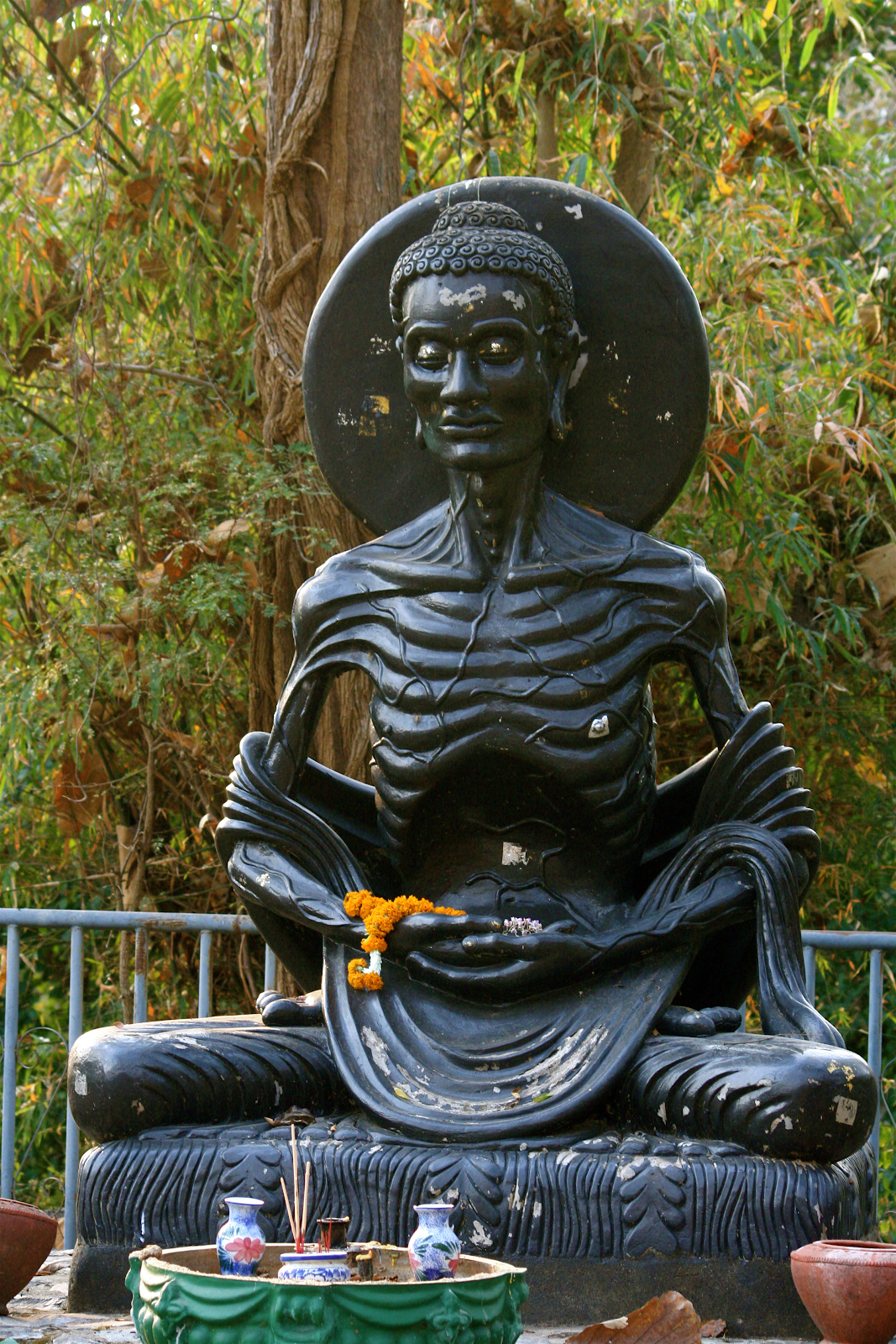


Well no one can be ashamed for thinking that. Even the great spiritual investigators made that mistake. Most famously Buddha thought (in line with the thinking of his age) that the only way to liberate from the something was literally the nothing. Okay he didn't kill himself, but he got very close. The belief is that to separate ourselves from the something we must deny it.

This is an important practice in fact. But its just one the bull horns. The other horn of course are all those people who indulge and affirm the something. Lets enjoy it. In fact both people are being tormented by the same Nazi officer giving them the same binary choice: either indulge or kill yourself.

Well is it any clearer? The truth is Neither, there is no force to chose. But we see Neither and we still throw ourselves into the horn of nihilism. Okay if its neither Indulgence nor Ascetism let me look for something else.

Ok this can go on for a long time. But the emergence of that word "something" brings us back to the top. The problem is this search for something to grasp in our hands. That something can be actual something or denial of something. All those people contemplating suicide are really just rejecting life. When its time to really die, death will come all by itself. If you need to kill yourself its only because really you are living rather well. All those people who throw themselves into self mortifications are really just rejecting their indulgence. You can't get to the Nothing by swinging this way and that. You must stop the twisting one way and then the other.

Start where you are!

That is the only real tangible spiritual truth. If you are indulging no need to self mortify. If you are in poverty no need to struggle for indulgence. If you are living no need to seek death. If you are dying no need to seek life. Be what you are.

Now its interesting that "what you are" when seen like this is the same as Nothing. It is not this way or that way. Humans are not this way or that way. That is why seeing that baby above and seeing Nothing is so hard. We think humans are something, and as soon as they become something we start judge and hanging things on them like good or bad and worthy and worthless, friend or enemy, or whatever we wish to apply. But at root we are not this way or that way. Perhaps some might feel the need to say we are the "potential." We can become this way or that way, but in our soul we are not.

So its an unusual way to think. We are so habituated to grasping, making, doing, becoming, dreaming, but all of it is through the sense of "something." Rarely do we see through the horns of the Bull to the Nothing and the infinite freedom from which all this kaleidoscope of busyness and thingyness comes.

Meditation is exactly this practice of seeing through the apparent something of the world to its source in the Nothing.

So no you can't grasp the fundamental truth of the world in your hand. It will never be a possession of yours. It is not something that comes at the end of a noble quest. Is is not a treasure at the end of the rainbow. As Paul Coelho writes about in The Alchemist the fundamental truth comes when we return to the start, to where we are right now, and ease up the search so we can appreciate what is already here, not judging it as something we want or want to get rid of, not forcing it into a something this way or that, but just opening our palm and letting the world rest there.

Thursday, 11 August 2022

Monkeys and Typewriters and Rewards and Capitalism and Erdos Number

The Infinite Monkey Theorem argues that a random text generator will eventually type out the works of Shakespeare at random. That could be a monkey in a vast random typing pool.

Now the way people think, that Monkey would gain celebrity as the smartest monkey on the planet. How can a monkey have memorised the whole works of Shakespeare in order to type them out you might think, or how can a Monkey even read and write.

But its an obvious problem that not faced with the context we can't actually deduce that much. We might--knowing a bit about monkeys' weak linguistic skills--deduce the monkey was just lucky and from a vast typing pool (given it would take more than the time of many universes to achieve this at random).

But is not the logic of Capitalism like this? We like to argue that rewards are merit driven. But we wouldn't say the monkey above had achieved much merit, yet it would make money (for someone) as it toured chat shows etc. Almost all the great achievements are luck. Its true that people who work hard are more likely to have this luck, but not necessarily. There is no direct connection. Life is a lottery, and its true you need to buy the ticket (get educated and work hard) but after that it is monkeys and type writers.

How many people have worked hard and not achieved greatness or wealth. How many have stumbled on it, or just innately had it like Mozart (which is luck).

A greatest test for true greatness is to repeat the achievement. The "second album test" I would want to call it.

The first achievement is a many to one achievement. From a vast pool of monkeys you get lucky and get selected according to the criteria (say the works of Shakespeare).

This achievement means nothing.

But once you have been selected the pool is now just you. Luck is no longer a factor now. If you can produce a massive second album then the record company knows you are a valuable talent.

So there are 2 stages in any achievement. The 1st being noticed and the 2nd actual achievement. The 1st can be just luck.

If the probability of doing something amazing is p then in a pool of n people the probability that someone does something amazing is '1-(1-p)^n'. That is the 1 - probability that no one does anything amazing.

But in reverse what is the probability of that person doing something amazing. Well it might be p. But there are geniuses so it might be g which is much greater than p.

So it might be that the mass of p achieves fame through randomness and the genius g is sitting there thinking why am I never rewarded!

How would a selector know whether there was a monkey out there who has some reading and writing ability if he was surrounded by many universes worth of random typists who regularly produced the works of Shakespeare at random?

===

Of course this is just one reason why true talent may never be recognised. I feel the more powerful one is to do with how society works. "Its not what you know its who you know." Power is a social thing.

And this is now a new blog about something I realised recently. There is a direct connection between the "weirdo loser" in your area who nobody really knows and the President who is endorsed by millions. And it has nothing to do with talent.

The problem for humans is that we are social and that means we gain security from society. It means that when we meet someone the very first thing we do is reference them with the society's opinion of them. If we are at a party we know already that the host has invited the guests and so they have passed the social status thing. But if we meet a complete stranger we are potentially a bit suspicious because they have not been vetted. We would not trust a stranger with a £100 loan, but we would someone at the party. Similarly in the vapid world of social media we look at the number of subs or likes and immediately form an opinion about this person simply upon their social status. The content may be rubbish, but its socially vetted and that feels good. We feel like we "belong." Usually "belonging" is considered a thing-in-itself in some weak hug-a-thon but I'm suggesting here its real meaning lies in establishing how people will see us. I may have few likes myself, but at least if I hang with people with may many likes and perhaps Holy Grail even get a sub from someone with more likes than me I am going up in the world. So its not so much about "belonging" as establishing your status (a pointless game if you ask me) but a game all the same.

On an aside doesn't all the grief associated with Social Media stem from this game of being liked? You may get bullied on social media, but if you are honest didn't you start this by setting out to be liked? You should deal with that need to be liked before going on social media cos if anyone finds out you want to be liked they are just going to use it by other people who want to be liked and can use you as a stepping stone up in the world. Consider how many likes the bullies get! The best way to beat a bully is to deny them the likes and you do that by not giving a shit. Okay that is hard, its an act mostly, but you need be honest with at least yourself. You wanted likes and you didn't get them. Now why do you want likes? Will likes make you a better person? No! No one ever became better by gaining anything. Really the best way is to give likes, honestly and sincerely, and not expect any in return. But that requires a full and deep investigation of self and existence so its the King's Way indeed! 

Anyway its no accident that a political organisation is called a "party." It is purely a social vetting process. "Oh you know A who is famous" that bumps you up the social network. In maths there is the Erdos Number which is the research equivalent. Someone who knows people at at the top we think we can trust simply because so many other people trust then. To be at the top means you have been vetted by a lot of people. And in return the risk of scandal means you have a lot to lose, so you might not be as likely to cheat.

However unfortunately its not such a pure system because with power comes corruption. People may turn a blind eye to corruption in order to rise the ranks themselves. You might vet someone just to improve your own status without it actually corresponding to talent. And so invariably the people at the "top" are not the most talented. They have simply risen in a game where everyone else is playing the same game.

This is much more likely the reason that the genius does not gain reward. They may indeed be a super talented person but if they are the lone "weirdo" who hasn't managed to make social connections and get a network of vetting then they are much more likely to be overlooked and never see achievement or reward.

Nothing essentially bad about that, its the way it is. But it raises questions about the "justification" of Capitalism that it rewards the talented. No it doesn't. It rewards the "successful" which is often quite different.

I think there is a lot of resentment amongst the true talents that often because of quite arbitrary and irrelevant things like social skills they get overlooked. Its a testament to Socialism and Government that it often provides avenues for such people. Alan Turing, of Enigma fame, being one. He was so socially unskilled that he almost failed to achieve anything. But he was at Cambridge and got noticed by the famous Von Neuman who championed him and enabled him to gain success most importantly being selected to work at Bletchley Park by the British Government and the rest is history. Of course that same government gave him a death sentence because of ignorant (by modern standards) laws against homosexuality at the time. But Turing is himself  is a classic example of talent not being fully recognised. There were many talented people at Bletchley and in my mind the most over looked is Tommy Flowers. I bet almost no one has heard of him, and yet he designed and built the first programmable computer. And what is most remarkable is his work was so fastidious and accurate that it worked first time! What a towering talent. People can barely get a program to work first time these days.  And it is Turing who seems to have stolen that fame cos all Turing did was design the Bombe which just checked combinations of enigma codes. And in fact the breakthrough I believe was suggested by Gordon Welchman who realised that feeding the output back in to create loops of related codes massively increased the chance of finding the Enigma settings. This is the basis of Rainbow Tables used in cracking hashes today. The genius logic is captured in the 100 Prisoners Problem.

So clearly no monkeys and typewriters here. All incredible people at the height of their game. But what actually is the role of luck here. It seems with Turing he does have a string of ground breaking papers to his name, so he was not a one hit wonder. But how do we know there were not even more talented people out there who never got noticed and never had any success. Perhaps in an attic one day a box of scribbled notes will be found written by a Patent Clerk (Einstein was a patent clerk!) which turns out too be utterly ground breaking.

Monday, 8 August 2022

Is Love Worth It?

 Just watched a doco on North India and they explained the myth of Taj Mahal. Many people think its a sign of the undying love of Shah Jahan for his favourite wife Mumtaz Mahal. It seems to me that it means the Crown of Mahal given that was her name. But this is clearly anachronistic. All these crazy modern ideas of love are really recent and come from Western Culture via the Romantics and the Medaeval French Troubadours and European codes of Chivalry. The primary relationship between women and men has always been around childbirth (obviously) and their relationship has been about this. Love if anything was just the duty associated with being faithful and generating children of known parentage.

In the days of the Taj Mahal it was a Mausoleum that symbolised the belief in Paradise after death. More complex and given that Mogul architecture and gardens were an expression of power it also served to cement the authority and power of the Emperor and his Empress.

Today though it is sad to see so many people absorbed into this new culture of Love. What is the point? What do people hope to achieve?

This blog documents my own struggle with this and the loss of "my muse." But now many years later I see that as the painful extraction of myself from this modern delusion of Love.

For me at the time the "union of souls" was an important step in person and spiritual development. I believed that romantic love was a gateway towards liberation from the self and enlightenment. A potent myth that made it very much more difficult to extract myself.

I have realised since that this is the worst type of nonsense. How can enlightenment lie in the mortal and condition soil of a romantic relationship. As if the point out the fragile foundations of this belief she died. What a blessing in retrospect. A short and sharp lesson of the futility of this belief.

So the usual approach is to not learn ones lesson and go in search of more union. Now this works if the goal is just childbirth and family. But if the goal is spiritual its an fast lesson in the fact this is not the way to anything worthwhile and lasting.

To add weight to the illusion I was also aware that we had had previously known each other somehow and that this was not the first time we had been attracted, and I knew the day we met that she would die. The sense of the "eternal" and the infallibility of love are integral to this illusion. But if Love is eternal why do we then have children in order to survive our deaths? There is a huge irony here. we have romantic relationship and form families precisely because we are not immortal and love is not eternal. Now it may well be that like Hungry Ghosts 餓鬼 after death we are not satisfied and go in search of what we still desire. Without a body to satisfy this we are in serious trouble. And then when we finally get born into a body and go in search of our still present desire we end up in my situation. But this is not romantic is it? It is insanity. What is the purpose of all this struggle to attain our desire? Is it not easier to be rid of all this trouble? So hopefully my change of heart has freed me from this many lifetimes struggle and hopefully that would free "my muse"... altho I always thought she was smarter than this and it was me being trapped in the loop.

In answer to the initial question, how can love be worth this?

Now what makes it more complex is ego. Much written in this blog about self and ego. It can be seen that even my desire for "my muse" was mixed up with investigations into self and ego. SRH even predates "my muse" she was almost the physical manifestation of SRH. You cannot enlighten by yourself, it must be done in relation to the "other". That in fact is Original SRH. But this all predates all of this by at least a decade in my conscious stream.

Problem with Love and Ego is that while Love should be the manifestation of a selflessness and the giving to another--which comes to its extreme in Chivalrous Love where the self fully submits to the object of love-- in fact Love can often become a reinforcement of the self. Its a displacement of self onto the partner. It is still self but like Narcissus it is a reflection of the self. The partner is loved only as long as the partner returns that love. When the narcistic illusion is broken it turns nasty, jealous and vindictive. All those women taking revenge on their cheating partners: this is not love, it is narcissism, it is just manifestation of self.

True love is what a mother shows for her child. It is about giving and humility. But a cynic would say of course it is their child so it is still selfish. But it is a start. True love involved liberation from the ego. Which was my original motivation for involvement in Romantic Love. But that is not the best way to liberation. Its like a moth looking for food in honey. If its lucky it will get a meal. But the honey is a huge trap that you need to be very skilful not to get trapped in.

Now there is nothing wrong with Romantic relationships. we get involved in them, like many things for reasons that change as time goes on. Perhaps we get someone pregnant and are forced to marry them. Its as good a reason for a marriage as any. In fact it might be a good one cos there are no illusions, the partners know from the start its about giving and sacrifice. But there may be a desire for romantic desire itself and the belief that without this heady cocktail of brain chemicals somehow the relationship is inferior and a waste of time for the partners. This is where the modern myth of love starts to rear its ugly head. What a load of nonsense. If we want a drugs hit then just go and do drugs, in particular heroine. And then get ready for the enlightenment someone I know when through: that if these feelings are that easy to make then what is the point in these feelings? Suddenly the whole post 1960s drug fuelled world of nonsense we have created in the West creaks and starts to fall.

Its such a perfect pile of nonsense I've started to wonder if it hasn't been perfectly engineered as a social control program. Get everyone worrying about pointless relationships and then they won't bother with politics and freedom. The irony too is that with all this focus on so called "love" these days actual populations in the West are falling. How does that work? One just as to look at "Love Island" to see the futility and self grooming nature of it all.

Now for Love addicts (of which I was one) this is terribly nihilistic. All the joy of life looks like it is being sucked out and replaced with a grey ashen sky of dull lonely unexciting misery.

Well partly yes. And its rather Matrix here. You need to go cold turkey to get out of this pile of pointless nonsense. And what is the motivation? Well you can get all those feelings and many more back on the other side but for free without being dependent on whether relationships work or not, and without always worrying about whether "you" are succeeding or failing to get what you want.

I read some comments on a Youtube video today about how Viktor Frankl's book saved them from suicide. Admittedly suicide makes no sense to me (surely being alive is the greatest gift already, what else could you want and what can killing yourself achieve? People die everyday and it makes no difference to anyone. If you think your life is pointless or you've got to the end of the road then yes kill yourself and be even more pointless and take an even more pointless road. Plus you will be reborn in an even worse state so don't think its a way of avoiding things). But it seems people need "something" to fill their lives otherwise they think they are empty. So we fall in Love to fill the void. Poor person we fall in love with, for they are just a butt plug to fill someone else's empty void.

Well just know there is no void, its nonsense. If we ever feel the void, and I have felt at times like being sucked down into a dark hole that dims the very light of my soul and existence (think it might be linked to low sugar amongst other things), then know that fundamental Buddhist thing that whatever that phenomenon is it hasn't always been there. It has started and it will end. The void is actually only temporary! You can't stop it being filled, even if that butt plug is plain fascination with what the void itself is! And now we are in SRH territory. Consider the Least Interesting Number paradox. Whatever number you decide is the smallest not interesting number becomes an interesting number. Equally try and go into the void and all voids, the deepest darkest emptiest despair in your soul and realise once you are there you just filled it so its no longer empty ;-) Its a nonsense.

What causes this darkness is a probably a toxic mix of guilt, anger, greed and ego. well these are all temporary things and we will find they completely fill what we thought was empty. And knowing that provides the sign post out of the pit if we want to work our way out. Or we can just wait and it will go away by itself as nothing lasts forever. That last bit is a struggle for the Ego, we think "why me", "why am I suffering and other people are not", "I don't like suffering I want it gone now." All brilliant demonstrations of Ego. All "bad times" provide us with the most vivid demonstrations of what we need to learn, but we rarely see the opportunity and usually default to the mistakes we made before. "Bad times" are really the "best times" cos used well we will progress faster to freedom than at any literally any other time. 

Now interestingly Peter 1 in Chapter 4 verse 8 says "Above all, love one another deeply, because love covers over a multitude of sins." But this is 2000 years ago long before the age of nonsense love we live in today. For Peter love is not a selfish desire for kicks and self-affirmation. Love is genuinely wanting other people to be happy and to see them free from all distress and worries. Now that original type of love is profoundly worth it! Just imagine for a second there are people out there who actually give a genuine shit about you! For the religious God does for sure. For the atheists then know there are some extraordinary kind souls around even if you have never met them or let them in yet. Such souls are the true souls who have found liberation themselves. You can bask in the joy of knowing them, or that they exist, or better seek the freedom to love properly oneself.

Joy of Poverty

 It possibly seems weird that the blog got stuck with this name. What has that to do with discussion of self-reference, existence and such things.

Well the point is that the blog should be heading towards an appreciation of the innate given nature of the world. We don't need to gain anything to have it all. Well Capitalism will try and trip us up and make us think we need stuff, but surely we grow weary of this way of thinking pretty quick. How many cycles of getting something "new" do we need to go through to realise that eventually it will be "old" and we will be wanting a new one for ever. There is no end to this. All material gain like this is tainted. And like girlfriends a new girlfriend is some one else old girlfriend. The only way to end this is to stick with what you have and appreciate it. And you can do that at the start and save all the effort.

So appreciate what you have. And that means looking at what is already here. This is now science rather than technology. Why make new things, we already have everything we need. It we don't then we're dead already! And if we are not dead we already have everything we need.

Now when we turn into the world and look at is as it is, we then face this "self" issue and we try to own that instead. So problems occur. But we're in the blog now and enjoying things the way they are and the poverty of that.


Use & Mention, Context, Self-Reference and Null

 Use & Mention is widely used in logic and text. 

https://en.wikipedia.org/wiki/Use%E2%80%93mention_distinction#In_philosophy

Apparently even Mediaeval philosophy was aware of this problem where it was named Suppositio or substitution. Things can be referred to in different ways depending on the context (see previous post). So in fact self-reference is impossible by itself as the referent needs a context to determine how the referent is to be treated.


But it happens in all places where there is meaning. Famously Magritte refers to the ambiguity present with a painting of a pipe. Indeed in one sense it is a pipe (its not a pig is it) but in another sense no it isn't as you would not get far trying to smoke tobacco in this pipe.


Now we live in a world of media. And as media gets more realistic we start to confuse this use/mention distinction more and more.


Surely these are actually pipes? Well no of course they are not, you can't smoke them, not the ones of this mage anyway. What the brain very quickly does is substitute these [pictures for a thought about real pipes. We "imagine" smoking them and so they become real. But drop the imagination. They are just pictures and no one reading this is able to even hold them. Such is the rapid movement of the mind, and its ability to quickly confuse!

So what about a pipe in VR. We can pick it up then and we can even smoke it. We'll we think we can, but in reality we are just sitting in a VR headset with haptic gloves on. we are being tricked we are not actually smoking anything. The computer is mentioning pipe just like Magritte.

So what about The Matrix. We were born with the headset on and so our reality is VR. Well this doesn't quite work either because the language we use contains words like VR and haptic and we might end up asking what they are and then we can start to realise that there may be a reality.

So what if we are in VR now? Well same thing what do the words VR and Haptic mean?

Well what if we put the VR headset on in a super Virtual Reality. Now we are entering the world of SRH. Once something depends upon itself it also becomes meaningless. If you try and construct reality in terms of Virtual Reality, and Virtual Reality itself is part of that Reality then you are in a loop.

There must be an actual reality for Virtual Reality to exist! Now we may have been fooled into thinking the Virtual Reality is Reality but actually that is the meaning of Reality. Morpheus needs to exist for Virtual Reality to exist! No Morpheus then no Virtual Reality. You can't be fooled by something that you can never know!

The problem with "brains in tanks" thought experiments is that we are told about the "brains in tanks" first and then asked to consider whether the brains know. We know that these brains are not an analogy of ourselves because those brain doesn't know and we do. But we are supposed to then forget the opening axiom that we are brains in tanks, and then starting from the fact we can't tell we are brains in tanks deduce we are brains in tanks. That is analogous to start with 5 (brains in tanks). Multiply by 0 to get 0 (lets forget we are brains in tanks). Then divide by 0 to get 5 (lets start from the fact we wouldn't know we are brains in tanks and deduce we are brains in tanks). We forget that 0/0 can be anything. Right now you can imagine you are really a butterfly or anything you like. As long as you wouldn't know you can invent anything. Occam's Razor was designed specifically to rid all this time wasting irrelevance, and clean up our thinking. If your ontology is undefined and enables you to pluck something out at random (0/0 in our maths example) then really your are just exploring what you already know. Let me pluck out a Unicorn. As long as Unicorns don't know they are Unicorns then I am a Unicorn QED.

So in all things thoughts, words, pictures, videos, computer simulation literally anything that is supposed to represent something else we have a context and we must pay attention to that context in order for the reference to gain its meaning.

This is Wittgenstein and language games. Just as a ball can be used in a multitude of games with different rules, so references can too. "pipe" is a word. Here it is in quotes to refer to the context of the word itself. But "I've never smoked a pipe" is a mention of a sentence where the context is a reference to a real pipe in general.

Now the real point of interest is the sentence "I am false." That "I" is making a reference and seemingly making unequivocal reference to the sentence itself.

But there are language rules, and context to navigate from the word "I" to get back to the sentence. You can't just substitute one for the other without going through the context and meaning.

Now in computers and logic substitution is virtually treated as a zero step operation. Its so axiomatic and obvious that it just happens. But if we can show that no substitution can take place without context then its a 1 step operation, and that step enables ambiguity to occur.

In reality our thought process goes:

"I am false"

Someone who has never seen this before may think "so what" and they move on. But depending on IQ they may follow the direction of the reference. "What is false?" And then they see that the sentence is false. Ok the sentence is false, big deal. But then again depending on IQ they see the problem that if the sentence is false that contradicts their opening assumption that the sentence was making a true statement. Oh wait a second they think "I assumed the sentence was true, but if its true then it is contradicting my opening assumption. So it must be false. But if its false then (assuming a binary logic) it must be true, which also contradicts the opening assumption. So there are no opening assumptions on its truth that do not lead to contradiction.

Now there is quite a lot of "process" and context and meaning going in here. Its not an atomic issue.

#TODO run out of time.

Just note what if English Language is tristate. True/False/Null. So we can just assume its nonsense and then put the statement in the bin without issue.

But if English is like this then "I do not what to get out of the boat" does not necessarily mean I want to say in the boat.

In fact English is like this. You get asked "Do you want Fish and Chips?" and when you say "no" it just means you want something else. Normally if we don't want to eat anything we would say "no, I'm not hungry" to illustrate that the "null" is not within the context of the "menu" but in the context of "eating" all together.

So there are levels of Context to negotiate. It is very like computer code where Context is identical to "scope" and scope can be nested, or even recursive.

So when we read "I am false" we actually read it in the same way as we read a menu when we don't want to eat.

Also of interest is "I am true." Like the "I am false" it doesn't matter what your opening assumption is. If you think it is true, then it works. If you think it is false then it works to "I am true" is false if you think it is false! So we should read this the same way as we do "I am false."

This is just rehashing in different language the same conclusions as Tarski, Godel and Turing about undecidability.

Saturday, 6 August 2022

It, Self and Context

 SO the statement:

"it is large"

is no use by itself ordinarily.

∃x | x is large

What language normally does is establish a context, like a context in software e.g. graphics context, that hold the state of the "conversation."

Conversations occur in separate statements and these are "held together" by a context.

So in normal language we would never say "it is large" by itself. The "it" refers to something that is held in context. If we had dipped into a book we would look back in the text to find the reference to "it" to find out its name. 

So "∃x | x is large" is not a natural representation of "it is large" it is not sufficient to note that "something is large" in natural language we seek a name for x. Just checking for "horned rabbits. "it is large" is problematic is we assume it always refers to something. Perhaps the context was not filled in correctly. We look back and see that "it" is a "horned rabbit" and we realise that "it" does not really refer to anything. But the mechanism of it is still to consult the context, or the passed history of the statement stream.

Now let me borrow from Plato and write thinks in Context with a capitalism like forms. So I might say lets eat pizza tonight. And then conversation occurs about Pizza (in capitals) so that "it is very good from a certain restaurant."

Now with Context in mind (ironic as we just put context into the context of this blog, and irony is only possible through context - you say one thing but the context says the opposite and we all know it was intended that way -- as a greater context?) what about "this is false."

"Jane said 'this is very expensive'" ("Jane said '∃x | x is expensive'") is not very useful by itself. If we had opened a book we might turn back a page to find out what Jane was talking about. So "this" is in the context.

So "Jane said 'this is false'" refers to something which is known to those in context but not know to those outside the context. Perhaps Jane is referring to a piece of paper she has just read, or something someone has just said to her.

Now "This sentence is false". It looks like we don't need to turn back the page to find out the context because "this" must be the sentence itself. But this is ambiguous. It may be the same situation as above. We turn back a page and see that Jane has been handed a piece of paper with a false statement on it.

So "this" actually depends upon context!

So you can create a direct self-reference without ambiguity. You need a context to complete the reference.

Take Godel: something like (this is not formal nor correct) "x is not provable && x = Godel#(x)" so with the fixed point of x we have a sentence being given its own Godel number. If it has a Godel number then it is a valid statement, but the sentence says it is not provable or derivable within the rules.

Now I need to reread the paper again (#TODO), but I don't think its obvious what Beq says without context. You need a logician reading the proof for the problem to occur. There is no sentence by itself, that refers to itself unambiguously Now that is OSRH extraordinaire. The idea that a sentence cannot be its own meaning. It occurs within the context of a language community and a culture, and a la Wittgenstein language MUST BE used. The usage of a language MUST be outside the meaning. Don't we get Tarski like contradictions if we allow statements to be constructed by themselves. https://en.wikipedia.org/wiki/Tarski%27s_undefinability_theorem#:~:text=Tarski's%20undefinability%20theorem%2C%20stated%20and,cannot%20be%20defined%20in%20arithmetic.

Anyway out of time.


Context is a necessary shadow of statements. And OSRH was looking for a proof that the Context could not be expressed within a system, or similarly no statement could exist without context.

Bit more:

A statement like "Jane has blond hair" is absolutely fine. We know how to speak the language and it draws us into a world where we know the kind of situations where this is true." we can now paint a picture of Jane and obey this description with no problem. The problems for SRH  occur when we say "this has blond hair" and this could be covered by the domain. So its absurd no sentence even has hair, but the door is open to bigger problems. A la Magritte "This is not a sentence". "this" now falls within the domain and could be the sentence itself. But without context we don't know and that is important.

OK missed one example. "I am false" in English "I" is not ambiguous. It means specifically the case where "this" is pointing at itself. You can imagine a quaint Gollum like language where people refer to themselves as "this" so it does work. This the problem of Anatta in Buddhism. Buddha says there is no "I" that exists without context. You can't have a self supporting solipsistic narcissist. Their conversation with themselves might go:

I exist!
Well who says so?
Well me obviously
And by what authority do you to say this?
Well am I not saying it, doesn't that prove I exist

Buddha says no. It is true that you are saying it, in that it is being said. But you can't deduce from that it is said by "you"**. Heraclitus would say here that by the time you try and point the toe at the "river" who said it, the river has changed (You can't stick your toe in the same river twice cos the second time you stick your toe in the river has flowed and so has changed, and actually so has your toe, and so have you!). 

** I notice a subtle ambiguity in language here. The school teacher says "right silence in class" and you shout out "loser." And the teacher says "ok who said that." Now it is quite right that you said it and the teacher is after you now. Perhaps teachers says "ok no one is going home until the person who called me a loser owns up". So class sits there (how often has this happened). Eventually teacher wants to go home so class dismissed. But perhaps teachers puts everyone in detention. Now you are unpopular and there is no doubt there is a "you" here and you get blamed for everyone in after school. But this is a social "you" teacher wants to know who, and your class mates know who. Everyone is playing this game.

This is very different from the self that Buddha is talking about. You are cast onto a desert island alone and you sit on the sand and think "oh no I am in trouble now." After a year of being alone what is the use of this "me"... there is no one else. What would you need a self? "I'm going off to bathe in the sea" seriously what is the point of this there is just you so no need for the "I". We would just think "time to bathe in sea." And we would bathe end of. Perhaps we would think "oops forgot to get fire wood to cook tonight" and we would "go get firewood." But would we think "you loser you are always forgetting stuff." Well perhaps we might be annoyed or scared if its getting dark and we must go the night without a fire. True we could end up hating our self for being an idiot. But it is different from the class room cos this is just us. We might make a resolution to not forget again and then its over." The "self" does not dwell about. In a few weeks we think back to the dangerous night slept in the dark without firewood and celebrate we survived it. There is no "fixed" self being carried around, because there is no society to remember and fix it for us. But actually society doesn't really do this, we project a fixed self onto other people. We think they have a fixed view of us, think we have to pretend to be whoever we think they think we are. Pretend to make some fixed thing. Its true in a way with long term, relationships that we feel a need to maintain the relationship, but a real relationship allows us to change and not be a fixed self. And that is also the true relationship we have with our self. It changes all the time.

So there is a subtle ambiguity in language that when teacher says "you said that" it can be perfectly correct that I said "loser", I mean no one else did, so it was me. But that is different from saying my "soul" said it. "you" does not create a fixed soul called me. Abraham Lincoln said “Folks are usually about as happy as they make their minds up to be.” but we don't deduce that Abraham Lincoln is still alive. So we can say that I said "loser" to the teacher yesterday but it doesn't mean I must exist today. It can be "me" without me actually still existing. The "me" only exists while its being said!! Language somehow seems to suggest there is a "person" that exists as long as the sentence so that when asked who said that we can tell who it was. But that "who" is long gone!!

So while "I am false" suggests a permanent self existing self actually its not that fixed and it does not exist outside context.

ok definitely out of time


Wednesday, 3 August 2022

James Webb Telescope and Everything


James Web first Deep Field. Not in any way diminishing the amazing achievement but something the West has lost sight of is that the mind is greater than anything like this. As the Hindus say nothing moves faster than the mind. It can get to the edge of the universe almost instantly and can travel before the start of the universe with no effort or cost.

Nonsense say the materialists. Look how hard it has been to get a telescope powerful enough to see almost to the edge and start of the universe (light only travelling so fast so the further you look the further back you look too). In this photo are galaxies as they looked 13.5 billion years ago, only a few hundred millions years after the beginning of time! They are still embryonic and poorly formed. 


What an amazing achievement and what a privileged insight into the world. We are almost staring at God himself and the moment of creation. We must be closer to understanding how the world formed.

But look at this picture of a fern frond before it unfolds.


So its not a photo of something as it was 13.5 billion years ago, it is just a few years perhaps. But both the fern and the galaxies are just pictures. And in both cases we are left with the question how did that come to exist?

Now we are trained to think our way out of this. Big Bang we say. The galaxies and the fern were created by the Big Bang. There was nothing and then by quantum fluctuation a universe exploded into existence beginning both space and time. And the universe has been inflating ever since, like a huge 3D air balloon. On an aside its tempting to think that Time is driven by this expansion too but I looked it up and the expansion of space depends upon a fixed time in the models.

There was no "before" the big bang, and the big bang occurred "everywhere". At the start everything was compressed into a point. That means that the space on your left and right were both in the same place at the start of time. Big bang was everywhere. That is why the background radiation is everywhere. Big bang created every bit of space.

Now it all great "ideas" but note we are back to mind now :O All the work done by James Webb is not so important. All the data and pictures it sends us are not really different from the fern. Something happened to create the universe is all we really know from all these picture, and the mystery of that creation is present in everything everywhere!

But true evidence was found that led to the idea of the big bang.

But now the real Big Kahuna Burger issue which has been known since forever. In the Mediaeval it was the a proof of God. Cause and Effect means that for every effect there is a cause. What was the cause of the Universe? You either have an infinite chain of causation forever or you have a "First Mover." JudeoChristian take the First Mover.  Buddhism actually takes the infinite past (tho that is just a mechanism to get you back into the Present rather than a "theory"). Yet the larger problem exists which is SRH in this blog. Whatever structures or ideas you identify as fundamental will always pose a new problem. Why this way and not another? At college we jokingly called that Q. The fundamental theorem must be atomic. If it was Q = 2 H we would have a new question of the universe why is there a 2 in there.

Now suppose there was a Universal Theorem of Everything of form F. To be Complete it needs to explain itself, or be a theory about itself. It needs to provide the foundation for why it has the form it has.

In previous blog raised 2 types of SRH. I'll do that again but they are Constructivist and Consistent theories.

A Constructivist Theory of Everything must provide a foundation for itself. This is OSRH (Original SRH) and that it seems is a problem. If your axiom is A and you build a theory out of A you still haven't explained A.

Consider a fractal like Manadlebrot: Z -> Z^2 + C where the set is all those values of complex C that do not diverge to infinity, and the pretty colours we see in diagrams are the number of cycles to escape 2. Now it looks like an infinite amount of structure comes from no where. Such a simple definition creates infinite complexity. But that is an illusion. It's a recursive definition and each recursion provides a less than trivial problem to solve. Iteration (i1) C = 0 is easy. (i2) C^2 + C = 0 (i3) (C^2 + C)^2 + C = 0 is now less than trivial and so it goes on. I believe the Mandelbrot Set is the Union of all the fixed points of this series?? #TODO. So all that complexity comes out of complex structure of the definition. Its deceptively simple. And while the definition is recursive Z -> Z^2 + C this simple axiom and recursion never get added to replaced. You start with Z -> Z^2 + C and you end with it. It is never "explained" by the Mandelbrot set.

Alternatively a Consistent Theory of Everything simply needs to build a theory such that it does not contradict itself. What you are left with is a candidate for the Theory of Everything, and if you can show that all other candidates are self contradictory you have the theory. This is very Kantian Categorical Imperative.

But again we are in the Mind. Returning to the top, what modern science has lost track of is that the Mind is the key feature here and you do not need multi Billion space telescopes to explore the Mind. Our mind is with us right now as we read this, it is the canvas on which the ideas and the world are painted.

Now Mind is a complex word, and I believe and am investigating that Sanskrit makes a load of distinctions. Initially note that Minds themselves exist. Sometimes we have a lazy mind, sometime a sharp mind, sometimes a bad tempered mind, sometimes a warm and kind mind, sometimes hateful, sometime loving, sometimes interested, sometimes bored and so on. But all these states of mind exist themselves and they come and go. When Buddha says "With our Minds we Make The World" he means this. When we are in a bad mood look at the mind state that is a bad mood, do not look at the world. The world is neither a bad mood nor a good mood; a mood is a mind state. The way the world is, its actually a mind state. This is the meaning of karma. When things turn bad., its the mind and why do we get bad mind states? That is down to what we have done to our minds in the past.

But there are more profound meanings of Mind. If we start the day in bad mood and then it goes and we get into a good mood the mood has changed but "I" haven't. I was in a bad mood, the mood has changed and now I am in a good mood. It is like I was wearing a raincoat and now I am wearing a summer jacket. So the mood is not us. Moods are like clouds across a sky: the sky is unaffected. Now this Sky is a really profound mind indeed.

Religious people are unique in that if religion is done well they start to see the Sky. Its no accident that the main god is the sky god in most? religions. Perhaps that is faith in God or perhaps that is something else. But Religious people are not so affected by the things or clouds. Someone insults them on the way to work. This can put us in a bad mood. But the religious person knows this bad mood is not so important and perhaps they forgive the insulting person, or perhaps they let go of the bad mood to focus on compassion and concern for why the person was so angry with them. And that might be trivial in the sense of "what have I done wrong" or more profound as in "how can I help them." But however people achieve it the religious path is opening our minds and hearts to the sky and that lets us see the clouds come and go more freely. I say religious, plenty of people do this without an formal "religion." I say religious just to indicate this type of approach not the hymns, prayers, chanting, good deeds whatever of a specific practice.

Shall we call that Cloud Mind and Sky Mind. There are others even more profound but this is enough for the blog. Pictures of galaxies and ferns are cloud mind. We look at one and think what we think, we look at the other and think what we think. Clouds come and go.

But the Sky Mind is always present. It is present as we investigate picture of galaxies and when we investigate pictures of ferns. It is present right now as we read these words and have any thoughts they create.

Now in the Theory of Everything don't we need to factor in Sky Mind? How can a space telescope help us here? Sky Mind is always with us. It was with us before we knew the Theory of Everything and it will be with us after. In fact searching for the Theory of Everything can change nothing. Surely Everything must include the Past. And so it must have been true in the Past as well as the Future.

So the Theory of Everything that is discovered in the Future is a contradiction cos it doesn't explain where it was in the Past. Self-Reference really is very "self?" destructive. (That is the current avenue for SRH if self reference is destructive then is it self destructive?)

And I will wind this once again long blog up. But pictures from James web are incredible in one way, but they are limited in what they can achieve, because pictures of a humble fern are profound and amazing too and also raise the same identical questions about the nature of existence, creation and Everything. How did it all get here?

US displaying its Imperialist credentials... yet again

Wanted to know the pattern of UN votes over Venezuela and then got into seeing if ChatGPT could see the obvious pattern of Imperialism here....