It makes sense. Railways are wildlife corridors and add stability to the environment. Unlike roads which severely damage the environment. Yet another reason to use the train, and pressure government to include raiways rather than roads in their plans.
Friday, 31 July 2020
Railways & Wildlife Corridors
As a kid I remember disused railway tracks as the best places for wildlife especially reptiles. I've noticed now that areas adjacent to railways are also high in reptile numbers. Our local foxes like to nursery their cubs on the railway. I suppose it is the safest and most peaceful place. Trains after all don't make contact with the ground and you rarely see wildlife electrified. Compared with a road that is a busy, noisy, dangerous and highly polluted place.


Wednesday, 29 July 2020
Violence Breeds Violence: proof
Courtesy of BBC in depth interviews regarding the Iraq war in Once Upon a Time in Iraq
"Some people say violence leads to violence, I say controlled violence leads to no more violence"
Except one problem. When Sassaman experienced "uncontrolled violence" and the death of his friend he become more violent, and less controlled. So obviously his enemy would have become more violent when they lost their friend also.
The only way to stop violence is "turn the other cheek". Someone somewhere has to take the violence and not escalate it.
Its a weird thing that the "just" always think that they aren't the ones who should experience violence. You just need to hear the US administration crying over every single American death. Such mentality and behaviour is the cause of violence. America is a source of violence, because it hasn't learned to "turn the other cheek."
In contrast you see those people prepared to forgive, who have the integrity and strength to experience suffering and violence yet still maintaining compassion for their oppressor. They are true Christians who have heard the message of Christ and have rejected the temptation to violence handed out by the Devil. The just are always those who feel they are not worthy, never the person armed with a gun who wants to defend what is right.
So is violence good for nothing?
Pax Romana as it was called was the peace that came with the Roman Empire. Episode 4 of the BBC Iraq series has an interview with a man who says he chose to live amongst Al Qaida because you knew who the enemy was and you were otherwise safe. In other parts of Iraq where there was civil war and chaos you had no idea who the enemy nor the danger was.
A strong military presence brings a kind of peace. Its the peace that Hobbes argues for in his Leviathon where a strong Monarch is preferable to the intense bloodshed of the English civil war - a conflict so horrendous that it claimed 1 in 6 English lives!
A huge irony here that for all the criticism of Saddam Hussein's violence it is exactly his violence that brought peace to Iraq. The American's despite using violence to topple the regime did not replace it with enough violence. They turned to just protecting themselves during the civil war and let Iraq spiral into chaos.
If you are going to be violent it seems, you are committed to a life of violence. Again as Jesus says "he who lives by the sword shall die by the sword." Once you have inflicted violence on people you must be strong enough to survive the violence they then wish to inflict on you. A strong regime like the Roman Empire that was without limit to its violence is perfect for maintaining peace. When the slaves rebelled the Romans captured them and crucified them on the Appian Way 10 meters apart for over 100 miles. People travelling into Rome knew the unlimited violence of this state. There was no-one who could match this violence and people were forced to swallow their pride and suffer in silence.
But this is not the Peace with a capital P we really mean by peace. It is just overwhelming force so that we are unable to express our anger and hurt. It is a pressure cooker and unless the ruling power is able to maintain the pressure by continual brutal power it will explode in chaos like Iraq. And that chaos will lead to further violence between people and propagate the violence. It never ends life after life, generation after generation, eon after eon.
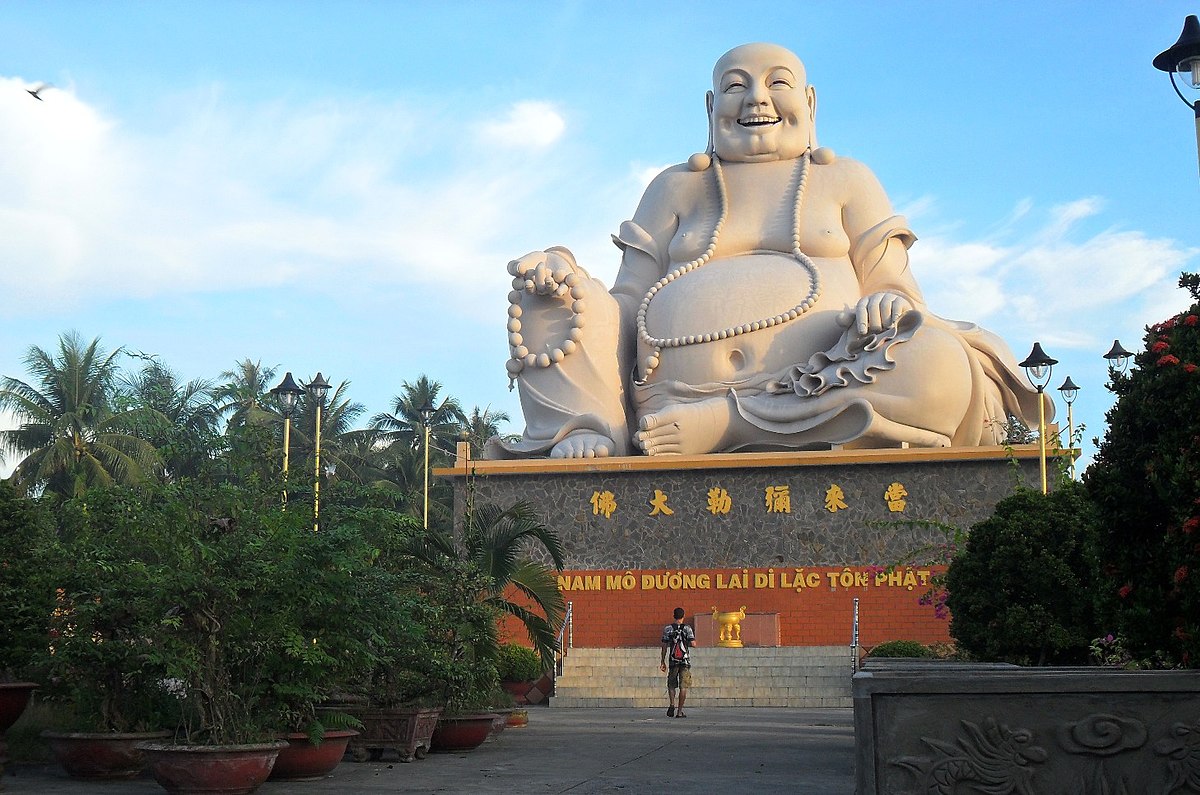
The ONLY way to end violence is just to swallow it and let it go. This man is fat because he is big enough to step over all the petty struggles and suffering of the world. Nothing is too big for him, and no adversary gets under his skin. He can maintain infinite compassion for all beings even those who view his as an enemy. And if violence means ultimately his death, he will certainly try to save himself, but what is inevitable is inevitable and he won't resort to vengeance or preemptive action out of fear like the American do. Bravery in the face of violence, so that you can connect with whatever is troubling your attacker, so that your attacker realises that you are more useful to them alive than dead is the logical way to approach violence. Picking up a weapon and threatening your attacker looks top your attacker like you need to be removed. Hold up a mirror in violence always and separate yourself from the animals by having a higher vision.
Heads SRH is true, Tails it is false
"This is a lie" is the classic contradiction. Sometimes Godel's theorems are styled as logical examples of that.
If we use random coins flips to make decisions as I have been for a while we can generate similar problems.
One such problematic decision is whether we should use coins to make decisions at all. We can ask the coin:
Heads: coins are fine for decisions.
Tails: never use coins to make decisions.
Fine if the result is Heads but what to do with the Tails decision. It says never use coins, so presumably we dismiss the result as it was made with a coin. But to dismiss the result is to make a decision based on a coin. So we keep the result which tells us to dismiss it and we are trapped. Its isomorphic with "This is a lie" and "This statement is not provable i.e. is not a member of the set of our logical statements"
SRH is an intuition I have that there was a problem with self-reference which I called the "Self-Reference Hypothesis" although I don't yet know what this is.
It seems that you don't need very strong self-reference to get into difficulties. It is sufficient for the player of "coins" to just ask questions about Coins.
Indeed any decision mechanism which can make decisions about itself has problems. And "itself" just needs to be its name, not "itself" in the complex "self-conscious" ways I was initially envisaging.
To recap. There are many types of self-reference. The loosest is using names. "Statement 5 is false" when put at position 5 in a list becomes a problem. The context of that "world" understands the "5" to mean position in the list. It requires no work "within" the statement. It's all up to the reader and inferred context. But "This statement is false" seems to contain its own context and world. It is always problematic regardless of context. Well not entirely true, the context must be English reading population. Such a statement in a world where English did not exist is just marks on a page and no problem exists. We might certainly decide there was information present if we found it on a beach as marks like that are rarely natural. But with no other context it remains a mystery.
Returning to coins. That decision seems to have us trapped. Every time I think about this I get to the same position something unsatisfying like Russel's Types or Cantor's hierarchy of Infinities. Systems that enable decisions about themselves seem to form a hierarchy. That self-reference like the cross-product generating a statement that points outside.
The point is that to ask the paradoxical question: "Can Coins be used to make valid decisions?" presupposes a context *outside* of Coins. The player is clearly more sophisticated than a machine that just makes decisions by flicking a coin. Such a machine couldn't ask the question. To ask such a question already requires a world in which coins are just a part.
As one sceptical paper on Godel argued: contradictions do not exist in reality. The "real" version of this paradoxical coins question is a machine that blows itself up if it gets a tails result. But obviously "time" is a constant here that is *outside* the question. If we allow the machine to go back in time and stop itself being created on a tails result then the paradox returns.
It appears that to ask a "self-referential" question of a decision device requires the question to exist in a wider context than the device. If we allow the device to make decisions about the context of the question we run into problems.
There does seem to be some necessary hierarchy with the context being a larger order than (and *outside*) the device.
Returning to the Coin Paradox. The coins cannot make meaningful decisions about the whole of the Coin game. To play the game puts the player in a different place to the coins. The coins know nothing of the world, even of decisions far less they can make decisions. It is up to the user to interpret the result and make the decision based upon the result. And the user is fundamentally and necessarily not a coin. This the paradox is being misunderstood. The coins are not the point. Really the user is asking "should I play coins?" this is something they must decide. Now they could decide to play coins to answer the answer, but the point is they already made the decision to play coins. The contradiction is no more paradoxical than someone flicking a coin and then flicking it again and getting a different answer. The first flick was the decision to play coins actually made by the user, and the second flick said don't play coins. It is not a paradox, but requires understanding the contexts outside the game.
Th paradox occurs if we forget the context and try and understand the game as "self contained". And this was the original insight into SRH (or God Principle as it was also called) that any system exists embedded in a context and so cannot become self-contained and so self-knowing or entirely self-referential within itself.
Sunday, 26 July 2020
SRH stub
If not already said "Outside" is the key to SRH.
In the same way as Godel there is the broad suggestion that any system that has self-reference must have an outside already. In other words self-reference cannot be contained in the system itself. To be self-referential means to have a view of a system, with a boundary and to gain that perspective we must be outside the system. A system cannot be self referential.
Consider taking a plane trip to see the land. We have a dilemma. Stay on the ground and not see the whole view, or leave it. You can't both have a view of the land and vbe part of it.
We need some distance from objects, See Pymalion.
In the same way as Godel there is the broad suggestion that any system that has self-reference must have an outside already. In other words self-reference cannot be contained in the system itself. To be self-referential means to have a view of a system, with a boundary and to gain that perspective we must be outside the system. A system cannot be self referential.
Consider taking a plane trip to see the land. We have a dilemma. Stay on the ground and not see the whole view, or leave it. You can't both have a view of the land and vbe part of it.
We need some distance from objects, See Pymalion.
What does most of this have to do with poverty?
So the blog got retitled Joy of Poverty. Yet how does economic reformation, insights into Life, and logic have anything to do with Poverty?
It could just as easily be called Joy of Freedom.
Poverty IS freedom!
Why?
Consider the drug addict. Within their world getting the drug hit IS freedom. That blissful moment when they are satisfied and the worries and struggles of the world seem far away seems like freedom.
But for someone looking on the outside all they see is someone desperately rushing around trying to get their drug and then a period of inactivity while they consume it and then its back on the tread mill of searching for the next hit. This is not freedom but a cage crafted by the drug and the brain.
Well seriously what is the difference between that and most organisms!
We have some image of what we "want" we search for it until we find it, or we think of something else we want. If we find it all is good for a while but soon the search starts again. If we don't find it obviously the search continues. And if we stop that search we will just divert to a new one.
Being on the treadmill of desire is not freedom. Looked out from "outside" it is clearly not freedom.
So being "outside" is critical to seeing slavery in action and so understanding freedom. Indeed all the slave or prisoner wants is to be "outside" the prison. Being "inside" is actually a euphemism in English for being in prison. Outside is deeply linked to freedom in English at least. But it appears that until the prisoner knows there is somewhere outside the prison they don't see the bars.
The mind is a cage, exactly as portrayed in the Matrix. The issue of poverty is covered there.
Logic is a formal way to approach the question of outside, and so freedom.
Economics is currently built around desire, consumption and production. It is an economics of slavery. That needs to change.
Discovering the Joy of Poverty, or finding that happiness that is not dependent on drugs and searching is the key to this blog and Life.
It could just as easily be called Joy of Freedom.
Poverty IS freedom!
Why?
Consider the drug addict. Within their world getting the drug hit IS freedom. That blissful moment when they are satisfied and the worries and struggles of the world seem far away seems like freedom.
But for someone looking on the outside all they see is someone desperately rushing around trying to get their drug and then a period of inactivity while they consume it and then its back on the tread mill of searching for the next hit. This is not freedom but a cage crafted by the drug and the brain.
Well seriously what is the difference between that and most organisms!
We have some image of what we "want" we search for it until we find it, or we think of something else we want. If we find it all is good for a while but soon the search starts again. If we don't find it obviously the search continues. And if we stop that search we will just divert to a new one.
Being on the treadmill of desire is not freedom. Looked out from "outside" it is clearly not freedom.
So being "outside" is critical to seeing slavery in action and so understanding freedom. Indeed all the slave or prisoner wants is to be "outside" the prison. Being "inside" is actually a euphemism in English for being in prison. Outside is deeply linked to freedom in English at least. But it appears that until the prisoner knows there is somewhere outside the prison they don't see the bars.
The mind is a cage, exactly as portrayed in the Matrix. The issue of poverty is covered there.
Logic is a formal way to approach the question of outside, and so freedom.
Economics is currently built around desire, consumption and production. It is an economics of slavery. That needs to change.
Discovering the Joy of Poverty, or finding that happiness that is not dependent on drugs and searching is the key to this blog and Life.
Saturday, 25 July 2020
SRH, new term, intelligence, NP vs P, cross product
Once again back on SRH.
My first insight into SRH was the "new term" problem in AI. I have no idea whether that is the "official name" I came across it in the mid 90s on the internet. It captures my insight.
Intelligence is not just selecting and reordering the contents of the solution space, it is developing the solution space.
Definition: at least my understanding of Solution Space is the same as Parameter Space. You define the boundaries of a problem with parameters and then the Solution must be some value of these parameters. The multi-dimensional space with all possible values of these parameters is the Solution Space.
So the new term problem and how I think of intelligence is the ability to add or remove parameters to the solution space as one approaches a problem. Just searching pre-defined solution spaces is not intelligence.
Suppose you teach a computer to play chess. The solution space is easy to define, but it is a huge tree of possibilities. The problem for players of chess is not understanding the solution space but just selecting which branches to walk. In theory a brute force approach is sufficient altho it is not practical given the side of the tree.
Neural Networks seem to generate extraordinary intelligent behaviour. I am certainly open to the possibility of radical achievement by AI. But, I'm always a bit suspicious. In this example by Two Minute Papers the AI discovers solutions outside the solution space imagined by the programmers who built the experiment. It finds things that the human observers of the systems didn't see. This is always the WOW moment of AI to be out smarted by a machine. The first time I heard of this was in the LISP programming language in the 1980s and a command line adventure game. The developer was playing the game, climbed on a statue and then cast a spell which killed him. He had to think about why he died and realised that the spell destroyed the statue so he fell and died. The machine was out smarting its player. But can't all this be explained simply by the fact that machines are able to search through the solution space and literally find things that humans had missed. It doesn't suggest that the machines have mastered the solution space. An AI set to work in a 2-dimensional game will NEVER find enter a 3-dimension solution space. Any more than these Hide'n'Seek bots will utilise the 4th dimension to hide.
My first insight into SRH was the "new term" problem in AI. I have no idea whether that is the "official name" I came across it in the mid 90s on the internet. It captures my insight.
Intelligence is not just selecting and reordering the contents of the solution space, it is developing the solution space.
Definition: at least my understanding of Solution Space is the same as Parameter Space. You define the boundaries of a problem with parameters and then the Solution must be some value of these parameters. The multi-dimensional space with all possible values of these parameters is the Solution Space.
So the new term problem and how I think of intelligence is the ability to add or remove parameters to the solution space as one approaches a problem. Just searching pre-defined solution spaces is not intelligence.
Suppose you teach a computer to play chess. The solution space is easy to define, but it is a huge tree of possibilities. The problem for players of chess is not understanding the solution space but just selecting which branches to walk. In theory a brute force approach is sufficient altho it is not practical given the side of the tree.
Neural Networks seem to generate extraordinary intelligent behaviour. I am certainly open to the possibility of radical achievement by AI. But, I'm always a bit suspicious. In this example by Two Minute Papers the AI discovers solutions outside the solution space imagined by the programmers who built the experiment. It finds things that the human observers of the systems didn't see. This is always the WOW moment of AI to be out smarted by a machine. The first time I heard of this was in the LISP programming language in the 1980s and a command line adventure game. The developer was playing the game, climbed on a statue and then cast a spell which killed him. He had to think about why he died and realised that the spell destroyed the statue so he fell and died. The machine was out smarting its player. But can't all this be explained simply by the fact that machines are able to search through the solution space and literally find things that humans had missed. It doesn't suggest that the machines have mastered the solution space. An AI set to work in a 2-dimensional game will NEVER find enter a 3-dimension solution space. Any more than these Hide'n'Seek bots will utilise the 4th dimension to hide.
This is the illusive "new term" or parameter that I don't fully grasp even 25 years later.
When people say that a problem is "NP" they saying that like chess the solution space is vast and also structured like a tree. You can't just solve a differential equation to pick a solution. In a trivial way the solution space to lowest value of (x^2 + 3x - 3) is vast in that x can be any one of an infinite values, but we can chose the answer -5.25 very simply and exactly with rules of algebra and calculus. Chess despite only having 32 pieces with very limited moves leaving not many options each turn, requires you and the opponent to wade through the solutions, trying to close down dead ends early and using a database of known solutions and patterns. An obvious difference is that continuous solution spaces are easier to navigate than discrete spaces like "moves."A chess players strategy includes tricking the opponent causing them to close down and ignore valuable moves. Once you understand the opponents game you can beat them knowing what move they are likely to make, producing a game that perhaps no AI would ever play.
But if an NP problem could be transformed into a different solution space it might be simpler to solve. Finding the route from point A to point B walking is difficult if we search the roads of the city. If we have a drone we can spy on the situation from the 3D dimension and put A and B on a 2D map and automatically prioritise paths that lead in the right direction and the wrong. Practically too tracing a route with ones eye means we can try out routes a lot faster than walking them, and we have added information like being able to see busy junction points which suggest if we can get to them we have lots of options. This last bit I believe is the basis of Dijkstra shortest path algorithm.
So crudely NP is hard to prove it seems to me because we have to eliminate the possibility of a new-term which transforms the solution into something easier to solve than brute force searching. Almost certainly this proof that "brute force"is either not resolvable N != NP or can be reduced to P only needs to be done once, like Turing Complete, as all such problems are hopefully isomorphic and what is proved for one can be shown for all.
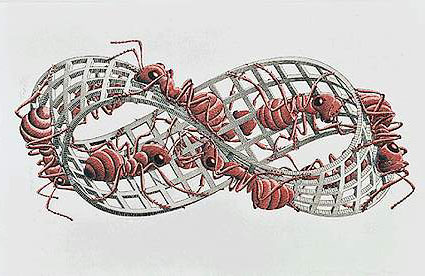
So all this blog was inspired by a good example of new-term. The Cross-Product. Two vectors define a plane. Using the Cross-Product we have a procedure to apparently "create" the 3rd dimension, the Normal to that plane. Likewise living in a 3D world we can prove there is a 4D world by creating the Normal to our 3D world. Any dimension apparently has the tools to bust out of its limitations into new space. The infamous ants walking around their Mobius Strip world just need to calculate the Cross-Product to have a vector pointing outside their world. (Obviously these ants are 3D so they are already aware of the 3D but flat 2D ants in a Mobius world.)
However actually there is no creating of a "new term" because to calculate the Normal we need to equip our vectors with a 3rd vector before we start! We might be able to show that we get some weird results if we try to do it with just 2 dimensions (e.g. just do part of the calculation using just 2 rows of the matrices) but the break through is not something we can calculate.
As a kid I spent considerably time trying to think of a new "mode of transport." we had flying, swimming, running, walking etc but try and think of a "new one." Novelty it seems is extremely difficult, the boundaries of our world are extremely rigid, the freedom we have exists only within rigid rules. It is like Mozart pushing the limits of Classical. He explored the space but traditional musical history says he never went outside.
Outside is what I call intelligence, and SRH proves, in the same way that Godel showed that self-referential systems are incomplete, that there must be an outside. But how we get there remains illusive and magical. Even in 21st century we must wait for divine inspiration and the grace of God it seems for such revolutions.
Thursday, 23 July 2020
The Cabal
If there is a Dominant Narrative (one is the rise of Civilisation and the Battle of the West to overcome oppression and Enlighten the World and the other is the Existence of God and the battle of Good and Evil) then there is a Counter Narrative.
Over the last 30 years the Internet has seen the development of this negation narrative.
It has reached its zenith now in videos like this:
https://www.youtube.com/watch?v=EAOHLw_8m2w
A tight consistent narrative that equals the narrative that came before it.
I have on problem with it, but firstly it is to be applauded in bringing new life to the old challenges of challenging corrupt power and protecting the weak and vulnerable. Although Nietzschians would argue that Power was just Power and the powerful will get away until a greater power brings them down.
My problem with this new narrative is that it is entirely negative. It tells us what is wrong but not what we can do about it. It is like a Jesus or Messiah exposing the working of the Devil but offering no guide to Goodness of Heaven. Narratives of the Past like Jesus protecting the weak and championing the Good, the Peasants Revolt in 14th Century Britain to overcome Norman oppression, Marxism being the theory of theories about the end of corrupt rule by Feudal Aristocracies, and then Capitalists and many battles by people against corrupt power structures of the millennia have all offered an alternative view of reality. Today there is none.
The best we have is Aliens will save us or Trump and JFK Jnr will save us.
Even Christianity which seems to say that Jesus will save us requires faith and obedience on our part. That it is true is a complex piece of theology: I saw it argued in the Zoom pulpit only a few weeks ago that salvation cannot come from our own hands and we cannot do good deeds expecting God to save us as a result. God is absolute freedom and mysterious as a result: He makes the Laws he doesn't need to obey them. We can hardly argue with St Peter based upon our faultless life, this is not what Goodness is about. It is not a bank account of deeds. As Jesus Himself says pray to God in silence, because if you go to the temple just to be seen by others as pious then that is all you will gain. While those who pray sincerely in silence are the ones that God hears. But if you get angry because God didn't hear you you don't understand prayer or God. It is not an equation, God is not there for deals. He is gracious if we are lucky! However all that said, Jesus gave us a very good idea of how we should live and what allowing the Spirit of God into our hearts is like. There is nothing to expect, and no currency, just an attitude and striving to be more like Jesus.
Yet what of the new narrative? Apart from uncovering the unspeakable evils of the corrupt elites like detectives and putting the State legal system to work to rid them what else is there? What does the new world look like? How are we to behave to make things better, what is the meaning of our life, what should we strive to do? It's actually just the same. And one wonders if its just the same whether the future is just going to be the same. It looks a lot like blaming a small cabal of bad people for the world's wrongs. There are high profile people in the US system being brought to light now for abuse of people. Yet no mention of the vast networks of criminality that span the globe trafficking people from all countries. The immigrant problem is not a problem with people running from oppression in "bad" countries but rather a mature market in human beings being fooled into giving up their life saving to criminal gangs for a better life abroad before ending up being dumped at the gates of foreign powers with no protection or assurance. Many end up in slavery both economic and sexual. This is nothing to do with The Cabal but a deep problem with human beings exploiting each other for personal gain.
The Devil is extremely subtle. He infiltrates the World at all levels. Removing a corrupt global elite will not change this. And Trump is not able to take on the Devil. However he may do a lot to clean up the current corruption in the US and good luck to him. But I suspect we shouldn't hope for too much, and we shouldn't get complacent that things will change by themselves. We need ensure that we are part of that better world, and we need to strive for clear ideas about what a better future looks like.
The current narrative is not enough. A lot more work is needed especially in the area of economic reform.
Over the last 30 years the Internet has seen the development of this negation narrative.
It has reached its zenith now in videos like this:
https://www.youtube.com/watch?v=EAOHLw_8m2w
A tight consistent narrative that equals the narrative that came before it.
I have on problem with it, but firstly it is to be applauded in bringing new life to the old challenges of challenging corrupt power and protecting the weak and vulnerable. Although Nietzschians would argue that Power was just Power and the powerful will get away until a greater power brings them down.
My problem with this new narrative is that it is entirely negative. It tells us what is wrong but not what we can do about it. It is like a Jesus or Messiah exposing the working of the Devil but offering no guide to Goodness of Heaven. Narratives of the Past like Jesus protecting the weak and championing the Good, the Peasants Revolt in 14th Century Britain to overcome Norman oppression, Marxism being the theory of theories about the end of corrupt rule by Feudal Aristocracies, and then Capitalists and many battles by people against corrupt power structures of the millennia have all offered an alternative view of reality. Today there is none.
The best we have is Aliens will save us or Trump and JFK Jnr will save us.
Even Christianity which seems to say that Jesus will save us requires faith and obedience on our part. That it is true is a complex piece of theology: I saw it argued in the Zoom pulpit only a few weeks ago that salvation cannot come from our own hands and we cannot do good deeds expecting God to save us as a result. God is absolute freedom and mysterious as a result: He makes the Laws he doesn't need to obey them. We can hardly argue with St Peter based upon our faultless life, this is not what Goodness is about. It is not a bank account of deeds. As Jesus Himself says pray to God in silence, because if you go to the temple just to be seen by others as pious then that is all you will gain. While those who pray sincerely in silence are the ones that God hears. But if you get angry because God didn't hear you you don't understand prayer or God. It is not an equation, God is not there for deals. He is gracious if we are lucky! However all that said, Jesus gave us a very good idea of how we should live and what allowing the Spirit of God into our hearts is like. There is nothing to expect, and no currency, just an attitude and striving to be more like Jesus.
Yet what of the new narrative? Apart from uncovering the unspeakable evils of the corrupt elites like detectives and putting the State legal system to work to rid them what else is there? What does the new world look like? How are we to behave to make things better, what is the meaning of our life, what should we strive to do? It's actually just the same. And one wonders if its just the same whether the future is just going to be the same. It looks a lot like blaming a small cabal of bad people for the world's wrongs. There are high profile people in the US system being brought to light now for abuse of people. Yet no mention of the vast networks of criminality that span the globe trafficking people from all countries. The immigrant problem is not a problem with people running from oppression in "bad" countries but rather a mature market in human beings being fooled into giving up their life saving to criminal gangs for a better life abroad before ending up being dumped at the gates of foreign powers with no protection or assurance. Many end up in slavery both economic and sexual. This is nothing to do with The Cabal but a deep problem with human beings exploiting each other for personal gain.
The Devil is extremely subtle. He infiltrates the World at all levels. Removing a corrupt global elite will not change this. And Trump is not able to take on the Devil. However he may do a lot to clean up the current corruption in the US and good luck to him. But I suspect we shouldn't hope for too much, and we shouldn't get complacent that things will change by themselves. We need ensure that we are part of that better world, and we need to strive for clear ideas about what a better future looks like.
The current narrative is not enough. A lot more work is needed especially in the area of economic reform.
Subscribe to:
Posts (Atom)
-
The classic antimony is between : (1) action that is chosen freely and (2) action that comes about through physical causation. To date no ...
-
Following from the last blog on animal/human a beautiful male Oedemera nobilis resting in a flower after presumably a good meal of po...
-
Same current territory (and raft) but a bit more polished. Or perhaps not! That will be be explained. With Deepseek: https://chat.deepseek.c...


