Wednesday, 10 April 2024

There is something odd about Consciousness

It's easy to confuse consciousness with what we are conscious of.


When we see a flower we can note that we are conscious of it, we are aware of it, and it has a presence right there. It doesn't need to be a real flower this picture has the same properties.

But we can do the same for all out sense. Perhaps we have a feeling right now, or if we are sitting a sensation of the weight of our body on the seat, or one that always works a sensation of breathing somewhere. We can do this for 5 senses.

In the West at least we are less aware, but it is noted in the East, that in addition to these senses there is also a whole realm of mental activity that we can be conscious of. We are conscious of dreams, and of thoughts, and of ideas. The common story of the person seeing a coil of rope and mistaking it for a snake. Clearly the person is conscious of one thing--a half seen coil of rope--but this causes an idea of a snake which is another thing. If we think about it there is no way a coil of rope can ever be a snake, but what happens is it triggers our mind to make up the idea of a snake. The point here is not a Platonic style analysis of how perception occurs, but just a noting that we are conscious of all this stuff going on.

Now this raises a problem for theorist of Consciousness. Often consciousness is seen as a product of the brain. But things like sight and hearing and thought are products of the brain. Consciousness is quite different, it is like the back drop to all this activity.

This is the odd thing about consciousness. It seems to have a VIP ticket and access to all areas of our brain and mind. We are conscious of hearing and sight and thought as though they belonged to the same stage.

Kant calls this unity the Transcendental Unity of Apperception. That our mind seems unified by consciousness is a powerful metaphor for the idea of a Self. Sight and Sound and Feeling and Thought all stand side by side because "I" am at the centre like a commander looking at them all from a central position.

But this metaphor does not work. What we see is call seeing. There is not a second seeing that we call consciousness. When we see that flower that is seeing. The consciousness is something else. That is how we can be conscious of seeing and hearing and thinking. While we say "I see" in English when we understand something this is a metaphor for the mind penetrating something and forming it clearly. Realising it is a rope we say "I see now" it is a rope. This is not a clear physical seeing, but a clear mental activity. The seeing occurs in these faculties. The Consciousness is not itself seeing!

Now Consciousness is described a dull and bright. When the mind is pure and illuminated we have a bright consciousness. But this is another metaphor. We can do this with our eyes closed and no light being around at all.

Consciousness is not separated into senses like the senses and has no associated sense organs like eyes or brain.

Daniel Dennett in "Conscious Explained" goes to lengths to describe experiments that show that what subjects describe of their conscious experience does not match what brain scans show up. The classic example is the order of events. They may say they did one thing before another, but measuring equipment shows it was the other way around. Dennett uses this to show that what we think is going on is not what is actually going on. And from this he deduces that what we are conscious of is a model of the world that the brain constructs. All that deduction is fine. But it does not draw consciousness into the brain.

Another view is epiphenomenalism where consciousness is seen to be like an audience member looking in on the world flowing past on a film screen. But this makes a huge mistake of thinking of consciousness as "another thing" separate from what we sense. It is not a 7th sense that sees all the other senses. Seeing and feeling and thinking is done by the senses. Consciousness is not a sense.

So this is the odd thing about consciousness it is like the canvas on which all the other things happen. This is how it gets into all the places of our minds at the same time. While the physical processes that give rise to sense are a complex mess of processing all this mess and the conclusions all occur within consciousness. With the person seeing the rope in half light as a snake, the unfolding of the vision and the thoughts and the decision to grab a stick and hit it, and then seeing it again and reprocessing this and deciding its an odd snake and perhaps not a snake and then perhaps as the sun comes up and there is more light seeing it as a rope and seeing the fear subside and thoughts of calm coming about: all this unfolds within consciousness. Even all the thoughts and actions that constitute the person unfold within consciousness. It is not that a person is conscious: the consciousness is of a person!

Now this is incredible really and really quite hard to explain. I made the huge mistake in my journey here of thinking that consciousness must be a product of the brain like sight and thought. That is some way "I had consciousness" where the self is materially based in bodies and brains. I believed that I had some actual foundational existence and that somehow gave rise to consciousness. While I was perfectly capable of relativising this and seeing "all things" as belonging to the Absolute, it is so habitual in the West at least that I always left some part of myself outside to act as the anchor and the foundation for my constructions. From this seed of self I could then say it was conscious. Yet consciousness is greater even than the self.

The self is not conscious. There is only consciousness of self. And this ability of consciousness to access all areas even beyond our self is what is truly extraordinary.

Now this gets much deeper. When we fall asleep and the eyes and the brain switch off their usual functioning so we get odd other features like dreams, what happens to the consciousness?

Well we can be unconscious. But I wonder actually whether it is just the brain shutting down that we can unconsciousness. and the consciousness is quite apart from this.

I met a boy once who was blind in that they could not see anything. Yet somehow the brain was still processing information from the eyes so they had a seemingly miraculous knowledge of things in the room. If ever we needed greater proof that seeing and thinking were separate senses. So it was like their sight was asleep but their brain was awake. I don't think the boys consciousness was effected in any way. He was talking and being awake like anyone else, just able to describe that for his vision there was none. He was conscious so to speak of being blind. What was odd is that we explored deeper into his mind and he described a force that was trying to take him over. He became scared and when it took him over his eyes rolled to the top and he passed out. I forcefully spoke to him and woke him up again to speak about mundane things and he recovered his brain activity. I have no idea what that was, a kind of epilepsy perhaps, and I did not investigate how that effected his consciousness. But there is at least the possibility here to see sense and brain function as being different from consciousness.

I have tentatively taken the view in this blog that consciousness is a product of brain function like sense and mental activity. But I wonder now whether there is any foundation for this at all.

Tuesday, 9 April 2024

Nothing & Ego

In Mauvaises pensées et autres (1942) French poet Paul Valéry wrote: 

"God made everything out of nothing. But the nothingness shows through."

Interestingly this is the year before Sartre's magnum opus Being and Nothingness was published in 1943. Certainly these ideas were doing the rounds.

Now I'm not familiar with "Existentialism" other than Heidegger riled against the inauthentic term and Kierkegaard my favourite modern philosopher would not recognise it.

But I mention "Nothing" here just to illustrate that it shows up across literature and history.

"Nothing" seems impossible to grasp. We grasp at things, so how can we grasp "Nothing." Well that is kind of the point. "Letting Go" depends upon appreciating the "Nothing" at the root of things.

It's not actually that weird. We know when we let go of things and they move out of centre stage in our lives, often quite suddenly like a window blowing open. One minute we are hot with the bother or industry of holding something and then the window blows open and we get the cool refreshing quiet of it having left us. Almost like a demon possession having ended, in fact exactly like a demon possession having left us.

Now we tend to live lives that get an external casing that we try to maintain. We need to be reliable to our spouses and our children and our employers and even to ourselves. We can't go "letting people down" by whimsically "letting go." This looks like "giving up." The great heroic myths of our predecessor culture Greece are all about staying true to a quest or trial or conquest and prevailing against the odds. Heracles or Hercules is one such super-human over coming seeming impossible challenges. He is not Nothing he is very much Something!


Our modern myths (American Hollywood especially) all are all about the hero prevailing whether that is defeating the enemy or winning the girl. We can't just let go half way through. An obvious example would be free climbing without ropes! Once you start you need to complete! Absolutely no "letting go." Not like that anyway. To have got to the position this climber has got to they will have had to let go many times else they would still be hanging on to the start of the climb!


But real "letting go" is not about egotistical choice. You do not "chose" to let go. Its not an option that you pick off the shelf when you are ready.

Letting go is the opposite. It is being open to change, and arresting the ego when it makes habitual choices that go against the flow of reality. If you relationship is over then no point fighting pointlessly to keep something that is dead alive. How foolish would Heracles/Hercules have looked taking on a challenge that was really impossible and perishing.

This is very perplexing to the ego. How do I know when it is time to let go? How do I know when it is time to take hold? You can't really get anywhere with this kind of questioning because the Ego is the whole problem. Ego is the opposite of Nothing. It thinks it is something. With this something it infects everything. When we make choices they are based upon the solid foundation of this something. This is how we get out of sync with reality. The Ego can keep pounding on forever driven by its own inner something and ignore the outside world and change indefinitely. Life gets hard, and then we die. Dying is the ultimate change that Ego will rile against its whole life, somehow we think maybe we can defeat death or put it off at least by being healthy and safe. Yet it remains there as a hard wall against the Ego. This is the challenge against which no Hercules can prevail.


Or can they? This is the most famous example of a "Hercules" who over came the impossible and returned from death. But is this a twisting of the story?

Firstly no. Faith is the key to Jesus' teaching, and anything which inspires faith is good. Faith has one powerful feature: it defeats the Ego. The Ego sits there going "this is ridiculous", "I can't explain it", "it does not fit within my world view", "it is crazy", "I reject it". And in so doing the Ego reasserts itself as in control and unchallenged. But faith requires us to go beyond the Ego. So belief in Jesus challenges our Ego. That is the ironic win! The humble weak carpenters son achieves the greatest victory in History, even greater that Hercules!

But very easily the Ego can claim this. The Ego can and does very easily claim all attempted to overcome it. Wait a second it goes. So if I believe in Jesus then I gain immortality and no longer die. Awesome that is a deal. I will live forever and no long worry about death. Love you Jesus.

But its a cheat because it won't work. Following Jesus is to sell everything we own, and give our lives over to God. Suddenly Ego no longer comfortable. I won't do that, so we lose immortality, or stay a bit on the fence having our cake of Ego and trying to eat it as well by pretending to follow Jesus.

We are struggling because we are holding so tight to that fixed something in our lives. So what is this Nothing? Where is it?

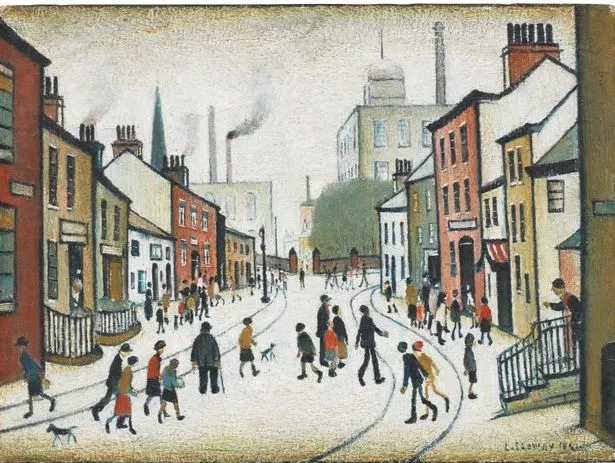
In this painting by Lowry we have lots of people going about their lives. In the bottom right for example is a boy possible being told off and a woman pointing at him from her house steps, perhaps his mum. We can imagine what the boy and the woman are thinking and what is being said. Lives are being lived in this picture. It is interesting, there is meaning, there is lots of something to absorb into here.


But let us ask a bewildering and crazy question, a Twilight Zone question. Behind the woman is the edge of the painting! She can almost reach it if she turns around and leans. What does this woman think of the edge of painting and what lies beyond?

Woah!

Craziness!

This is the same question we face when we try to think of Nothingness. Now we can't deny there is a border around that painting, and if its possible to wonder what the woman is saying to the boy, its possible to wonder what she thinks of the white space around the picture.

This reveals something about context. All the "normal" stories we would create looking at that picture assume that the figures represent people. But they are not really people they are just colourful marks on a page and marks on a page cannot think. Yet despite the fact they are just "dolls" we are able to fill them with life and meaning. This ability to tell stories, to create what are called narratives, is the very essence of the "something". To make real progress we need to be able to separate the "narratives" from what they are about. That is very hard and takes long meditation practice. Separate the name/nama from the form/rupa.

Within the context of the picture we can make up a whole world of stories. Perhaps she is his mum. But step outside the picture and that is clearly just colours on a page. Its the same object but used in a different world, contexts, or as later Wittgenstein would say "language games." The same ball, but in one set of rules it's tennis and you hit the ball, but in another context it is a game of "one knee, two knee" and you catch the ball. Likewise in one set of rules she is talking, and in another she is colours on a page.    


 The whole "something" of what something is can be totally changed by the context, or the rules of the world it is in.

So when I ask her what does she think of the white border around her I am smashing up narratives. I steal the rules from one context where she can talk, and then apply to the other context where she is just colours on a page. These world's exclude one another and cannot mix. They have their own borders. Gilbert Ryle called this kind of thing "category mistakes" and argued that the difference been "body" and "mind" worked the same way.

This blog has got a bit more complicated than I wanted but the pattern still remains. Each context has its boundary that stops it mixing with other boundaries. The colours on the page cannot talk to the boy. The woman cannot speak about the white colours of the border.

Yet they exist. The picture is definitely bounded by the white border of this blog page, and she is definitely pointing at the boy and saying something. These are both things we can discuss and come to an objective conclusion on.

And this means that while the contexts do provide immanent limitations, the woman can never step out of the picture like the girl in the film The Ring, they do somehow fit together into the same world. We have quite happily skipped between being in the picture and being outside the picture and back in again.

Now how is this possible?

This is the Nothing. The ability to be listening to the woman one second, and a split second later wondering what she thinks of the border outside the picture.

The mind is agile, and can be here and there, and in this context, and outside this context instantly.

This is possible because it has no context of its own!

The problem happens when we start to take hold.

Perhaps we decide the boy is being unfairly scolded and we take to disliking the harsh woman. Perhaps that represents experiences of our own and it raises all kinds of emotions. Suddenly we cannot be so free and easy in stepping into the picture and out again. The woman has become something fixed!

The ultimate fixed thing though is not the woman in this picture but it is our self. And this is where ego and mind differ.

Yet we are literally just a painting. We have no more flesh and blood than the woman on the steps of that house!

Woah!

We are a narrative crafted around, not colours on a page, but instead memories, feelings, thoughts, emotions, beliefs, possessions, friends, hopes, fears all the things that surround us.

So this blog has once again got long. But the whole problem of life and death lies in holding onto the narrative and not seeing it exactly like the character painted above so that we can drop in and pull out again from multiple contexts. And to do that requires letting go of each context and not getting stuck in the something, being open to asking a crazy context-busting question like "what is the white around the picture like" that mixes contexts and breaks us out of a particular fixed world and context.

So the first thing we think here is: oh no that is nonsense I need protect myself because unlike the woman I am a real person who if I don't look after myself will die. That is a fixed reality. And that fear of death and the struggle to exist fuel belief in the solid something self, the Ego.

But this is where separating narrative from what they are about is SO important.

The woman who is pointing in the picture is really just colours on a page, but colours on a page cannot point!

The Ego that is scared of death is really just a body, but a body cannot be scared of death!

It is the exact same difference. 

Thursday, 4 April 2024

The end Of Capitalism as a serious economic theory

Preface, Introduction, Preamble

If you ask a proponent of Capitalism the weakness of other economic theories they will say that they do not set price.

It used to be said that if the whole world turned Communist at least one country would need to be left with a free market so that the price of things could be known.

There are counter quips like ‘a man who knows the price of everything and the value of nothing' [Lady Windemere’s Fan, Oscar Wilde]

This expresses the intuitive need for other modes of economy that respect some "intrinsic" value to things that price cannot represent. In Marxism "price" goes by the name of "exchange value" to distinguish it from intrinsic value. That is the "equivalence" that is set during a trade where a number of one commodity are exchanged fairly for another. If that commodity is money you have the monetary value which is what most people mean by price.

While I am about to destroy the notion of price in absolutely no way must the value of the instrument be undervalued (ironically). This is the single most important machine ever invented by man, far exceeding the wheel and the computer.

Despite its simplicity this machine gave us the concept of "equivalence" and from this came another unsurpassed tool, the equation:

=

Everyone knows the rules of algebra that "what we do to one side we must do to the other" but this is just an abstraction of what was learned in Babylonian market places. To keep both sides equal we must do the same to each sides.

And from the also comes the idea of "Justice." The core idea is expressed in the Babylonian Code of Hammurabi "and eye for an eye." Justice means to rebalance wrongs done to people. If someone steals then they must pay back. If someone injures they must be injured. Not until Jesus did this notion of justice change. Jesus teaches "turn the other cheek" and "forgiveness" to mean that equality cannot be measured and we should ignore such ideas. How when you body and mind were given you by God can you be possessive and demand anything of another person who is also God's creation! We are already so enriched by the grace of God that nothing can ever put us in deficit. Indeed Satan's work is just to make us own our bodies and estates so that we can spend our lives feeling the loss as things decay and we need struggle to keep hold, repair them and constantly seek justice. "Look at the birds of the air; they do not sow or reap or store away in barns, and yet your heavenly Father feeds them" [Matthew 6:26]. The point here is just to look again at the world and realise it is all a miracle and we were given it for free. We did nothing to belong to this world and deserve it not one bit. Whatever life we live should be one of complete gratitude for we could just as easily be extinguished and have nothing to even complain about. Science does its best to paste over this unavoidable truth. The world is inanimate resources, and value is made by human hands. And we understand and own where we came from because we have the theory of Evolution which makes it all just a blind machine and of no value. And yet what insane absurdity. How ever we twist it Humankind itself was created by no action from any human at all. How ever great and capable Humans wish to feel they are, know that the Universe made us and is infinitely superior. So as the religious texts across the globe remind us, be humble for the mind and hands that you use to craft things were made by no one and are not yours.

Yes despite this revision of Justice from Equality to Forgiveness by Jesus 2000 years ago the West at least is still stuck with the scale and remains a Pagan country! How ironic given us lauding Jesus and claiming to be Christian.

And the sickness which is Justice and Equality now reflects back on Price and Exchange Value. Jesus famously remarks in Luke 18:25 that "it is easier for a camel to go through the eye of a needle than for a rich man to enter the kingdom of God." He means what he says in Matthew 6:24 that "No one can serve two masters... You cannot serve both God and money." The problem with ownership and the need for equality of trade to feel you have "good value" is that you ignore the fact that everything was given to you in the first place. Even the body and hands and brain that you used to become a successful businessman were all given to you for free. Even the labour and effort that you mustered to achieve your wealth were all given for free. The world of human "value" is what you could call an "emergent property" in modern language, a product of the "game." 

We can see "emergence" from simple rules in Conway's famous Game of Life. 


The whole world of human endeavour is actually an emergent property that comes from the more fundamental rules of reality. Jesus, among many others, is always pointing to the raw simplicity of the world that underpins the games we play. "Money" or Mammon is just a game we play, it has no intrinsic truth. It is this basic intuition that drives other economic insights.

We need only look at slavery to see that the exchange system lacks value. Without outside forces controlling markets then humans will realise their exchange value. As has been seen in the Past humans become commodities with an exchange value. This more than anything challenges our understanding of the world. Surely a human is more than just a tradable commodity? Surely I am worth more than the price bid for me in a slave auction? Most people are already aware that there is something wrong with pricing and that it does not reflect something more fundamental that we might call "value." Robert Pirsig in "Zen and the Art of Motorcycle Maintenance" makes a detailed exploration of what he calls "quality" and how the world first becomes apparent to us in the form of "value" rather than information or data.

Seeing money and economics as just a game we play is only the start of what follows. All of Western Imperialism, Empire building and Globalisation is actually just a vast game we play, and a game that has been spread through endless violence and coercion. A myth exists that Capitalism has spread because it is "better" yet anyone who has not accepted it has been victim of genocide as we see across the New World. There is nothing "intrinsic" about Western Economics, it is spread via education of if that fails the gun. But this is just preface, introduction, and pre-amble.

Where is the Flaw in Pricing

So lets look at the stock market, the ultimate engine of pricing. Indeed the whole justification for the stock market and all the traders working tirelessly there is under the belief that they perform some function in determining pricing.

Let's take a 6 month chart of one of the current success stories: NVIDIA


Typically understanding of pricing take two approaches:

(1) Fundamentals. here we look at the assets and cash offset against liabilities in a company to get its base value and then look at projections of growth to see how desirable it is as an asset in our portfolio. We believe with this fundamental analysis we get an idea of whether the company is valuable or not. However note the circularity. We are using the market value of assets to determine its fundamental value. The rest is speculation on supply and demand.

(2) Charting. Another method of pricing is near Astrology. This is the reading of previous prices to predict future prices. Fundamentalists would argue it is hocus pocus as all people are interested in is hard accounting and economics. Yet who can discount the attraction of seeing a chart like NVIDIA. While it appears to have topped now certainly between January and March the rising chart would have been a compelling reason for investing.

But actually surprisingly these are the same!

The argument is that price only moves according to supply/demand. Fundamentals don’t move price!

Both Fundamentals and Charting set up supply and demand equally. A good end of year report from a company does nothing to price by itself. What happens is that people read it get excited about the health of the company and so buy shares. Supply reduces and demand increases so price increases.

Equally a rising chart like NVIDIA will excite investors and so create demand.

A fake news article spreading misinformation about a company could crash it. Recently Reddit readers collaborated to counter short sellers in GameStop to raise the price.

While fundamentalists will argue these are just blips and markets will always find their "true" value, actually its easy to see that this "fundamentalist belief" is just a part of the price. It is a self fulfilling argument. The moment people stop believing this then prices will deviate from fundamentals.

So we can see that "price" actually has no fundamental basis beyond supply and demand. The whims of the population is all that sets price. If feathers in hats come back into fashion then the price will rise. If people decide a company is "lucky" then the price will rise. There is literally no logic to it.  


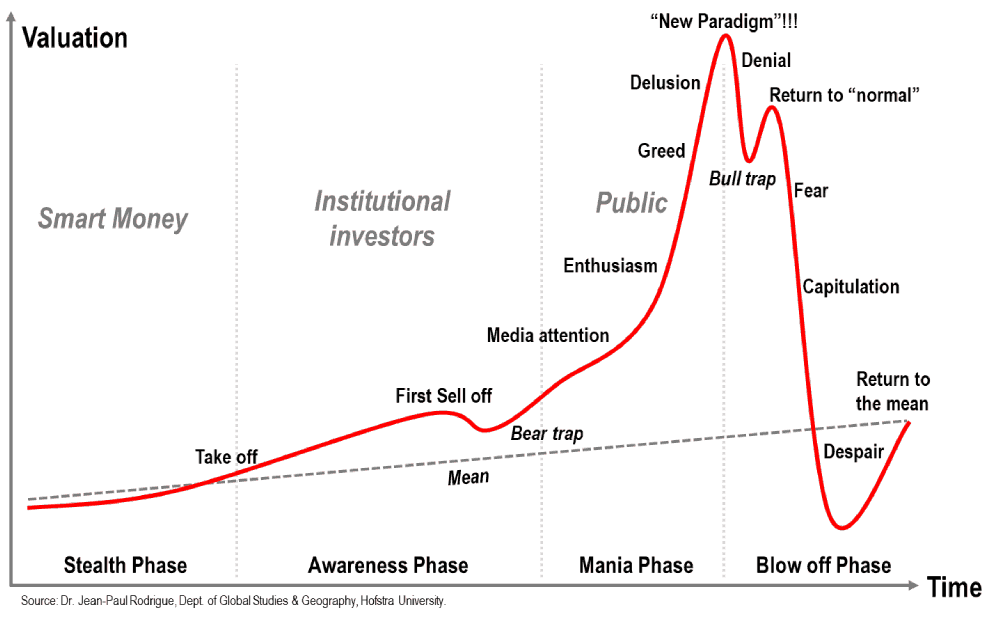
And there are hysteresis and self-fulfilling aspects of price as well. A rising price may attract investors which will all by itself increase the value of the company. This is how bubbles occur.


So we can conclude there is actually no "fundamental" basis to price. Complete rubbish can trade at value, and complete value can fail to trade and there is no problem with this.

Ironically "Fundamentalist" ideas are an admission that there is some "true value" to things, which the price should reflect. But if there is a "true value" that fundamentalists are sure about then does this not open the door to other ways to decide value other than markets like other economic thinkers suggest? If however Markets are the only way to find the "true value" then "true value" and "price" are really the same the "true value" adds nothing to the idea of price.

I imagine the middle ground here is like Democracy. Proponents of Fundamental thinking would say each person can determine the "true value" for themselves, but markets represent a way to sum all this into a single global value. But then they are just being Totalitarian, in that they are saying there is one truth that we all must live by even despite our own individual wishes. The decision to adopt markets is just a Totalitarian decision, that instead of a King deciding for us someone has made the decision for us all to have this machine.

That could be explained by a Nash Equilibrium. So that no one person gets to decide the value of things, we have all implicitly agree to allow markets to make this decision which is not ideal, but its better than having an individual do it.

But that was the point of Democracy. Rather than everyone fighting to rule the world we all agree to cast a vote so one person can be King for a limited time. The great advantage of this system over the Market system is that there is a human making decisions rather than a machine. As we see with Economic Depressions and Inequality the Pricing Machine has huge flaws. And while Democracy has its flaws the idea we can replace the arbiter when things go wrong is a huge advantage over the Totalitarian Machine of markets that we must suffer without choice and depend upon the actions of a small band of Economic Oligarchs tasked with trying to keep the economic machine working.

Anyway pricing does not achieve an arguably sensible result. It is just a result. And it is just dogma whether you use pricing to value things or not.

This opens up the stock market. The Efficient Market hypothesis argues that if any information exists that can be used to predict the price then rational investors will exploit that to arbitrage any profit available. That is if information becomes available that suggest a company is trading at too high a price then shares will be sold or shorted bringing its price down. Or if too low a price then shares will be bought raising the demand and therefore price. As a result a market always works to bring the price to reflect all the available information. But there is circularity here because how do people translate information into price moves? They look at supply and demand. They assume that the discovery of an oil well will add value to a company and so when the information gets out investors will want to buy and the price will rise. But what if a TV documentary about Global Warming frightens the world so much that they abandon investing in oil? The Fundamentalist will hold strong by saying well that is just new information for the markets to process. But this argument can never fail because whatever happens the Fundamentalist can always retrospectively attribute it to some information. It is not a predictive theory, and so Pricing and Efficiency turn out to be just dogmas.

So how do you invest then? Well all you can do is try to predict what other people will do. Given that the Fundamentalist Dogma is so strong you can use fundamentals in that other people will invest based on them. Black-Scholes is a good system for pricing options because it appears to find fixed points. That is a community using Black-Scholes pricing will force the market towards a stable price. If another model existed that if used across the market led to chaotic pricing then it would be dropped. Black-Scholes pricing it turns out does not always lead to equilibrium prices as seen during the 2008 economic collapse as the idea of CDO over pricing spread panic through the markets and liquidity dried up.

Price then becomes just the result of markets and has no intrinsic meaning. We may as well set prices according to a random number generator.

=======

Now there is one problem with the above argument.

Not everything is about stock markets.

If say there was a bubble in the price of Wheat what would happen is farmers would stop producing other crops and start sowing wheat to cash in on the high prices. This would create more supply and so lower the price.

Unlike other commodities where fashion and trend are the dominating factors affecting price, Wheat remains a central part of global diets and this provides a solid anchor to the price. Here you could argue for fundamentals. But it is the prevalence of wheat in our diets that provides the fundamental here. And you do not need a pricing system to find out that we like and need wheat. We have done so for 10,000 years. It is like Christmas you don't need to predict the markets to work out that Christmas is coming and that it is valued.

Proponents of markets argue, sure but the market is the most efficient method. If prices of wheat are too low then farmers will stop producing it, and vice versa to ensure a perfect supply to match demand. But I imagine that demand for this does not change very much, there are not sudden trends in wheat consumption like there are in NVIDIA GPUs and chips. Any economy can delivery wheat.

And that last statement "Any economy can delivery wheat" needs more analysis. Capitalism is failing in the West as people are going hungry right now, as they did during the Great Depression also. But Proponents of Capitalism will point to food shortages in China under Mao and Russia under Stalin.

To be continued...

Friday, 29 March 2024

Where does the light come from?

At the moment this is the core issue. And have been through this a lot but just running through again.

The simplest level is we look at a light bulb and we see light coming from it. Great in Humphrey Davy style we have light!


But what this question is looking at is how does the "vision" of light occur. We close our eyes and the light stops. The light bulb is still shining but something else has changed. The "vision" has stopped.

We can dream of a light bulb. There is light, but there is no light bulb. Where is this light? 

In the West we conclude roughly "the brain" is where the vision is, or the brain is like a light bulb and it switches on and creates the vision with in itself. We have a schematic like below and roughly assign the "vision" to this object:


But this is a rabbit hole. It hasn't got us any closer to what we actual experience. We have just slapped a big label over our experience saying that bit over there is the physical light bulb from shops and when we switch it on it produces light which we then see and that switches on the "vision" from my brain that I was born with.

It makes sense that you cannot see the brain when you look, because the brain is how we look. That would be like a camera taking a photo of its own film plate. That is nonsense. This is why we see a light bulb and not a brain when we see. This is SRH you can't see your brain and what you see at the same time because brain is how we see. So you could argue the "identity theory" that what we see is the same as the brain. You can't have Hesperus (Evening Star) and Phosphorus (Morning Star) in the sky at the same time, because they are the same thing (Venus). Phosphorus can never see Hesperus. The Brain can never See itself.

So we are saying that the brain is the source of the vision. But we would say that the brain is part of the objective world. It is a thing that after we die a surgeon can remove and put in a jar. If we are saying that the "vision" of light that we have via our eyes is made by the brain then we are saying that the vision comes from the same objective world that the light bulb belongs! The vision of light does not come from us. In fact where is there anything that is "from me" and is "mine"?

This is the core issue. When we separate the light into the light coming from the bulb and light coming from our brain or consciousness we are trying to separate things into "mine" and "not mine." And that is the issue.

Really nothing that we see comes from "me"!!!!!! Yet we persist in believing that this is "my" experience and "I" am somehow intimately involved in experience. Worse we persist in believing that I somehow contribute something to the world.

This spills out into thinking this is "my" brain. But if you actually are the brain then whose brain is it? It can't belong to itself! Suppose we break a couple of cups and their handles fall off. When we reassemble them we decide which handle belongs to which cup. We say this handle belongs to that cup. But we don't say the handle belongs to itself. Why then do we say that my brain is mine?

And that raises the whole issue of subjectivity and personhood.

So a lot comes from this core issue of trying to separate things into "world" and "me."

In Upanishad Hinduism "Tat Tvam Asis" concludes that seen correctly the Self and the World are the same. But this is also to say that there is no self separate from the world. What is world is self, and what is self is world.

Buddha says that "all things are non-self." We have a clear statement from someone who got as far as seeing this correctly that nothing we experience has any links to a "me". There is no clue of our self in the world. The vision of light that appears when we see a light belongs to the world not to us. It belongs to the same world as the lamp itself.

But wait a second isn't this Naïve Realism? This is the opening belief we probably had as a child that what we experience is exactly what is there. We have no split into objective and subjective. It happens pretty fast that we realise that people see different things, or at least different sides of the world. But to get there we have developed this problem idea of "separate people." We have installed in the world of experience these "people" who are centres of experience. It is this move that distorts the world into a billion separate bubbles.

Yet we cannot maintain that there is just one uniform world of experience. There are parts. The light bulb is one layer. The arising of consciousness is another layer. Light "exists" physically and also mentally if we wish to examine it and start to split it up. And there is the layer of "self" as well.

What is difficult is to unpeel the layer of self and get beyond it. The problem, as said in previous-but-one post, is "who" is getting beyond this layer? Well by definition we can take no one with us. To experience more fully we need be able have nothing in any part of it. We are not the light-bulb is pretty simple. We are not the consciousness is a bit harder. We are not the belief that experience is happening to someone is very hard. Yet it is easy to see this is true, but very hard to actually step beyond, because we habitually want to take our self with whatever move we make. The issue here is to take no one with us when we step beyond having a receiver of experience!

The light comes from no one, and it goes to no one!

Thursday, 28 March 2024

I refuse to join any club that would have me as a member

There is a lot of truth to this.

I think Groucho meant that if someone invites you to join their club it feels like they are the one to gain from the relationship and so you end up being used. You want to get into a club that doesn't want you so you can wear it as a badge and gain, while they take the loss.

But being Jewish, and given my suspicion of Jewish thinking*, I wonder if Groucho looked at it the other way.

If you have doubts about yourself then if you were the club you would not want yourself? So you only identify with clubs who do not want you. You feel kinship when you are not wanted, cos that is your view of yourself. And that is the irony you want to belong where you are not wanted and vice versa.

So I didn't have a contract renewed recently owing to a falling out with the company. Quite whether it started with me losing interest, and they responding to that, or they responding to some feature of me and me losing interest I cannot calibrate or know. Or perhaps they are one and the same, and we only divide it into sides afterwards. These things are always two sided. Anyway it ceased to work. But what has occupied my thinking since is how the individuals in the "organisation" closed ranks and behaved as an entity in quite a complex way to secure my removal. I am mostly unconscious to this kind of thing and only realised as I analysed afterwards. I have seen this happen to other people. It is actually quite extraordinary how groups self-organise to "include" and "exclude" people. This is a really fundamental part of human make up.

Contrary to this view however we spend a lot of our time in the Liberal Democratic West being told we are individuals free to chose etc. But little is said of the collective identities that we also have. And this is not just individuals buying their season tickets and taking their seats to watch their football team, it is a genuine "organism" that exists that takes over our behaviour. In Europe we are aware and even celebrate this in ideas of Solidarity and State. But in the US it is itself a rejected entity. So ironic (and Ayn Rand was vaguely aware of this) that as a collective the Libertarians organise to exclude the collective. You can't out-think the "collective." As an individual you are already beaten before you even pick up the collective language of your thoughts to think about it.


I think Monty Python intended this to be mockery of religious followers who do not think for themselves and just recite mindlessly whatever their guru teaches them. Obviously Monty Python skipped the passages in all religions that warn people of this and encourage them to embody the laws and become a living example of the law not a dead reciter of laws. In fact is this not one of Jesus' main points to the establishment of his age that they do not embody the laws they protect:

 "The teachers of the law and the Pharisees sit in Moses' seat. So you must obey them and do everything they tell you. But do not do what they do, for they do not practice what they preach. They tie up heavy loads and put them on men's shoulders, but they themselves are not willing to lift a finger to move them." [Matthew 23:2-4]

And in Buddhism there is a whole word Ehipassiko which means come and see and test for yourself.

So the irony really is on Monty Python and the fact that it is them who are the collective reciting "individuals" like robots and not really understanding what it is to be free. Those people in the clip reciting "we are all individuals" are actually all the liberals of the Western Democracies who have been told they are free but actually have no idea what this means other than get a job, do some shopping and go and vote, or dig deep into "oneself" and be creative and create new products. Strangely all things the establishments tells them to do. And why? Well I suspect we are told to do this because it makes the economy grow and all those rich people invested in the system then get richer. So the ruling class are actually plugged in to the system in a way that makes them encourage the working class to seek employment and work. Not sure there is a conspiracy here, it is just that this self reinforcing loop has become socially stable and no one has got wise to it yet (Marxism for one tried to but not taken shape yet, or the "collective" has excluded it for now).

Being an "individual" then in fact turns out to be a collective action. And our whole life is really made up of joining collectives that influence our behaviour which we confuse with "my choice" because we belong to Western Liberal Democracies that tell its collective this. Without a strong sense of irony none of this makes any sense ;-)

But what really came home to me in being "excluded" was how this sets up a division between people. I presume people who join a club want to be there. And so when someone enters the club who does not fit or who threatens the club they work to exclude them and protect the club and themselves.

Yet in the grander scheme of things, especially in our modern world of inclusivity, we are all humans and the idea of someone being outcast is something we don't like. We think of the Jews being persecuted by the Nazis as the epitome of what happens when a whole group gets excluded. I prefer to remember the American Indians who were excluded by the Western Imperialist Capitalist economy that got imported unknowingly on the backs of the colonists. In both cases millions of people were hunted down and killed. We definitely think this is not good. These days we prefer at least some level of inclusivity for all people.

And so we arrive at the irony. Unlike Groucho we wonder whether we want to join a club that excluded us? You see if it excluded us then it would exclude other people and this is not a good thing. If being excluded was of any consequence to us, then if we joined we would be weighed down by the knowledge of all those people who our club was excluding.

And so I came to think about the company that excluded me. Wow! would I really want to become part of the ranks of a club that closed out other people?

Suppose I don't care and am easy whether I get included or excluded so that I don't care about other people being included or excluded? In which case then joining in club means nothing to me. This is close to my own position where I don't even realise I am a member even when I am. I guess that is confusing for women who are always trying to form a club of 2 and I don't even realise. Perhaps this is the result of my experiences with "My Muse" early in the blog?

But then there are people who really want to join, and feel hurt if they are excluded. They also should not join knowing that the organisation they join is excluding other people.

Whichever way you look joining a club is not something of interest.

Which gave me a slightly different view on my previous work colleagues. While I was casually doing my job, I think they really got hooked on being part of the club. At least their behaviour at the end was certainly very protective of the club and they were certainly very willing to embody the interests of the club.

Despite all this talk of  Liberalism and Democratic Individualism we are all very susceptible to embracing the collective. Friedrich Hayek acknowledges this when in 1940 he wrote that while Capitalist businesses are collectives, you stand a much greater chance against something of the scale of a business compared to a state. Surely in his lifetime he saw business grow far beyond the wealth and power of states? We have almost all countries indebted to organisations, and a growing number of countries unable to free themselves. The other thing he doesn't seem to have noticed is that states are ideally democratic and the collective undergoes constant evolution and revolution (revolving) as its stake holders jostle for a voice. Meanwhile Capitalist institutions are Totalitarian under a CEO who reports to the Capitalist investors. How does Hayek think this is anything to celebrate? Ridiculous.     

Anyway quite opposite to Groucho who would join an organisation that rejected him, I settle myself in the irony that I could not be happy in (and so refuse) any organisation that would not have me (or someone) as a member.

But before ending a final irony. That is too neat an ending. How comfortable for me! At the start I acknowledged that everything is two sided. All organisation have some right to exclude people. People who are incompetent or criminals for instance. So being excluded from an organisation should never be "comfortable." But at the same time being included in an organisation should not be too "comfortable" either. The "ego" is highly activated in matters of inclusion and exclusion and we will twist narratives and gain fuel for narratives from every aspect of "organisation". "I got a promotion" encourages "I am awesome" or "I lost my job" encourages "I am worthless" etc. trying to narrativise to protect oneself is red alarm bells always.

Quite a rich terrain to explore here, just wanted to jot down some of the twists and turns.


* And this is hugely ironic given that there is an ironic undercurrent of Jewish thinking in the likes of Freud et al. - yet I would say the ultimate irony is that Jewish thinking is not ironic about its own irony - and Jews will laugh at that cos they think they are hugely self-deprecating and ironic - but at root are they really ironic? Jewish thinking is conservatives at root as it will never compromise the Jewish Identity and this leads at root to Dualism and separate sides and not irony.

Tuesday, 26 March 2024

There is One Truth

Applying a bit of Kantian logic we can get this:

If there is a truth it must be universal.
This means it must be true in all places and all times and for all things.
This means the truth cannot itself have a place or a time or be a thing.

So we are left with this puzzle how do we approach something that has no place or time or even being?

A common form of the Universal is God. There is much debate over the nature of God and whether "He" exists.

It is a feature of most branches of Hinduism that God has a personality. Indeed that is the main difference from Buddhism which says the Universal has no form at all not even personality.

The common debate over whether God exists is probably better for what comes next.

Given we are talking about the universal how ridiculous to even be thinking about whether God exist. To ask this question of whether God exists means the questioner has limited their scope of questioning into whether things exist or not.

This is kind of Humian thinking (after David Hume) whose pronouncement that became knows as Hume's Fork was the inspiration that legendarily awoke Kant "from his slumbers":
 “If we take in our hand any volume; of divinity or school metaphysics, for instance; let us ask, Does it contain any abstract reasoning concerning quantity or number? No. Does it contain any experimental reasoning concerning matter of fact and existence? No. Commit it then to the flames: for it can contain nothing but sophistry and illusion.”

But ironically this limits its scope below the level of itself. Does Hume's Fork pass its own test:

(1) contain any abstract reasoning concerning quantity or number? No.
(2) Does it contain any experimental reasoning concerning matter of fact and existence? No

Himes Fork is itself nothing about "quantity or number" and itself presents no "fact and existence." So it should be cast into the flames. This is classic SRH (see chunk so this blog)

But the point of interest here is how we become blinkered to the scope of the truth's we pronounce.

When Richard Dawkins is challenging the existence of God why does he think like Hume that existence is everything? Simple SRH: existence itself cannot exist! It is simply a limitation of scope chosen by the interrogator.

Instead of "scope" perhaps "context" is just as good. When performing some investigation or thinking we set a context, a playing field, in which to play out our thoughts. SRH is when our game goes outside the bounds and we are forced to re-evaluate context as Hume should have done immediately after establishing his Fork.

So when we speak of the Universal the classic mistake is to impose some context or bounds to our investigation. But we should realise immediately that to speak of the Universal we must include everything and so any bound we should establish is immediately subsumed by the object we are trying to contain and think about. God is boundless so all attempts to delimit and put a perimeter around the Universal are immediately futile.

So what drives people to still try and establish qualities and knowledge of God?

Well this I believe is called "Ego" and ironically this is exactly what God stands against. When the Devil tempts he calls upon our Ego to put up limits and barriers to exclude God. Ultimately under the commands of the Devil we may even think we know God and can put boundaries around Him. Again ironically we should perhaps try and do this to the Devil and the Ego itself before trying the Universal. That is SRH.

As noted in later blog about SRH here lies the great problem of SRH. It looks like a law we can apply to everything. But it's very nature is to say that boundaries are there to be broken. So any attempt to fix SRH into a well defined theorem is doomed to failure. It was noted that this "doomed to failure" nature of it however might be the key to a theorem that defines its doomed to failure nature and so fails itself thus at least remaining consistent even if incomplete. This was illustrated in this failed statement:  

"Every rule has an exception"

So if this is true then it must be incomplete and have an exception. But it is not inconsistent for that exception to be itself! Thus a self-contradictory statement can remain consistent ! It was speculated that SRH may have a definition of this form, where it states that all bounds are broken, and then breaks its own.

Anyway God breaks all bounds. And rather it is the way that we approach God that reveals our self. For Dawkins its was a preoccupation with material existence. For Hindus it is a preoccupation with personality.

The reason why God seems so baffling is because we find it so hard to give up our boundaries. If we live in a world of physical things how hard to give this up. Instead, like an oyster, we try and cover the annoying grain of sand in pearl and make it try and go away. So we rile against God and argue that he doesn't exist so that is the end of it. Or we try to coat him in Personality so he is more approachable.

Buddhism is very radical in this. Buddhism makes no pretences. The Universal is not graspable and is beyond all form and phenomena and thought or mental objects. There is nothing in all the universe called God so give up looking like this.

Buddha says in the Diamond Sutra:

"Someone who looks for me in form or seeks me in sound is on a mistaken path and cannot see the Tathagata."

So we are truly baffled what to do, where to look, this is hopeless we think.

But this is progress!

As Hui Neng says to Sin Hae:

 "Keep this 'don't know' mind at all times, and you will understand your Master.''

To truly grasp the Universal we need to start dropping everything. We are like a groundman who has covered the field in all sorts of chalk marks for the games. Some for football, some for rugby, some for hockey. Or perhaps like kids who have chalked the pavement to play a game of hop-scotch.


The whole world is like this to us. Everywhere the safe boundaries and signs we have set up to make sense and give us orientation in our world. And there is nothing wrong with that: but know that we don't need them. In the night the rain washes the hop-scotch game away and we are distraught that we can't play the game any more. Perhaps we push this away and draw a new one. But stop, look at the empty street as it is, don't redraw the game (yet) and gain something greater a freedom from needing the confines of the game. Just get used to the street again. It's frightening or depressing at first and the mind throws up a million emotions to drive us back into hop-scotch but have faith in the Universal. The Universal after all made the whole universe including yourself why are you suddenly so worried about not playing the game?

So universal is not like this. The universal is true in the hop scotch game. The universal is true when it is washed away. All things come from the universal, it is not itself one of them.

So really we grasp the universal not in things but in having a free attitude to things.

But how big is the scope? We don't redraw the hop-scotch game and go for a walk outside it boundaries instead. Wow this feels liberating we think, I never realised I had grown to need hop-scotch so much. Am I enlightened now?

Well you have a taste but hop-scotch is a small boundary indeed and the walk was a couple of steps to get outside.

If we take Dawkins' hop-scotch game it covers all of existence! So what exists?

Okay now we get to the real sticking point. What about myself? Am I a boundary that I need to get outside of?

Uh ho we have a problem now. Suppose we think we need go for a walk to get our self outside the boundary of this limitation. We go for a massive walk, perhaps get on a plane and fly across the planet. Climb a mountain and stand at the top staring across new worlds we have never seen. Are we outside the game of self?

Of course not we just took it with us!

"you" cannot put "you" outside "yourself"

Again completely bamboozled. It's hopeless how on Earth do you win this one. We are a long way from stepping outside hop-scotch game we loved. This is a vastly different challenge. But is it?

We loved that hop-scotch game so much we didn't want to let it go. But after we had it was liberating and we looked back and wondered how the confines of that chalk pattern could have been so enthralling. Its not that we never played hop-scotch again but we were not contained by it anymore.

But that was hop-scotch, this is me. What am I without myself, this is craziness you are asking me to die.


Not the first to struggle with this.

Okay this can get crazy. A person struggling with escaping the limits of them self finds a cliff and jumps off. Unfortunately that achieves nothing, because like flying across the world we just take our self with us. This is why the Hindus say you get reborn, and why suicide is a sin. If you take yourself to the grave then unfortunately you will live again because you failed to get outside the hop-scotch game of life. Okay that probably sounds crazy doesn't matter let it go.

Getting outside the game of self is nothing something we can do. That "ego", that conception of ourselves as "being" with boundaries and which does things and has a name etc all that is just a hop-scotch game drawn on the pavement of the world.

Now you are talking rubbish. "I AM" and I exist as a real thing separate from the world with a beating heart and real feelings and a real life and you can "f*ck off " with your rubbish philosophy and just leave alone.

So exactly like previous post we've got the protagonist angry at the suggestion they are not a single real thing in the world.

But we were at Dawkins stage and challenging the boundary of existence and it can be seen clearly that our protagonist needs that existence to secure their self: "I AM"

But what if you were greater than existence? What if it was just a hop-scotch game and like the kid it is possible to step outside of this? And that does not mean die, or live or do anything it just means step outside the game right now.

To do this is exactly the same process as with hop-scotch. Buddha makes it very simple he says:

"all things are non-self"

So full disclosure I have not done this myself. It is not obvious how to do this. But we can see that is must be possible. Take our protagonist: what did they list as reasons to believe they existed.

"Beating heart." Well we know under surgery that beating heart can be removed and another one put in. And for a while with machines processing our blood we have no beating heart. Would we say those machines are "me"?
"Real feelings." Is there a particular feeling that we have always had that could be me? We have no idea what we will feel in 5 mins let alone a life long feeling. So none of these feelings is me.
"Real life." Think "life" here means the amalgam of people I know and things I do and what makes up my life. But this is hardly a constant. That person we liked the company of so much we end up not wanting to spend do much time with. It is all subject to change. Sometime for the better sometimes for the worse. Nothing constant in all of this "life" you could call me.

Instead of actual existences and things we can hold up and say "this is me" really what we are saying is that I can feel my heart beating and I can feel my feelings and I relish the world around me and the people and things that go on around me. So we are not identifying with any of these existences at all! We are kind of the camera at the centre seeing it all and living our life.

We are kind of a long way from existent things now. But one remains that camera at the centre seeing it all. We tend to think of that as a thing.

But if we examine it it is just thoughts and feelings and memories and wishes and lots of "things" but it has no thing of itself. This is why Buddha says "all things are not self." List everything and none of it is you. "you "is the thing doing the listing... except we are not a thing!

We are all stuck in Dawkins world at the moment more of less. Even faced with overwhelming evidence like Hume asked for, where nothing in all the world is actually "myself" we still hold on to the hop-scotch game drawn on the pavement that draws out the boundaries of a "me" or an "I."

It takes along time, perhaps many lifetimes, but we are free to step beyond that game at any time.

And when we do we are one step closer to true God. But unlike the common belief in Hindus and most religions we are free from the idea of an existing personality or entity to confine God.

This is not to say that all Hindus and Christians and Muslims don't understand God. We are all confined in different games and chalk boundaries and many people have done great work to step beyond these boundaries. We should not measure people by the side of their boundaries. That kid wiping away the tears as they realising their is gone and stepping beyond hop-scotch is gaining freedom as Buddha when he made the final step beyond all chalk boundaries. 

So returning to to the top. Yes there is a universal, there must be a universal, because that is the pavement on which all the chalk games have been drawn and what remains were all the chalk to wash away*.

* caveat we don't need to wash it away! People go and live in caves and throw their lives away. It is enough to know deeply the true nature of these things, although it is such a precious gift to know this that the games of our life are not important in comparison. "Come follow me" Jesus said. 


Wednesday, 20 March 2024

I'm Here vs God's Here

So here's the absolute root issue:

When we step on thorn only I feel the pain. There is a 4 line British philosophical verse I mean to find that captures this fact that pain is irrefutable and mine and prior to thought and analysis.

There is empathetic pain and other people will flinch but we are not pretending that by standers are the subject of the injury and pain. They only share in some one else's experience.

So this leads to the crude Western philosophy of Self which is a low point for humanity and probably the most ignorant thing this planet has ever seen.

The Sphere
The argument is that the "sphere" that contain this experience of pain is closed off from other people who cannot experience it. The very proof of this schism in the world is literally that they cannot feel what I feel. There is no argument about this it is true and no one has ever challenged that. I feel what I feel and you feel what you feel. We then deduce an "I" inhabiting this sphere who is the recipient of the pain, the "feeler". In Daniel Dennett philosophy the homunculus sitting in the Cartesian Theatre watching the film of experience and observing the pain turn up. With all this established you get pugnacious teenagers exclaiming "you don't get me", "no one understand me", "just leave me alone." Which extends into adulthood but we have coping strategies. Ultimately we end up proclaiming like Orson Welles, "We're born alone, we live alone, we die alone."

In this paragraph we started off well but somehow ended up all wrong.

How can we be alone? There are 8 billion people crammed onto a small planet here. It is a great struggle to be alone especially in the cities. Indeed I would suggest that Orson Welles was never alone in his whole life. To be crude he spent the first 9 months in his mothers tummy and he was born in the company of his mother and at least a midwife. What is this "alone" he is talking about? It is none other than the "sphere" of experience in which feelings and thoughts happen that only we know about.

I know this way of thinking. In 1991 I wrote a short piece where the sphere was called "O-Space" the observer space in which private experiences unfold. What more proof do we need that it is private than only we know about it. Should be an alarm bell here that this model of experince is suspiciously like private ownership of a house in a Capitalist economy.

So we create this sphere, but where is it? We know there is only one universe. Here is a map of the microwave radiation across the known universe:


Note it is a sphere. Sphere's turn up in measurement of radiation because the lines of detection radiate out in all directions. A point with rays going out in all directions intersects a sphere one point on the sphere for every ray and so we can map this experience perfectly onto a sphere. We could use any convex shape but sphere is the simplest with rays being of equal length. How odd that Orson Well's lonely space should map so well onto physical measurement?

So we each have a sphere of measurement around us? Or perhaps a sphere of consciousness? Are humans really like foam bubbles all neatly fitting together sphere?


Not very realistic is it. We definitely interact and for the most part experience the same world. It's only when we get down to the really nitty gritty that we find differences that if we focus on them can seem like chasms. We feel we have a friend until we find they have screwed us and taken something for themselves leaving us with nothing. Perhaps we put money together for some plan and then find they have spent it all on themselves and done a runner. Now we feel the vast chasm between our self and other people bigger than ever. Not only are we stuck in a foam bubble but it has become separated from the mass of foam. We are all alone and worthless.

Note here that Richard Rohr discusses bubbles and uses them to picture the rigid concepts that we use to think about the world. Missing out feeling the real nature of what we are dealing with in favour of skipping over the surface. Interesting when applied to the self. That we have a bubble view of our self, when if we access the bubble we get something quite different. That is another take on what lies below.   

So how do we stick these two completely different ways of thinking together?

(A) On one hand we know there is only one world. Only One Sun, only One Earth, only One Moon*, only one United State of America, only one China, only one Pacific Ocean, only one Everest.

*On an aside saw a video of a tribal woman watching the 1969 Moon landing footage and she thought that the Americans only landed on the American moon not her one. This is a very broad schism between the "universal" and the "self."

(B) On the other no one in the whole world knows what I am thinking right now but me. Well perhaps a bad example there are only so many thoughts to go round and most of what we think we got from somewhere else. As demonstrated I believe my "mind readers" using "suggestion" or advertisers, these thoughts are very easily implanted and the feeling they are "mine" is an illusion. But while I am thinking them, in that moment they are mind. Pain is a better example. When I feel pain I know that is mine right now, no one else has that pain. There are types of pain that are hallucinatory and do not even come from the body, only I know about them and when I have them they must be mine and mine alone.

Now we note that B is a subset of A. There is only One Me. So B actually depends upon A. The problem though is that B then grows to conflict with A.

When I see The Moon, despite there being only One Moon right now it is My Moon because I am seeing it, and I am seeing this vision of the moon.


When I see the reflection of the Moon that is definitely My Moon. No one else is standing here at this lake, this scene is purely Mine, for me alone. A moment in time that will be gone, seen and remembered only by me. In this way we carve out pure, perfect, private experiences that are very beautiful. But we need be careful, these are dangerous cos without wisdom these can sour very quickly into Orson Welles isolation from the world.

In this example we have a good marriage of the One Moon and My Private Experience. Somehow they fit together perfectly.

Or perhaps we should ask where in this is the problem. They fit together perfectly in the Moon reflection, why don't they fit together more broadly.

Now the crux.

Where did The Sphere paragraph go wrong?

We start quite correctly observing pain that only I can experience, that is indeed private as no one else can feel it. And we end up locked away in an "Orson Wells chamber" all alone separated in an eternal solitude from the world. Worth noting here that this is actually the definition of Hell. Hmm interesting right? What Sin did Orson Welles commit to get to Hell?

So the problem lies in the previous post on "I'm Here." The Moon is quite happy riding on its reflection and the wind gently gliding across the smooth lake to tickle it and make it shudder. Each moment is unique and special. And have been doing this type of thing for billions of years ever since water first collected on the fledgling planet. But this moment, this Now is not like them because it is actually appearing Now and Here. It fills the Present Moment and is Alive.

So far so good. Where does it go wrong?

But then we think someone is here, and they are seeing it. The Moon is not alone I am here.

Oops straight from top to bottom of the class.


But wait we protest if I was not here then the moon would not be seen. I mean if I close my eyes it is gone immediately. If I left and got in my car and never came here then it would not be there. I AM the one who made this and I need to be here for the Moon to be rippling on the lake. Note "I AM" translates as Yahweh in Hebrew which is the full name of God in the West.

We have the AB problem again (A is One Moon, B is My Moon). We are not saying that the Moon is not reflected on the Lake! We do not have control over existence only "God" can do that. If the Moon really did go missing when we closed our eyes the NEWS would definitely cover it pretty soon. Ah we start to argue perhaps I make the NEWS as well. Well in a way you do, but really do we have to do this now? That for later. You are wearing the Dunce Hat cos you said something else stupid.

The thing is yes it is true you need eyes to see the Moon and you need a brain to see the Moon. But this is true for everyone. You can call your friend and say hey come and see the Moon reflected on the water and he turns up and he says "wow mate that is cool." And you go "can you see it " and he says yeah of course I have eyes and brain too. So just being a body with senses does not make it "My Moon."

When we say "I am here" we are not just saying "someone is here" cos anyone will do, we need to explain how this Now and this Here is uniquely occurring right now that no one else can see.

So its not the eyes and the brain that matters, it is "these eyes and this brain" that matters to get these experiences.

But that is not what we said to get the Dunce Hat. We said "I am here."

The point is that these eyes and this brain are quite capable of making these experiences all by themselves. Nothing else is needed.

The feeling that there is something unique here in addition that makes it "mine" is a creation of ours that is not necessary.

Woooahh we protest but this is MY EXPERINCE do not try and wizard it away from me. I AM HERE and this is MINE. When I see that Moon rippling on the water I get a deep experience that validates my life and makes me happy to be alive. I am so happy to be here and to be experiencing such beautiful things. F**k off if you think you can separate that from ME. In fact just F**k off and leave me alone to watch the Moon in silence dick head.

Okay I got our protagonists really angry, was that realistic? But it was to illustrate how the Moon rippling on the water is one peaceful thing, and the person watching it is a potential bag of noisy nonsense.

This is like the The Sphere paragraph it starts off with a peaceful accurate portrayal of a very potent image of the experience of pain and ends up with noisy nonsense about "being alone". Who is alone to start with? The same person who started out experiencing pain? I'm not sure there is time for philosophical reflection about "whose pain it is" when we experience pain, it just happens. I mean when it happens it always happens to the same person right? In fact were the brain to tag "oh btw this pain is your btw in case you wanted to know" we would put it in the bin. The pain is all we care about. Perhaps in that we can see the subtle step that comes later to package that experience up into "my pain." Its a useless thing to think really. Obviously its your pain, your experiences are always yours why even think this?

This thought happens when we step into A type World Thinking. When we phone the medical services to report pain and the receptionist goes is this call about yourself. Yes you go: it is my pain. That could well be the first time you bothered to think it is Mine.

So why watching the Moon do we tag on I AM HERE? We don't need to do this, it adds nothing!!!!!!!! Moon is there regardless.

Wooahhh bomb shell.

Okay but if we think about that we still have no way to package it up. How can the hospital have hundreds of patients with pain and the doctor still be so acutely aware of his just own. Doesn't this sit us back at the start in the Orson Welles Chamber? This incidentally is the Sin. If the doctor ignores his patients to treat his own pain then he is fuelling belief in the Orson Welles Chamber and eventually he will end up with the illusion of isolation. The Orson Welles Chamber is a mistake. We wear the Dunce's Hat when we think this.

In its place then we need a way of marrying the private nature of actual experience with the public sphere of collective events. Personal pain in a crowd of hundreds in pain.

Might be worth noting that personal pain is far less when experienced in a crowd. Its an awful thing to say but the suffering is Gaza right now will seem less for people because it is a collective suffering. There is no pain like the person suffering alone because this pain leads to thoughts of the Orson Welles Chamber which is Hell.

A woman once begged Buddha to resurrect her recently deceased husband. He said he would on one condition. He gave her a bowl and said I want you to collect a grain of rice from every house not visited by death. If the bowl is not empty I will bring your husband back. She eagerly she set off with dreams of meeting her husband again. But returned reflective. Her bowl was empty and she started to realise that the loss was not hers but rather something shared by all beings. She departed the Buddha with something better than her wish, bearing a deeper understanding that it was quite natural to let her husband depart.

So how do we do this? Bring our private experience into the world?

Let us not pretend in universal consciousnesses and experiences that will bring us into the company of the universal truth. Experiences are experiences whatever form they take. I don't believe there is a level of experience that transcends the individual. These eyes see these things. This brain thinks these things. For sure there are deeper experiences. This Third Eye can give us visions and knowledge of these things. But in every case we are not escaping the problem here of this being this. Even if I could feel your pain it would just become my pain. In the future scientists will find a way to add more eyes or link our brains to cams so we can experience directly over the internet rather than first render it on a screen and see it. In such a world we would feel our consciousness pop up somewhere else. I like AfricaCam at the moment. In a real Matrix like world we could open the website and have a direct vision of what was being seen in South Africa. Like a dream of a distant place. Up till now this was only possible with Third Eye mystical experience but its well within the bounds of technology. But none of this is the solution to the issue in hand. In all these cases the experience remains "My Experience" no matter how complex the brain/sense set up.

Altho one thing would be interesting. What if multiple people had the same stream sent to them. I wonder if there is a case of a Siamese Twins sharing an eye? That is two brains but with their optic nerves growing together in one eye. It is possible. Then you would have two people with separate experiences which when they discussed it would be the exact same. Well that would depend on their language centres being being separate. It starts to get weird because "a person" is not one thing. As Daniel Dennett discusses a lot the idea of a "unity" of experience is a myth. It is a chaotic asynchronous mess. We see one thing, think another and say another. What we "think" is happening is another layer of modelling that the brain does to try and make sense of all this. Lets not get into that, altho it does help this discussion because this "problem" we are discussing, namely of "My Experience" does depend upon this mess all being unified, so we can see from this angle that it is a genuine problematic way to think.  But this does not replace it with anything else.

This blog entry is getting long I will cut to the end.

So how can many different selves belong to the same world?

Well hopefully enough has been said to pick the first problem part. The Experience of the world and the  need for a "self" to experience it are separate. Experience, like the pain of standing on a sharp stone, just happens. It is later that we think that happened to "me" and that is "my pain." Described this in the previous post.

But we still appear to have the problem of experiences still being separate. While this pain is not mine, it is still pain that you do not experience.

This is the A B problem. (A) is the One World we know exists and when we stand on a sharp stone medical science is in a position to study that for me and I don't need to worry. (B) and yet when the pain gets too much it is me that is suffering and no one else.

So in a way this problem has no solution, as there is no problem. How else did we expect it to be? When you stand on a sharp stone it will hurt how else could it be? No one else feels it cos no one else stood on the sharp stone. Once we are no longer adding "self " into the picture to hold this experience then it is just the experience.

Yet it is still mind blowing to try and think how all these separate experience fit together into the One World.

Borrowing from the Hindus we can have this thought.

Instead of thinking there is a "Me" experiencing these experiences, why not have God experience them?

We already decided that "Me" was just an add on we perform later, and is not inherently there. So why not replace "Me" with "God."

What is the difference? Well while "Me" is private thought stuck in its "Orson Welles Chamber", God is Universal. To get started think that God can see and experience everything that everyone can. So he can feel all the pain of the world as his own. Wooahh one second is this not the story of Jesus Christ? Anyway doesn't matter.

The point is to find a way of thinking about all the experiences of the world in a way that marries (A) the One World and (B) My World.

Now obviously we can never see things from God's perspective. What I see is what my eyes see and I cannot see what your eyes see by definition.

But just to start we can imagine that God can see both what my eyes see and what your eyes see.

We now have a higher way to have a "watcher" which escapes the Orson Welles Chamber of private loneliness.

Going back to the Moon Reflection. This means that at the immediate level the moon is in the reflection right here and right now. But who is seeing it? Well if someone needs to see it then its God who is the recipient of all experiences for all people. (This is not yet correct but it is closer than Orson Welles.) 


We can picture the world of experience like this polygon shape below. God is the polygon, but our particular experience is like a face that is just a part of this One Body. We are not irrelevant though because if our face was not there then the polygon would not be complete. But we are not everything either as we only experience a part of the whole. 

source
https://robertlovespi.net/page/181/


Now this is close to the truth but not there yet. For this to be true we need to create a God Sphere. Which is much much better than The Sphere above but still mentally clunky and probably ends up in its own problems like the Orson Welles Chamber if we think about it too much.

The bottom line to get to the point is that eventually we have to let go of thinking about this.

Thoughts have their own sphere. Experiences are quite happy just being experiences without ever getting near thoughts.

All these issues discussed of "whose experience" are secondary issues. Oh yes they are issues, but the key here is to not let them invade experience. And this takes practice. You can't think your way into freeing experiences from thought!

If you want to think about things then think. But do not think you can get into experience and start to make sense of "whose pain is this." That is thinking and is different.

Knowing the difference and mastering it is what is missing. A true experience belongs to no-ones and no-one is there nor needs to be there, not even ultimately God. But that last bit is dangerous.

The main problem in the West is Orson Wells Chamber and we 99.999% of the time slip down this way of thinking. God is such an enormously imporatant antidote to the Sin of holding onto Self that it is best to keep God in our thoughts all the time. Who is feeling this pain? Only answer we need is "not Me but God". 

US displaying its Imperialist credentials... yet again

Wanted to know the pattern of UN votes over Venezuela and then got into seeing if ChatGPT could see the obvious pattern of Imperialism here....