Infinity is not a number. It is the number of numbers.
So we have the idea of counting. 5 Sheep, 10 fingers etc. Let us call this method c(x) = number of x so that c(sheep in this field) = 5. c(appendages to my hands) = 10.
Now what if we do an SRH: c(numbers) = ?
The answer CANNOT be a number by SRH. So when we apply c() not to an element of its domain, or even an element of its range, but rather to its whole range the result cannot be in the range! It is called infinity. But infinity I'm suggesting is just the result of the super general SRH, rather than something unique to numbers. Or vice-versa infinity is an excellent example of the super general SRH.
Now why is it that if we have 2 sets X,Y with elements {x1,x2,...xn} and {y1,y2,...yn} and a function f such that
f(xi) -> yi
f(Y) if it exists -/> Y
it implies that Y must be a member of itself.
So that the counting numbers themselves can be counted. But the result is not a counting number! Isn't there a contradiction here?
{all counting numbers n} = N
e, in set of
-e, not in set of
X = {set of things x}
c = give count/cardinality of x
c(x e X) e N
if N e X
c(N e X) -e N (by SRH)
but N e X contradicts c(x e N) e N !!!!!!!
Showing posts with label SRH. Show all posts
Showing posts with label SRH. Show all posts
Friday, 13 November 2015


Sunday, 7 August 2011
Death implies Other
Further to the post on 25th Sept 2007 "Notes as I read..."...
Thus a system is either Eternal and XCI or it is not Eternal (mortal) and not XCI.
To be not XCI a system must be caused by something other than itself (even if it can also be caused by itself). Thus no mortal system can exist independent of other systems. Death implies Other.
Now the SRH (which states that referring to oneself is impossible) is based on similar logic. To refer to oneself we must also be in existence, for if we were not existing then how could we be referring. Equally if the statement is a self-referring statement, then it must be referring in order to exist (as a self-referring statement). So we have the chicken and the egg again, albeit rather loosely:
If the statement fails to refer to itself it is still an existing statement so we can say that the existence of the statement is prior. The fact of whether it is self-referential or not, is built upon the statement existence. So the SRH is complaining that the reference is apparently to something which somehow embodies "itself", as though failure to refer would destroy the "self". The reference to a statement is thus not strictly self-referential:
"This statement has five words." could refer to the existence of a statement alone which is independent of the further judgement that the statement referred to is itself. This wouldn't raise the chicken egg problem. Yes, there is a statement here which has five words, it happens to be itself, it could have been any statement on the page, it just happens to be the same one as we are reading. Very boring.
However to be self-referential it would have to be taken to mean that "This statement has five words." is really the statement we are reading. This exciting possibility is why these statements are so alluring. This is the feeling we have of ourselves, it is more than one person amongst billions who just happens to be us. This means that "this statement" is only true when there exists this statement which also refers to itself. This raises the chicken and egg problem. There is only a statement with 5 words, if there is a statement with five words.
Put another way if the statement is "really" and "essentially" and "necessarily" self-referential (EN-SR) then it must refer to a self-referential statement. It is not good enough to set up reference to any old statement and then notice that this statement is itself. That is only partial, secondary and non-essential, non-necessary self-reference. This point has been made before in this blog.
To further illustrate. Suppose this page forms an ordered set of statements, P. We now have a statement "Statement x of P" where x is a free variable. Now I could list on this page random versions of this general formula with random natural numbers substituted. Eventually one of these statement must be numbered with the same number as its position in the page P. Alternatively I'll just cut to the chase with the next statement. "Statement 37 of P." Now this happens to we statement 37 on the page because I just counted all the current statements and added 1. Now I added one because I knew that once the statement was formed it would be a new statement but I did this before it was formed, before there were 37 statements, done in anticipation of it being the 37th statement. Before I typed it out and put the full stop at the end it wasn't true. Thus I built a system by other means whose self-reference only became "switched on" when the full stop was put in place. Thus it was built without self-reference being in place. As above if self-reference was needed to build the statement then it would have to be immortal. But because it is created, there must be other ways to create the statement other than itself. So we know that the real nature of a self-referential statement is actually just a statement and this is what is referred to. The statement does not refer to a self-referential statement, so it is not really self-referential! This is the SRH.
To further illustrate. Suppose this page forms an ordered set of statements, P. We now have a statement "Statement x of P" where x is a free variable. Now I could list on this page random versions of this general formula with random natural numbers substituted. Eventually one of these statement must be numbered with the same number as its position in the page P. Alternatively I'll just cut to the chase with the next statement. "Statement 37 of P." Now this happens to we statement 37 on the page because I just counted all the current statements and added 1. Now I added one because I knew that once the statement was formed it would be a new statement but I did this before it was formed, before there were 37 statements, done in anticipation of it being the 37th statement. Before I typed it out and put the full stop at the end it wasn't true. Thus I built a system by other means whose self-reference only became "switched on" when the full stop was put in place. Thus it was built without self-reference being in place. As above if self-reference was needed to build the statement then it would have to be immortal. But because it is created, there must be other ways to create the statement other than itself. So we know that the real nature of a self-referential statement is actually just a statement and this is what is referred to. The statement does not refer to a self-referential statement, so it is not really self-referential! This is the SRH.
Sunday, 26 June 2011
Mass of Higgs Particle
For a while I thought that physicists had explained the origin of Mass by describing it as the interaction of particles and the Higgs particle.
By the SRH then the Higgs particle can’t have the quality of Mass: that is it can’t have either a zero or non-zero mass.
It turns out that the Higgs Particle has mass, and that interaction with the Higgs explains only the masses of other particles but not the Higgs (obviously by SRH). But assuming that the theory proposed that the Higgs gained mass from interaction with itself, reveals the very fine distinction required for the SRH.
Borrowing the terms “inner” and “outer” from Hofstadter we can examine the situation where a particle. Suppose it gains mass by interacting with itself. Now the “inner” quality of the particle, the nature of the particle that enables it to give mass, must be mass-less. This would mean that mass is simply an “outer” quality, a superficial veil draped over the core nature of the particle.
Returning to sentences this distinction enables a better analysis of the sentence: “This sentence has five words.” The inner nature of the sentence is indeed a reference to itself, but it refers only to an “outer” quality that has no intrinsic relationship with the essence of the sentence. Using Google Translator into Chinese gives “這句話有五個字" which in the “inner” sense is the same, but clearly the outer quality is very different. Thus the sentence escapes actual “inner self” reference and so escapes paradox.
So just as Use/Mention is a distinction, so Inner/Outer are distinctions just as Hofstadter argues. I need now re-read that chapter of GEB to understand the 3rd distinction he makes and whether that is relevant also.
Thursday, 26 May 2011
Multiverse & SRH
Think I had it in for the Multiverse concept at some stage; obvious change of mind now. Multiverse is the concept that instead of quantum waves collapsing into discrete recordable events, instead they create new universes, one for each event. David Deutsch champions this idea in connection with quantum computing where the possibilities in many universes can be utilised to compute results in this universe.
My problem with this is—after recent developments in the SRH—just linguistic. A universe suggests already that there is nothing outside it. To coin the term “multiverse” is completely oxymoronic and contradicts the meaning of universe. What quantum theory has opened is the realisation that what we thought was the limit of the universe is really just the limit of one bubble of space-time and other bubbles might exist. The “multiverse” is just a name for our better understood universe. For analogy how absurd to call the other planets multiverses in the days when the universe extended to just this planet and its atmosphere.
It might seem trivial but this lies at the heart of the SRH conception. A SRH Universe is unlimited just as Cantor showed that the sets of numbers are unlimited—that is not just that the numbers in each set is unlimited by the sets of infinities is unlimited in a way that can’t be grasped by any set! A fractal that extends in both directions with an infinite hierarchy of scale going upwards and downwards—the proper conception of Universe is something that in its very nature is ungraspable. The SRH says why very simply—if a body of understanding ever did try to grasp the scale of the Universe it would always need something outside itself in order to say something meaningful about itself. It cannot by the SRH ever say anything meaningful about its own existence, because that is a given from which the theory necessarily already depends rather than explains.
QED
Monday, 23 May 2011
SRH + Time
Ideas forming. The SRH depends upon a type of relativity. It says that any entity lives within a unique ontology where it is a given that it exists. In other words it can never be the case that it doesn’t exist within its own “frame of reference”.
This hierarchy is the same as we see with a brain scientist looking at their own brain patterns. Whatever they conclude “objectively” depends a priori upon what they experience “subjectively”. If they find a pattern that corresponds to them thinking they must realise that their conclusions are based upon the perspective of everyone else, not upon their own perspective. Within their own perspective it is rather pointless the conclude that they are thinking from the image, since “thinking” was what they had to be able to identify anyway in order to determine the correspondence between image and “thinking” in the first place.
Now, as is well documented, this is all a linguistic feature since patients can only inform scientists that they are “thinking” through language. The correspondence is between events in the body and things said, between phenomena and mysteriously the meaning of what is said (which is somehow for materialists an unexamined, unexplained, given). Typically scientists rarely question that what they are doing, and how they understand it, is within a prior world of language so they can only imagine that their experiments are somehow mysteriously beyond language. In reality language and culture precedes their enquiries. This hierarchy is the SRH also as above. As an aside I mused recently that “myth” which we attribute to the ancient stories is just as active and important today, it is just that the wealth of phenomena and facts that we weave together with myth today is so much denser. We have facts on everything and so the stories are that much more convoluted to account for all these details.
Finally the relevance to Time. We can never be outside our own time frame. Whichever time we end up in, be that Past, Present or Future for us it will be just our own time frame—it will always be Today in other words. Just as an entity cannot meaningfully make a statement about its own existence, it cannot, it seems, make a meaningful statement about its Time either. Time, like existence, only happens through the eyes of someone else for whom we may be dead or for whom we have been gone a long time. To explain the death of my grandfather to my young sister my parents said that he had gone on a long trip. There is little difference. The point is that these things are only meaningful to someone else, necessarily never ourselves. So the idea of Time travel actually contradicts the nature of Time. If I travelled in time it would mean nothing to me, in reality it would still be Today when I arrived. What would be different would be my memories and expectations. I would have memories of things that hadn’t happened yet and would have the habits of the world I left. I wouldn’t be able to meet the people I remembered and might not know the language or the customs if it was a long time before for example. However while everything might have changed it is still Today and the Time in my frame of reference hasn’t changed. Only by finding out the year from someone else and comparing with my memory of the year (which I was told before I left) would I be able to say that I had time travelled. But this is just language not reality; it is only what other people would say.
Now does this shed light on the murder paradox? Can’t see it for now…
SRH (summary) and Time
The SRH is purely linguistic. There are no contradictions in reality—things just are—problems only occur when we try to assert things one way and then change our mind. The reader is left unsure what we mean and complains.
To summarise: the SRH (which needs a new name) notes that when referring to something by some description (essence) or asserting its existence one cannot then meaningfully attribute that essence or existence to the subject e.g. “(Ex) x exists”, or “(x) P(x) & Q(x) –> P(x)” respectively “there exists something which exists” or “for all x where x has quality P and quality Q it has quality P”. These tautologies sound ridiculous in logic but “all black swans are black” sounds almost meaningful and “I think therefore I exist” is famous.
To recap further the problem with these tautologies lies in their negations: they are contradictions or at least always false. Respectively above: “(x) x ¬exist”, “(Ex) P(x) & Q(x) & ¬Q(x)” that is “for all x, x doesn’t exist” and “there exists an x such that x has P, Q and doesn’t have Q”. The latter is a typical contradiction the former is a type I don’t know that i’m calling existential contradiction. The famous Descartes’ statement has this SRH problem at root: its very appeal and certainty lies in the tautology that to be thinking at all he must exist (we know what he means even if it doesn’t technically imply an existing self like entity). But the statement is misleading because its negation is an existential contradiction and so there being no situation under which it can be false (it is always true) and so fails to convey any particular meaning! We know nothing after reading it that we didn’t know before. Another way to put that is there is nothing to learn about such a sentence’s use; we can say it anytime and anywhere in any imaginable universe.
The relevant to a proof of God is firstly not to prove “(Ex) x is God” i.e. there is a thing called God. This is clearly nonsense at first sight since God made “all” things so one presumes he either made himself or he isn’t a thing. It staggers me that Dawkins et al. waste time pursuing this dead end. It makes more sense for God to be a principle (principal perhaps) namely that nothing can assert its own existence, instead depending upon other things. The name of God in the Arahamic religions is Yahweh in Hebrew which means “I AM”. It is important to realise that because of the SRH we cannot meaningfully assert this for our self. Any sense of “I am” comes from outside us.
Returning to the thread if this blog entry. The SRH and existential contradiction is linguistic. There is one famous field of existential contradiction namely time travel typified by the paradox of going back in time and killing oneself. The problem then arises was there a murder? If there was then the person who was murdered is also the murder. But if there was a murder it also means that the murderer was killed before he did the murder. However if there wasn’t a murder then what exactly did the time traveller do?
It is only an embryonic thought at this stage but similarity to the SRH signals an alarm bell that this “time travel” and indeed “time” itself may be only linguistic at root and not real. This wouldn’t be a new idea but I don’t grasp it yet. I read earlier in the year (but can’t remember where) a poem in which it is said that “self” is only a feature of our Indo-European languages and with a different language structure we would be able to avoid this cultural artefact all together.
Sunday, 22 May 2011
SRH : Existential Contradiction
A month ago I had a brain wave. It occurred to me that the SRH is to do with existence.
I use the logical syntax:
(x) : for all x it is true that
(Ex) : there exists x such that
¬ : not/negation
<statement>
Thus the proof of God is this:
The simple sentence “this sentence exists” seems unproblematic:
- <(Ex) x is this sentence>
But consider:
- <¬(Ex) x is this sentence>, or equivalently
- <(x) x is not this sentence>
These sentences are equivalent and are false because the sentence itself serves as an entity which contradicts them.
Now we can’t say that the sentences are “not sentences” because that would eliminate the entity we need to make them false. So it is not that self-reference is impossible as was naively proposed by the SRH. However there is something odd.
The sentences are necessarily false. Once we have read the sentence we cannot then deny that the sentence exists, for what did we just read? So by the time we have understood the sentence we are already committed to its existence; we are already committed to its falsity. It is an analytic statement false by virtue of the definition of its own words. However it is a posteriori to the extent that we must have experienced it to have proof that it exists. (This is in contrast to Kant’s synthetic a priori.) It is thus a necessary contradiction.
It follows that its negation (statement 1) is not just true but necessarily true. It is a tautology, an analytic a posteriori.
So all the sentences above carry no information that the reader isn’t already familiar with by virtue of reading them. While they seem to make profound statements they are actually meaningless just as “Black swans are black” doesn’t tell us anything we didn’t already know: if we can find a black swans we already know it is black. More generally then for any predicate:
- (x) S(x) & B(x) –> B(x)
clearly doesn’t tell us anything i.e. anything which is S and has property B has property B… i.e. all swans(S) which are black(B) are black(P).
What this means is that no entity can carry information about its existence or any feature which is required to identify it.
This means, and this is the SRH, that entities can only be meaningful about the existence of other entities apart from themselves.
To put it another way: we are very unlikely to hear that we have died and if we did we would know it was false. Thus the statement that we are alive is meaningless to us. It is this meaninglessness which means that we must be silent when it comes to issues of our self-existence and non-existence. Death, or indeed any word, doesn’t make sense here.
In contrast however other people can die and so we can make meaningful statements about their being alive or dead. When someone else makes a statement that we are alive then it is meaningful, but only from their point of view. This is social consciousness. If we attribute meaning to “I am alive” it is because we have adopted a social consciousness. This is not a good thing because why would we do this when we can see with our own eyes the truth? I suspect that the search for fame and social status derives from this weakness of our own eyes. The need to make noise and words (as I do here) is also such a weakness. For such a consciousness Death is a very real thing.
From this stems all the rest of the SRH. Most importantly that no system can exist independent of another because if it was an Ultimate theory of Everything it would need another system to state meaningfully that it did indeed existed as the ultimate system.
Likewise for every entity that seeks knowledge of its existence there is always an Other outside it that it must acknowledge first. This is the God Proof. Not the proof of a particular entity amongst all the others (the naive view of God) but the principle that there is always and necessarily an entity outside.
This also explodes the narcissistic, solipsistic world view. No self can know its existence before it knows the existence of another, and worse for the self it is the view point of the other that it adopts as its own proof of its existence! If it really looked at itself with its own eyes it would be speechless because what can its eyes “see” that his “seeing” hasn’t already told it?
Monday, 21 March 2011
Logic/SRH notes
All arguments are double edged. If we take an argument over the things it is meant to apply to and apply it elsewhere we will see that it has the opposite effect. For example "everything is worthless". If this argument is worthless then rather than proclaim that everything is worthless it states that it is worthless to state that everything is worthless - which is probably the source of depression itself realising the worthlessness of this kind of activity it is involved in. If it is worthless to do this then it must be worthwhile doing something else and so we contradict the assertion that everything is worthless. This is SRH.
In the notes I applied it to the statement that "Life is pointless". In which case there is no point to me spending my life coming up with statements like this.
So a negative statement defeats all sides of an argument, and a positive statement supports both sides of an argument. The note concludes that arguments make no changes.
===
The world of difference is itself indivisible. Thus the world we see of many separate entities cannot be separated into a world of many separate entities and a world of one indivisible entity. There can be no difference between these because if there was then that difference would be part of the world of difference.
For the same reason a world of indivisibility cannot be indivisible from a world of indivisibility.
There is a meta level here (by SRH) that is neither divisible nor indivisible. But it is neither the same nor different from Derrida's Differance ;-)
===
§ open set + neighbourhood SRH, complement s in R3 = all points not in s, p on boundary if neighbourhood contains both s & s'
===
There is a contradiction in the idea of "self-replication". One can replicate "like" features so that one's child is "like" oneself, but one cannot replicate "oneself" for two identical copies are still two and not one.
===
In a processes each step of the process must change the state of the machine. Each step thus exists in the state space of the machine (the set of variables that hold the computation).
Now to get a self-referential system the whole state of the machine at any one point must be present as a point within its state space and so a reference to this state must either create a change of state, or to fix the state of this system the self-reference must be recorded as a state outside the system.
For example I can work out that this sentence has forty six words while the sentence itself can't because I can step outside the system complete the sentence count the words and then change the system from outside, as indeed I am thinking of doing now. I knew that most numbers between 21 and 99 have two parts so just added 2 to the word count of the sentence. Now in true Turing style I could not count the state of the system (the sentence) before it was written because how did I know when the sentence was going to finish without actually creating the sentence first. The sentence can't work out itself if it will finish so can't decide how long it will be.
So it is only because the author can decouple from the sentence after writing that it looks self-referential. It never was able to refer to itself. What it refers to is something that I made, and I am part of that essential state system that the sentence can't exist without namely the English speaking world and actually the Universe in general.
Now for exercise can I create a state machine that runs into the problem above? It seems easy to create a machine that outputs an apparently self-referential number like one that is hard-coded to output 5 which happens to be the count of variables, or a Quine even. What has alluded me so far in the SRH quest is a definition of a machine that is "authentically" processing a self-reference and one that just happens to do so either by design or by accident. Of the set of all possible state machines obviously some will appear self-referential. My question is to find the meaning of a difference between Quines - that simply have self-referential output - and "Ruines" which have a self-referential process that has self-referential output. And what would the difference be?
Sunday, 20 March 2011
6 Nations: what is the score with 1 team playing?
Finally got around to a bit of analysis I thought of at school.
In a round robin contest where everyone plays everyone (like the 6 Nations rugby contest) it seems to me that there is a lot of information redundancy in the network e.g. in a contest of 3 teams A, B and C then after 2 games we ought to have a good idea how the third game will go. If A easily beats team B and team B easily beats team C then there is a fair chance that A will very easily beat team C. We might create a concept of "goodness" to determine that A is better than B which is better than C so A is better than C.
For notation let teams be A,B etc and games be AB, BC where the value of AC = (score of A)/(score of C) in the same game. If AB = 2 (i.e. team A scored twice as much as B) then BA = 1/AB.
On the assumption that a team has some fixed quality of "goodness" then a loop such as above of AB * BC * CA ought to give a value of 1 since if team played itself one would expect it to score as much as itself. Now this is a huge assumption that I will show is false!
In the 6 Nations there are 6 teams and so (n^2 - n)/2 possible games: that is 15 for this contest. So the results space is 15 dimensional with points representing the 15 possible (AB, AC, AD,...) network arcs or strengths. Such a network is "inconsistent" because AB * BC * CA != 1, abbreviated to ABCA = 1
A "consistent network" where all loops multiply to 1 has only n-1 dimensions, in the case of the 6 Nations that is 5. It is the reduction from 15 to 5 dimensions that creates the redundancy that I hope to exploit in predicting games.
The source of this redundancy was that concept of "goodness". The idea is that a team has a goodness that we can determine by considering that were it to play itself it would be as "good" as itself. Now the SRH claims this is an impossibility and a meaningless conception. This is all to say that a team has a self, or a substance which is invariant and determines qualities about that team. So by appealing to the concept of "goodness" of "self" we reduce the world from (n^2-n)/2 complexity to simply n-1. It is no wonder that the human mind appeals to ideas of fixed self, upon which it bases its understandings and which is only updates periodically, in preference to seeing everything as entirely new! It is also interesting that the concept of "loop" is actually the foundation of the concept of "self" here. Previously a link was seen between loops (non halting programs) and Godel statements both of which put limits of systems and raise the question of incompleteness and imply the a meta level. It is this insufficiency of "self" and impossibility of "self" founding it-self and so inherently depending and being built upon what is "non self" that the SRH seeks to prove.
The method used to solve the 6 Nations problem was to construct an expression that determined the distance from the 15 dimensional point to the 5 dimensional point in the consistent network. In a 4 node completely connected system the experimental data consists of 6 arcs and the consistent network needs to obey the loops where ABCDA=1,ABCA=1,BCDB=1,DAB/DB=1,DBCD=1. So if AB=x1,BC=x2 then CA=1/(x1 * x2) . If CD=x3 then DA = 1/(x1 * x2 * x3), and DB = 1/(x2 * x3) so the consistent network has points on
This squared distance between these is thus:
d = (AB - x1)^2 + (BC - x2)^2 + ... + (DB - 1/(x2 * x3) )^2
It occurred to me that this should all be done in log space. I've not thought it through properly yet. Update: NO because the reason for "nearest" was to change the values as little as possible from the ratios established by the data. In log() space this would mean change the scores as little as possible which is another interpretation but since I'm looking for the "goodness" of a team it is sufficient to change this value as little as possible.
This is then minimised either numerically or by partial differentiation in the 3 dimensions, setting to zero, and then solving to give the values of and the full 6 dimensions can then we calculated. These are then the values of arcs in a network where each node is a particular number. This number can then discovered and the relative "goodness" of each team can be found.
After two weekends of play in the 6 Nations it is clear that the predictions this system gives are useless. At best it is 200% out. Maybe for larger systems that 6 teams there is more interaction and so more meaning to "self" but I suspect there is something else wrong.
Teams do not play as well as themselves on each occasion. This is the flaw. Ireland played an amazing game against England on Saturday. Had they done this on all the other occasions they would have won a grandslam. They didn't. So there is no predicting team if they play like different teams on each occasion. It is all down to conditions and just because two teams seem to be the "same", and have the same name, and be the same "selves" on each occasion we should not be fooled into believing that they are the same as before. What is the sound of one hand clapping? What is the score with 1 team is playing? So we can't meaningfully separate a team from its opponents and so we can't meaningfully speak of how "good" a team is. Seems very much to support Buddha!
Thursday, 10 March 2011
What shape are trees?
What shape is a tree?

The standard classical way to think about this would be to first consider what is a tree made from. We can pulp it all up into a block of wood pulp and weigh it and see how much "stuff" there is. Then we might consider how all this "stuff" was put together. We might isolate trunk, branches and twigs and show how they are stuck together end to end in a "branching" pattern - the very concept of branching here comes from familiarity with trees (an SRH problem).
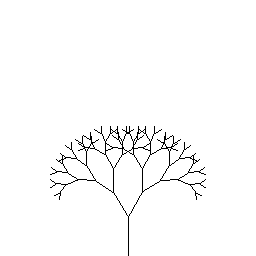
But if we shift to thinking fractally we see that each part of the tree is identical with the whole tree. Cover up the rest of the tree to show just a branch and it is a copy of the whole thing. Obviously this only works with an infinite set, where removing a finite amount from the start of the set leaves the set still infinite. That is a branch of the tree really is identical (apart from scale) with the whole thing. Interesting that infinite regress is linked here with notions of self again, just as it is with paradoxes and non-halting programs. See the image to the left. So the real building blocks of the tree are actually the tree itself. And with just a simple geometric relationship defined between building blocks we can avoid having to define a substance at all and just say that it is made from itself!
Now this blows apart the SRH... but not quite.
The SRH says that things cannot be made from themselves because there is a contradiction in the idea of "substance" being built with itself. The proof is oneday supposed to show that things are always made from what they are not.
In a fractal however there is no substance either because things are made from the whole structure not a "part" or a "thing". The only substance is a relationship between parts, but parts with no substance.
It is a new way of thinking for me - that of total relationships. I need to "fix" this - it is what I'm searching for.
===
The above was written in a hurry. Some more elaboration. 21/3/2011
Visualising fractals poses a problem because a definite point needs to be added to the system, or to put it another way a start needs to be made in what is an infinitely deep system. In the tree it is customary to start with a trunk somewhere (after our experience of real trees). This is really just a branch of an infinite fractal tree that could be projected into larger scales. We only focus on the smaller scales - the contracting affine transformations in an IFS.
So a fractal that really is infinite and doesn't have a start point is just a set of all the possible applications of the transformation rules, branching just like a tree but in logical space. This is a very familiar structure for example probability trees, or wave functions, mapping all the possible outcomes. But there is something unfractal about all these because they do "collapse" into discrete actualities, the substances of rendered fractals that we can sense and interact with. That said the point of this blog is the appreciation that the real structure of what we see does not lie in the inner "substance" but in the hierarchy of functions that relate the scales of a structure. That hierarchy is of the mind and not of substance and enables a thing to be made from itself which the SRH says is impossible.
However to recover the universality of the SRH it need only be pointed out that while the tree is made from copies of itself under transformation, the simple transformation rules that govern the shape of that hierarchy are not themselves built from the tree. There are three affine transformations needed to make the whole tree. These must be constructed "outside" the space in which the tree is constructed - e.g. in a symbol space for example. Thus the SRH is not really affected by this shift in understanding.
Monday, 7 February 2011
Aristotle on Robots/Work
~ 322 B.C.
The Greek philosopher Aristotle writes...
“If every tool, when ordered, or even of its own accord, could do the work that befits it... then there would be no need either of apprentices for the master workers or of slaves for the lords.”
Except (as explored in depth in the blog) Aristotle misunderstood a very deep aspect of human Life - that society implies hierarchy. Robots (99.95% of work is done by machines) will never release us from employment because that is a hierarchical feature.
Tuesday, 1 February 2011
Here & There

After seeing Uranus last night for the first time and commenting on Facebook that I had now seen them all I was going to update with what a fraud I am since I have not yet seen Earth...
This irony commented on before (1st occurring to me as I looked at a holiday photo from the side of Ben Macdui mountain) that to see the here we have to be over there, is broadly explained by the SRH that we cannot have "self" knowledge.
I now totally concede to Hofstadters way of thinking. The world is fractal in nature infinitely twisting in through itself. What we think is here is really only visible to us when we are there. What is there is only visible because we are here: to understand what is There, we HAVE to be Here! There and Here are the essential poles of the mirror. M.C.Escher above has to paint a glass sphere in his hand to show himself what he looks like. The only other way is to have someone else paint him. It is a head-over-heels world. (I am writing bitty lines here to rapidly try to catch the general point). It is not a matter of finding a fixed "reality" or series of material building blocks but rather as Hofstadter argues the folding of the large scale into the small scale. What we look into become what we look at; what we look at becomes what we look into. Put more physically it is as though the doors that we pass through during our investigations becomes the things we are investigating and what we were investigating inside those rooms becomes the building where our science is done.
This kaleidoscopic world is all brought about because of the deep contradiction that "objective self" would bring about.
Materialism... again
Watching the BBC Horizon program on Pain last night I had two thoughts. Firstly the issue of the Sciences great achievements and secondly the issue of materialism. A quote from the discussion board at http://richarddawkins.net/discussions/584583-my-daughter-has-made-me-realise:
My name is Mark and my beloved daughter's name is Sophie-May. Almost 6 years ago she was born with pontocerebellar hypoplasia type 6 caused by the RARS 2 gene fault. This is a progressive metabolic disorder which is very rare: as far as her geneticist knows, there have only been 4 other children born with the condition and all sadly passed away before they reached 18 months.
Sophie is severely brain damaged and depends on my wife Kelly and me for her daily care. Like I said, it is a progressive neurological disorder so things will get worse. Anyway the point I'm trying to make is that Sophie will be 6 in May and she wouldn't have got this far if it weren't for her geneticist who helped in discovering her diagnosis, her paediatrician for his medical knowledge and care, the ear nose and throat surgeon at Bristol Children's Hospital for my daughter's tracheostomy to enable her to breathe, the metabolic specialists, physiotherapists, homecare nurses, etc etc. I could go on but you get the picture.
I used to go to the church on the camp where I work (I'm in the Royal Marines) but since watching The God Delusion, Enemies of Reason and The Genius of Charles Darwin plus reading The God Delusion, I've realised that going to that church, all the praying, the begging really, never did anything to help my daughter. I'm an atheist now because I know that religion has never played a part in keeping my daughter alive.
I'm so humbled by the work her medical team do, it has made religion seem petty by comparison. Please tell me what you think, thanks very much!
This same thought came to me watching the program on Pain. There is simply no substitute for clear investigation of phenomena. I used to argue in the Mahayana Buddhist Temple that if you wish to help people then get a profession; what can a monk actually do to help in say medicine? "Helping" is a very complex issue.
But the problem as always is a mismatch of scale. You can't discuss this with people like Mark (above) this because they are utterly devoted to the immediate small scale. The story of Buddha's approach to death is revealing here. A woman who had lost her daughter cam to him pleading for some magic. Buddha said he would revive the child but only after she had been into the village and found a house that had not been touched by death. She went from door to door discovering as she went that everybody has been touched by death. When she returned she understood it was not death she was grieving but the loss of "her" daughter. This is why we can watch the news day of day and see people dying and it mean very little to us, that is until it happens to us! This is where Mark above is. However that said one cannot, and shouldn't, dismiss the wonderful work done by the researchers, it is just we must put it in perspective to see the real nature of the world. Technological science shouldn't become a prop to maintain our fantasy land. It ought be pointed out here also that Jesus' miracles are perhaps more complex as well. After the feeding of the 7000 the disciples were talking amongst themselves and Jesus was quite abrupt with them saying "hadn't they understood yet". One wonders whether anyone really gets the Kingdom of Heaven and what Jesus was really trying to say.
And so to the second point. The Nature of Reality: Materialism. If I hear it enough I might start to believe it! Apparently Pain is created by the Brain: it is not "out there". This is the new religion almost and is branded across all science to do with human beings. It is not a bad place to start however, but it is only a start. For me the revelation was realising that colour was not "out-there". But there began a long investigation into what is "out-there". So lets list some suspects for "in here": pain, colours, emotions, feelings in general. The reason we conclude that they are "in-here" and not "out-there" is because there is variation between people's experiences (in-here) while there is only one "out-there" that we all agree on... (well that is one reason there are many).
So now what about tastes: sweet, sour, bitter, salt? There are four regions of the tongue that respond to these so we might argue it is more a feature of our tongue than anything "Out there". Chemical come with a variety of properties why should these 4 be so special? So taste, and we can add to that smell are "in here". So that leaves sound. We can see sound waves on an oscilloscope so we agree that pressure waves in air exist what we can question is the "tone" of these waves. IN the West we split the scale into 7 intervals, there are mathematical reasons for this but other cultures and animals don't and there is no reason to value these mathematical relations especially. So we can rapidly split the perceived phenomena into brain features and more abstract "real" features.
But what about movement. Surely movement is a profound fundamental, mathematical, feature of space-time and reality. A simple brain injury can destroy the sense of movement. I remember an interview with one such woman who described that crossing the road was very difficult because cars would be stationary and then suddenly be right up next to her without moving. We are beginning to run out of "real" things, and everything seems "in here".
So to reverse the process... a quick reductio-ad-absurdum: if we put a blender in our brain case and mash up our own brain what results do we expect (only a "thought" experiment not a "brain" experiment - which leads to the next point ;-). This is where it gets tricky. What is the sound of a tree falling when no-one is there to hear. Well I've just argued for very little "out-there" but now it seems absurd that when I have no brain, then is no "in here" either. This is all very Shurangama Sutra (previous post).
Now we are into the realm of "thoughts" because that was a thought experiment (as indeed this whole thing has been) and I made the assumption that there was a real brain to blend in the first place. Put that another way: how could I have blended my brain if there was nothing "out there" in the first place. This is now were the SRH kicks in. This idea is growing in robustness. In short it says that any statement which results in any loop is meaningless (exactly why is still unclear). Now if I say that everything is "in here" the question is in what? Whatever "here" is, is that in "here" also. OK there is the loop and so it is meaningless -> end of discussion.
Likewise if I say that everything is "out there" the question is what is "there". IS that "there" out-there also. OK loop -> end of discussion.
So almost all the time you can't say "All" anything because it will include itself and so you get a loop. I say almost because it seems that putting a limit around oneself is the problem, so to say everything we need to have an open set. You can't make a close set with yourself inside (that is the SRH bit) because then the limits of the set are then within the set and so what are they within... this is the paradox but it seems a bit more complex to show up in maths...
SO we can't take the "here" and "there" as fixed aspects of reality. What we are left with importantly is the idea of "ideas". Now not everything is an "idea" by SRH but what is not an idea can't be expressed in an idea, which is another idea and we start spiralling very fast into the net of the spider of Structuralism and private-language arguments. Best to leave that as an open set also. But once we are thinking about ideas Scientific Materialism gets its "substance" because the ideas that Science has about what "is" are really just that "ideas" about what is. Everyone may agree and we have a "reality" but it is through consensus that it has its power not some God given material fact. And, there is the irony: the Materialists are still appropriating factual immutable Creation [uk ho Richard Dawkins = more contradictions].
SO looking for the absolute truth we have spun out of the low orbits of materialism rather fast but realise that there is no limit to the orbits we can enter. That is the ancient long ago seen point that whatever we do we are in orbit. Hence the Swastika and Dharma Wheel in Buddhism. What are we in orbit around? That is the intangible next step but its takes a different approach to what is here.
Friday, 28 January 2011
SRH more
There are 2 sources of work. Old jobs not completed and new jobs.
Now the formulation of this system creates a new job and problem: how to improve the processing of jobs. So it adds a new problem to the stack.
Now since the consideration of jobs and problems is itself a job and a problem it means that we can never revolutionise this level of reality. It is a normative given that we must accept within the paradigm of problem/solution.
So any model of something (a diagram so to speak of the component parts) can only be about itself if it agrees entirely with itself. A tautology in other words.
A statement can be about itself positively or negatively. If the statement is always positive then there is no problem, but there is no truth either as it is a tautology. If at any point it is negative about itself them there is the liar paradox. Now the liar paradox is famously odd. I suggest for now that its nature is the opposite of a Tautology which if it is Always True or False is Always neither True nor False. This is a non-logical statement with no truth content but so is a tautology in this argument since Always True or False has no truth content either! The only non-value in Logic is the contradiction which forces re-examination of assumptions, so maybe Tautologies and Paradoxes work like contradictions also.
I realise there is a confusion here between types of Truth. Deductive Truth works by tautology e.g. "¬(A & B) === ¬A v ¬B" (equivalent). While Inductive truth depends upon the possibility of falsehood. "Ducks === Ducks" has no information value.
OK need to think that thru...
So the SRH suggestion is that any existence of self-reference forces us to abandon Truth Content leaving the statement/system vacuous.
Meme Theory - the proof (finally)
[Response to Facebook].
Agreed as long as we stick to truth. I personally agree with Meme Theory (think he based it on mimesis) it explains why Mozart never wrote Schoenberg ;-) It is demonstrably "right" (I had the same idea at school so it's pretty obvious). But I also think that God is "right" (ironically for exactly the reasons involved in this argument!) Now the problem with RD here, it seems to me, is that he has slipped into dismissing some ideas as popular simply because of Meme Theory (e.g. God) and doesn't regard their truth value any more. They do the same thing with Terrorism: it is spread by Radicalisation; but I have never heard anyone discuss it rationally. All all Terrorists just sheep? 'Personally I think suicide bombers are as clueless as the people who are trained to shoot at each other by governments' - at least that is a clear discussable point of view unlike the Meme Theory approach. With Meme theory so clarified it can then be seen as a sophisticated marketing tool which can be (and is! see MIT research) used to engineer society which for a Libertarian principled society is quite sinister; it is what the Nazis started - but that contradiction is a different debate.
Anyway with this abuse of Meme Theory in sight then follows the argument above. Religion may go extinct in people's minds but that doesn't make it wrong so why is RD using Meme Theory in his arguments then? That's how we know he is a fascist bigot :-)
Thought of a purer reformulation of the problem. Meme Theory, if taken as a measure of validity (e.g. 'God' idea is only around because the idea spreads well), makes claims about its own truth value. Then we have the liar paradox. If we model the conditions for the extinction of Darwinism and Meme Theory (maybe a rise in Religious Fundamentalism) then on one hand we are taking the model to be true (the model results), but on the other hand the results say that the model is invalid because it is extinct. Contradiction so ergo we can't say that Meme Theory can ever make claims about something's validity. So the prevalence of Religion tells us nothing about whether it is right or not... (which proves Meme Theory's fascist roots also) QED.
Thursday, 27 January 2011
SRH - is this it?
SRH:
A statement that refers to itself is either a tautology TT or a contradiction TF. The most famous example is the liar paradox.
TT: "This statement is True."
TF: "This statement is False."
My favourite object of contemplation from a few years ago doesn't actually refer to itself!
T = {T}
Makes an equality between T and the set containing T which are different objects.
So SRH is not about Impredicativity. To define something in terms of itself is to enter a "temporal" version of the SRH which is a loop. One is then left with a different question of starts and ends which is not an immediate problem. Loops are the root of the Halting Problem, and I have speculated isomorphic with contradictions. Induction is maths famously has survived this problem.
I'm busy on other stuff so this will have to wait for further thought...
Memes
On Dawkin's again, after Facebook discussion...
Darwin first introduced the world to a natural selection based evolution theory (NEST - apt since it's the home of species creation ;-) in his explanation of the diversity of species. From this huge revolution in thinking the idea has found application in everything. I have just built a model of the solar system which evolves by NEST from dust (to look at the emergence of Phi in dynamic systems). It is everywhere. It was the biggest shift in thinking since Renaissance clockwork universe Mechanics and before that the idea of Divine Order. It is that massive an idea.
Now Dawkins has taken Darwins idea and revamped it for the Capitalist Free-market 80's generation telling the tale of individual successful in free competing genes. Then he observed the process in ideas also and dubbed them memes.
At which point the SRH kicks in because Meme Theory (MT) is an idea and a meme itself. I have struggled to turn this into a fully fledges problem however (as with the SRH also). It is more revealing however to take NEST as a Meme also. Now if NEST fails then MT (as a subset of evolutionary theory) must fail also. Now there are many theories about the origin of diversity in the world not least the idea that things are immutable, don't evolve, and have a design or blueprint, an essence, imparted to them by The Creator. Now it is quite reasonable that NEST, which was unknown to the world for many millennia might once again fall into obscurity. It is this threat which has made Dawkins so animated. This in written into the rules of MT. Now if MT can envisage the extinction of NEST from the human mind then it envisages its own extinction from the human mind.
Now a theory is true when it can provide an answer under certain known conditions. There is no Universal theory yet (I have pages in this blog trying to argue that it is a fundamental contradiction - an argument which must be as close to a universal theory that there is). An incomplete theory has a problem because it must be able to define when it is not applicable. Quantum Theory is not applicable for gravity (as I very crudely understand it) and Relativity fails on the small scale and the other 3 forces. Each theory is incomplete, but that incompleteness is unknown to the theory. Relativity doesn't predict that it can't apply to the small scale we just know that it doesn't. Being complete and incomplete are meta statements about a theory. A Universal Theory, being Universal, must account for all its own meta statements... that is the root problem captured by the SRH but I can't quite see it yet. Now MT predicts a possible future when NEST will no longer be a meme of sufficient frequency to really be used in constructing the world... Dawkins' huge effort is proof of this possibility. The world will be thought about in different ways. This means that MT will no longer be relevant and applicable. Yet this contradicts the assumption by MT that it is relevant and still explaining this event! So if MT goes extinct which is it: is it still relevant but in hiding, or is it no longer relevant.
What this argument reveals is the dogmatism behind Dawkins position that fundamentally he believes that he is right and the NEST is true. I don't disgaree with him (I have a model right here of the solar system evolving by natural selection) but I do have a problem in the theory making claims about its own validity!
Wednesday, 26 January 2011
Boundaries
I asked someone over Xmas, a manager for Bechtel, whether they thought that management was necessary, or whether things could manage themselves. Her answer, obviously, was that management is essential; quite rightly also because certainly things wouldn't function without some level of management. But looking deeper no-one manages the course of history or human development, or love or wars, and more fundamentally no-one manages nature; and, yet these things have their own passage and logic; something sufficiently benevolent and orderly because we somehow "manage" to survive. This I have commented on before as being the "wheel of the world", it is one of the fundamental ideas that Mankind would seek to forget in His drive to supremacy. Mankind is at best obedient to Nature and at his most foolish ignorant of Nature. More importantly this illustrates the breadth of influence of whatever lies at the heart of the SRH. It is obvious that "management" can never be a complete world view because what manages management? So last night and this morning in bed I transform the problem (once again) into topology and the notion of regions enclosing one another.
 In this diagram there are 3 regions. Region A, region B and the black ring. Region A is separated from region B by the black ring through which any path from a point in A to B must pass. The ring encloses region A and "excludes" or "excloses" region B.
Region B depends upon the context. In this case we are in the real plane R2 so we know that B is simply the rest of this plane. If we were to define "swan" then it is harder to say what not-swan is, because the field is not clearly defined. For example if someone was to produce the skull of a swan, is that swan or not? It is true that it is not "a" swan because we assume here that we are talking about actual animals. But in a physiology class where skulls were the topic we might agree that this was swan rather than goose.
Exclude/Exclose: Region B is defined in terms of the ring just as is region A, but the ring is enclosed by region B. Exclude illustrates that region B is subject to the ring, and it gives the ring the active part of the sentence.
Now two issues arise from this. Firstly the "Dual Nature" of definition and secondly the question of whether something can define itself.
Dual Nature
The ring performs a dual function. By enclosing the region A it automatically excludes the region B. This has been commented on before in this blog in connection with the dual nature of "false societies" that exist by including some and excluding others; any structure with a name, description or definition has this dual, false character. I say false because true Society is about people, but if it exists by excluding some people then it is self-contradictory. Regions of space are not so elevated and self-contradictory. That space within A is separated from that space in B. Without the process of separation of A from B then we cannot define A, so to define A we have to define B. B is often termed its negation, ¬A or not-A.
Now it is because anything we wish to define and name equally defines its negation that we have problems if we try to define something in terms of itself (the problem flagged by the SRH).
If something could define itself then it could define what was not-itself also. So we might have a function that defined a family of functions, for trivial example y= a*x where a is an integer. So the function y = 2*x is defined by this rule and y = 3 + x is not defined.
…
Other point is that about boundaries. If we say ¬A then we include B and we include the ring. So the ring seems to be included in the negation of what it defines. Let us assume to begin with that this is a real world example and the ring is a wedding ring. Region A is the space through which a finger can pass and the ring begins with the gold atoms whose structure holds the ring on the finger. Region A is thus clearly defined with gold atoms on one side and something else on the other. An imaginary line exists between the various atoms. Now in which region is this line? It is actually between the atoms. We shift now to maths.
If I was to say that point (2,0) was in region A and (3,0) was in region B what would we know? If I was to add that this was integer space then we know that the two regions are side by side at these points. The points could be defined/selected by the rule for the circle of radius 2 centred at (0,0) in integer space:
{ (x,y) | x,y are integers & Sqrt(x^2 + y^2) <= 2 }
(0,-2)
(-1,-1), (0,-1), (1,-1)
(-2,0), (-1,0), (0,0), (1,0), (2,0) …. (3,0)
(-1,1), (0,1), (1,1)
(0,2)
What is not clear here is the notion of a boundary. We simply have a set of points A and a set of points B with nothing in between and nothing relating them. However we have defined region A to be those points at a distance from the centre with a limit of 2. This is clear in the definition but not in the areas. The areas do not contain the definition.
In the ring above the black region is supposed to be the definition of region A. Negating region A then creates the region including Region B and the ring! The ring seems to define itself!
...unfinished...
Friday, 14 January 2011
Intrinsic/Extrinsic Self-Reference
Almost certainly blogged this before but its clear at the moment:
One type of self reference (extrinsic self-reference) involves a system being able to select itself from amongst others. This sentence has five words. The previous sentence has selected itself from the rest of the text and in particular distinguishes itself from the next sentence. This sentence has five words. It is as though the system looks out into the world, identifies itself and then looks back in again. In reality it is using us, the reader, to do the looking and the thinking and we lie outside the system - or at least we are not the sentence. However I am unimpressed with external self reference because what is the real difference between the second and third sentences of this paragraph, or even this sentence here. The second sentence refers to itself and the third also refers to it. Both sentences are selecting one of the sentences on this page, in that they are the same. So the fact that the second sentence "happens" to select the sentence that is also itself is quite unmiraculous and is just a trivial feature. There is no "self" here other than that which a reader may infer when (or if) they realise that the sentence is referring to the same sentence they are reading.
The other type of self-reference, and the one which I'm saying is logically impossible in the SRH, is intrinsic self-reference where the entity refers to itself within itself. Now this is non trivial and quite miraculous if it exists. It is the situation monists believe is true within humans where somehow we have a secret mirror in which we can see ourselves, and know our own thoughts and wishes. This they believe would be true even on a desert island or in a world where nothing else existed but them. I used to hold this view and it is through failure to actually find consciousness or a self and after being given a push by Buddha that I changed view.
The idea that somehow self-refernece and recursive feedback in the brain causes consciousness just doesn't go anywhere. Recursion does indeed creates a many leveled intersecting fractal structure (which is Hoffstadter's brilliant view) but that anything would be mysteriously "created" is untenable. What "I" am would be just be phantoms in the swirling mix of data (the hall of mirrors as it is called in this blog). What I am careful to avoid however is the suggestion that the "world" is any less a phantom. The belief in material entities like brains that somehow mysteriously underly the "self" or consciousness implies some special knowledge of "reality" which I am yet to see myself! After all if it was so easy to escape the hall of mirrors why hasn't everyone other than Hoffstadter and Dennett!
Intrinsic self-reference involves not having to identify oneself from other things by "external" features but involves having an almost tautologically connection to oneself - and inner bond to oneself. The "I think: I am" bound into ones existence. I'm not taking sides and saying that outside is better than inside (though the Western Materialists side totally with the outside while Buddha said that inside/outside is just part of the illusion) , just looking for an immanent problem with holding the inside view.
One type of self reference (extrinsic self-reference) involves a system being able to select itself from amongst others. This sentence has five words. The previous sentence has selected itself from the rest of the text and in particular distinguishes itself from the next sentence. This sentence has five words. It is as though the system looks out into the world, identifies itself and then looks back in again. In reality it is using us, the reader, to do the looking and the thinking and we lie outside the system - or at least we are not the sentence. However I am unimpressed with external self reference because what is the real difference between the second and third sentences of this paragraph, or even this sentence here. The second sentence refers to itself and the third also refers to it. Both sentences are selecting one of the sentences on this page, in that they are the same. So the fact that the second sentence "happens" to select the sentence that is also itself is quite unmiraculous and is just a trivial feature. There is no "self" here other than that which a reader may infer when (or if) they realise that the sentence is referring to the same sentence they are reading.
The other type of self-reference, and the one which I'm saying is logically impossible in the SRH, is intrinsic self-reference where the entity refers to itself within itself. Now this is non trivial and quite miraculous if it exists. It is the situation monists believe is true within humans where somehow we have a secret mirror in which we can see ourselves, and know our own thoughts and wishes. This they believe would be true even on a desert island or in a world where nothing else existed but them. I used to hold this view and it is through failure to actually find consciousness or a self and after being given a push by Buddha that I changed view.
The idea that somehow self-refernece and recursive feedback in the brain causes consciousness just doesn't go anywhere. Recursion does indeed creates a many leveled intersecting fractal structure (which is Hoffstadter's brilliant view) but that anything would be mysteriously "created" is untenable. What "I" am would be just be phantoms in the swirling mix of data (the hall of mirrors as it is called in this blog). What I am careful to avoid however is the suggestion that the "world" is any less a phantom. The belief in material entities like brains that somehow mysteriously underly the "self" or consciousness implies some special knowledge of "reality" which I am yet to see myself! After all if it was so easy to escape the hall of mirrors why hasn't everyone other than Hoffstadter and Dennett!
Intrinsic self-reference involves not having to identify oneself from other things by "external" features but involves having an almost tautologically connection to oneself - and inner bond to oneself. The "I think: I am" bound into ones existence. I'm not taking sides and saying that outside is better than inside (though the Western Materialists side totally with the outside while Buddha said that inside/outside is just part of the illusion) , just looking for an immanent problem with holding the inside view.
Thursday, 30 December 2010
Simple SRH
Just formatting a column in Excel using VBA I thought I'd just do it quick and replace each cell with itself formatted. Just checking the logic to make sure it would do what I thought it would do I found myself thinking that the value of the cell would be copied to memory, formatted and then copied back into the cell. This is the behind the scenes computation of this code:
Cell(2,2) = CDate(Cell(2,2))
Yet the code looks like it implies a self-reference where the contents of the cell is made the same as a function applied to the contents of the cell. A more absurd example would be:
Cell(2,2) = Cell(2,2) + 1
Why don't computers ever end up with a paradox here? It's not really a question because everyone knows that the "=" sign is not a statement of equality but of assignment. The contents of Cell(2,2) are to-be-given the value of themselves + 1.
But semiotically it is interesting that we use the "=" sign here. Better languages than VB have three signs: = for assigment (add 1 to y and put it in y), == for equality (are they the same), and := for definition (resolve the value of y=y+1) . Yet they all recognise these three quite different things as belonging to the family of =.
1) Cell(2,2) = Cell(2,2) + 1 is an instruction
2) Cell(2,2) == Cell(2,2) + 1 is always false
3) Cell(2,2) := Cell(2,2) + 1 is the contradiction! It actually ends up in a recursive loop.
Now it is (3) which is the problem for logic. Loops I have suggested before are the computational symptoms of the same problem as contradictions and paradox in logic. Where a paradox occurs in logic, a computer hangs in a loop. What Godel discovered by contradiction in his famous statement, Turing discovered in his non-halting looping programs. There is a deep connection. I am just starting to read Chaitin on this; looks like it will be very promising.
So what the SRH is crudely saying is that a definition (:=) can't be constructed from itself i.e. impredicativity.
Iterative processes and self-organising systems are a different type of equality (=). They are not created from "themselves" but from their output. Obviously if they were created from themselves then they could never change because they would always be themselves. The equation y = (y ^ 2 - 1) / -3 iterates to its roots -(3 +/- root(13))/2 for certain starting values of y. The complexity of successive applications of a function is extraordinary in many cases. Unlike a snooker ball bouncing around a snooker table where very quickly the ball ends up following a repetitive trajectory, with relatively simple function systems, paths can be created which never repeat (except for precision rounding errors)! Link here to the Lorenz curve. Fractals etc illustrate the enormous hidden structure to iterative/recursive procedures (things built from identical copies of themselves). But the point is that this is all a distraction from the SRH issue of things being built from actually themselves, rather than copies and things that are similar.
An issue here is that of identity. A floor can be completely tiled in repeating shapes. This is of interest to the builder because a simple production process specialised to a few shapes can create tiles that are guaranteed to fit together anywhere and cover any expanse of floor. A wonderful example of mass production. Yet this simplicity ought not be misunderstood as Penrose discovered with just 4 types of tile it is possible to tile a floor without ever repeating. Apparent infinite complexity from a very finite set of building blocks. Shades of the Lorenz curve here where something built from simple components iteratively never repeats. Yet each tile is intellectually the same as its type (same angles and lengths of side) each individual tile (token) is necessarily different. A floor cannot be covered by one tile. It is exactly the interaction of many tiles that covers the floor. The patterns that arise can only occur between tiles, they are not intrinsic to any particular tile. Indeed to even "be" a tile requires that we have seen other tiles before, are familiar with the culture of tiling, and speak this language where they are understood as tiles. A single tile all on its own in the universe is more than useless for covering a floor, it doesn't even get given a name by the people of that universe.
SRH only applies to things built from their own token. Now in maths, unlike with the building trade, this is far from clear.
y := y + 1
There are actually two marks on the page here corresponding to the single letter 'y'. If there were not two marks we would not be able to write this equation. Once read however we understand that the two names, 'y' on the left and 'y' on the right, are supposed to be names of the same thing.
In the case above
y := (y ^ 2 - 1) / -3
are we to understand that the thing 'y' has two possible stable values (a superposition) so to speak. Very quantum physics ;-) This finding of multiple possible values to fit incomplete conditions seems to be me to be more a feature of the language of maths than anything "real". We don't think that some mysterious entity is lying here under the page with two values.
In
y = y + 1
They are names of the same 'storage place' or 'variable' which can have any value. Unlike above the value is not what is named by 'y'. Strictly the two variables should have different names e.g. y(n+1) = y(n) + 1 and a starting value given also y(0) = 0.5. As a function the relationship is a mapping of left and right hand sets. In this case it forms a zig-zag relationship through all members of the sets.
Also things that are defined in terms of themselves can't change because they can only ever be themselves. To change we need to become something else. This means that things that are defined in terms of themselves are both immortal and can't be created. SO impredicativity is violated in immortal, a priori, analyic, uncreated entities. This means obviously that you cannot "build" or "create" something using itself, you can only support it. This is the castle in the sky with its foundations built upon its walls.
So the only problem that SRH is referring to is the idea that something is built with exactly itself. It is perhaps an ontological problem as much as anything.
Subscribe to:
Posts (Atom)
-
The classic antimony is between : (1) action that is chosen freely and (2) action that comes about through physical causation. To date no ...
-
Following from the last blog on animal/human a beautiful male Oedemera nobilis resting in a flower after presumably a good meal of po...
-
Same current territory (and raft) but a bit more polished. Or perhaps not! That will be be explained. With Deepseek: https://chat.deepseek.c...


